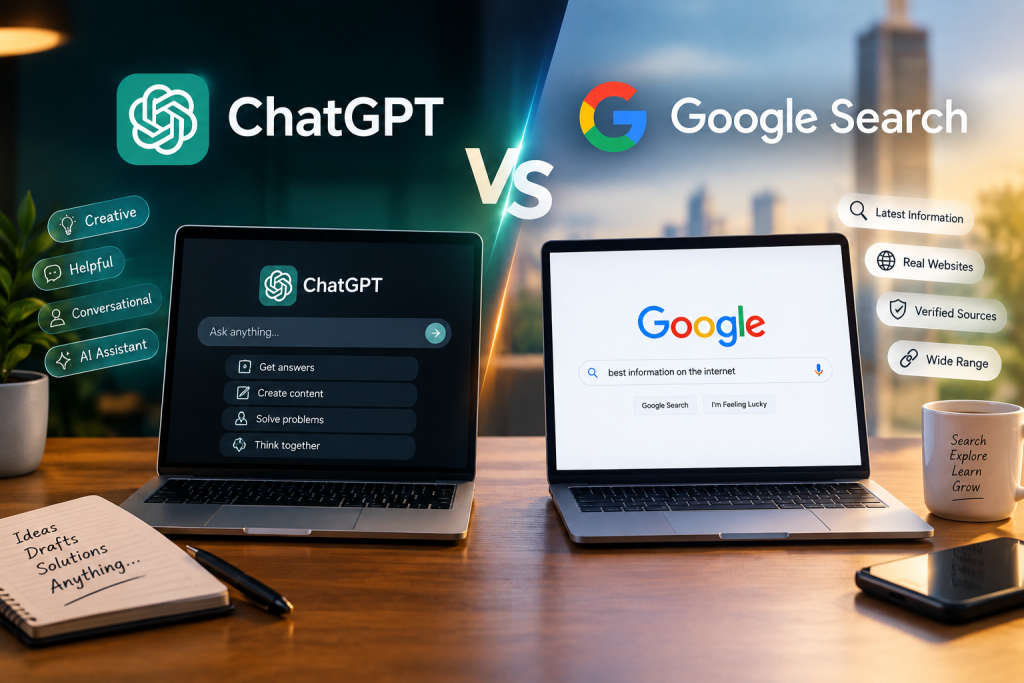
ChatGPT vs Google Search: Which One Is Better for Finding Information in 2026?
The debate around ChatGPT vs Google Search has become increasingly important as the way people find and consume information continues to change. For years, Google Search has been the primary tool used to discover websites, research topics, compare products, find local businesses, and answer everyday questions. However, ChatGPT has introduced a different approach by allowing users to interact with information through conversational questions and detailed responses. Therefore, understanding the difference between ChatGPT and Google Search is now essential for students, marketers, business owners, professionals, and anyone who regularly searches for information online.
Although both platforms can be used to find answers, they work in fundamentally different ways. Google Search primarily helps users discover relevant webpages, videos, images, maps, news, products, and other online resources. ChatGPT, on the other hand, is designed to understand a user’s prompt and generate a conversational response based on its capabilities and available context.
However, this does not necessarily mean that one platform has completely replaced the other. Instead, each tool has its own strengths, limitations, and ideal use cases. Consequently, the better choice depends on what the user wants to accomplish.
This article provides a detailed comparison of ChatGPT vs Google Search, including how both platforms work, their advantages and disadvantages, differences in search behaviour, accuracy, SEO implications, digital marketing opportunities, and the skills marketers should develop for the future.
What Is Google Search?
Google Search is a web search engine that helps users discover information available across the internet. When a user enters a query, Google’s systems attempt to identify and rank webpages and other content that are relevant to that search.
For example, a user searching for:
- Best digital marketing courses in Haryana
- Google Ads certification
- Restaurants near me
- How to learn SEO
- Latest technology news
- Digital marketing salary in India
may receive a combination of websites, advertisements, videos, images, maps, featured snippets, news results, shopping listings, and other search features.
Therefore, Google Search is not simply a list of websites anymore. It has developed into a large information discovery ecosystem.
How Google Search Works
Although Google’s search systems are highly sophisticated, the overall process can be understood through three important stages: crawling, indexing, and ranking. Each stage plays a different role in helping Google discover webpages, understand their content, and present the most relevant information to users.
1. Crawling
First, Google needs to discover webpages before it can consider them for search results. To do this, Google uses automated programs known as crawlers, Googlebot, or spiders.
These crawlers continuously explore the web by following links from existing webpages to new or updated pages. They can also discover URLs through other sources, such as sitemaps. During this process, Googlebot examines the content, links, images, and other accessible information on a webpage.
However, discovering a page does not necessarily mean that Google will immediately include it in its search index. Several factors, including technical accessibility and crawl restrictions, can affect how Google accesses a website.
In simple terms, crawling is the discovery stage where Google finds webpages and collects information about them.
2. Indexing
Once Google discovers a webpage, it needs to understand and organize its content. This process is known as indexing.
Google analyzes different elements of a page, including its text, images, videos, metadata, and overall content. It also considers the relationships between webpages and tries to understand what each page is about.
The processed information can then enter Google’s massive search index, which works like a huge library of webpages. However, not every webpage that Google crawls will necessarily appear in the index.
Therefore, website owners should ensure that their important pages are technically accessible, provide valuable content, and offer a clear structure. In addition, factors such as duplicate content, technical issues, and indexing restrictions can influence whether a page becomes eligible for search results.
In simple terms, indexing is the stage where Google processes and organizes the information it discovers.
3. Ranking
Finally, when a user enters a search query, Google needs to determine which results are the most relevant and useful. This is where ranking systems come into play.
Google evaluates numerous signals to understand the relationship between a search query and available webpages. Depending on the query, these signals can include the relevance and quality of the content, the meaning behind the search, the user’s context, webpage usability, and many other factors.
Moreover, Google does not simply rank pages because they contain a particular keyword. Instead, its systems aim to provide results that best satisfy the user’s search intent and help them find useful information.
For example, if someone searches for “best digital marketing course in Hisar,” Google may look for webpages that provide relevant information about digital marketing courses, their curriculum, practical training, location, credibility, and other useful details.
As a result, SEO professionals focus on creating helpful, relevant, technically accessible, and user-focused websites that can earn greater visibility in appropriate search results.
What Is ChatGPT?
ChatGPT is an AI-powered conversational system that allows users to interact with artificial intelligence using natural language.
Instead of requiring users to search for multiple webpages, ChatGPT can understand a prompt and provide a structured response.
For example, instead of searching:
- “Google Ads meaning”
followed by several additional searches, a user can ask:
- “Explain Google Ads to me as a beginner and give me a practical example.”
The response can then be presented in a conversational format.
Moreover, users can continue the conversation by asking follow-up questions. Therefore, the interaction can become more personalised and iterative than a traditional search experience.
ChatGPT can be used for tasks such as:
- Explaining concepts
- Brainstorming ideas
- Writing and editing
- Summarising information
- Learning new skills
- Creating content
- Generating marketing strategies
- Analysing provided information
- Developing campaign ideas
- Creating outlines and plans
- Assisting with coding and technical tasks
However, ChatGPT should not automatically be treated as an infallible source. Information should still be verified when accuracy, recency, or authority is important.
ChatGPT vs Google Search: The Fundamental Difference
Although ChatGPT and Google Search can both help users find information, they follow fundamentally different approaches. The key difference lies in how users interact with information and how each platform delivers an answer.
1. Search Results vs Conversational Responses
- Google Search primarily helps users discover webpages, websites, videos, images, maps, and other online resources related to their query.
- ChatGPT provides a conversational response based on the user’s prompt and the context of the conversation.
- Therefore, Google generally acts as a gateway to information sources, whereas ChatGPT acts as an interactive conversational assistant.
2. Keywords vs Natural Language
- With Google Search, users often enter short and specific keywords, such as “Google Ads course” or “SEO meaning.”
- ChatGPT allows users to describe their requirements in complete sentences and natural language.
- For example, a user can ask, “Explain Google Ads to me as a beginner and give me a practical example.”
- Consequently, ChatGPT can make it easier for users to express detailed requirements without converting every question into a short search query.
3. Multiple Sources vs One Interactive Conversation
- Google Search can display multiple sources, allowing users to compare information from different websites.
- ChatGPT generally provides a direct conversational response instead of simply presenting a list of webpages.
- Moreover, users can continue asking questions within the same conversation.
- For instance, after asking about Google Ads, a user can immediately ask about Quality Score, bidding strategies, keyword match types, or conversion tracking.
- As a result, the interaction can become more continuous and personalised.
4. Finding Information vs Understanding Information
- Google Search is highly useful when users want to find specific information or discover reliable sources.
- ChatGPT can be particularly useful when users want to understand, simplify, organise, or discuss information.
- For example, Google may help a student find several articles about SEO, while ChatGPT can explain SEO step by step in beginner-friendly language.
- Therefore, the two platforms can serve different purposes even when users ask similar questions.
5. User-Controlled Sources vs AI-Generated Responses
- Google gives users direct access to the webpages that appear in its search results. Consequently, users can open the original source, examine its information, and compare it with other sources.
- ChatGPT generates responses based on the information and context available to it. Therefore, users should critically evaluate important information rather than automatically assuming that every response is correct.
- For important decisions, checking official websites, primary sources, and authoritative references remains essential.
6. Search Intent and Conversation Context
- Google primarily interprets the user’s search query to determine which results may best satisfy the search intent.
- ChatGPT can also interpret the context of an ongoing conversation and use previous messages to understand follow-up questions.
- For example, after asking “What is SEO?”, a user can simply ask “What are its main types?” without repeating the original topic.
- Consequently, ChatGPT can provide a more continuous conversational experience.
7. Discovering Websites vs Completing Tasks
- Google Search is excellent for discovering websites, businesses, products, news, documents, and other online resources.
- ChatGPT can assist users with tasks such as brainstorming, writing, summarising, planning, explaining concepts, and analysing information they provide.
- Thus, Google focuses heavily on information discovery, while ChatGPT can extend the interaction into information assistance and task support.
8. Fresh Information and Source Verification
- Google Search can be particularly valuable when users need current information, recent news, official announcements, product availability, or specific webpages.
- ChatGPT can explain concepts and help users work with information; however, users should verify time-sensitive or high-stakes information through current authoritative sources.
- Therefore, neither tool should automatically replace the other.
ChatGPT vs Google Search for Learning
One of the most interesting areas of comparison is education.
Traditionally, students have searched Google to find articles, YouTube videos, PDFs, blogs, courses, and educational websites.
For example, a student learning SEO might search:
- “What is technical SEO?”
Google could provide several articles and videos.
However, ChatGPT can be asked:
- “Explain technical SEO in simple language, give me five practical examples, and then quiz me.”
Consequently, learning can become more interactive.
Why ChatGPT Can Be Useful for Students
ChatGPT can:
- Simplify complex concepts
- Provide examples
- Generate practice questions
- Explain concepts step-by-step
- Help organise study plans
- Provide alternative explanations
- Assist with brainstorming
- Help identify areas that need further learning
Nevertheless, Google remains valuable because students can access original sources, official documentation, academic resources, websites, videos, and current information.
Therefore, an effective student should learn to use both ChatGPT and Google Search rather than relying exclusively on either.
ChatGPT vs Google Search for Current Information
When information changes frequently, verification becomes particularly important.
Examples include:
- Current Google Ads policies
- Latest SEO updates
- Government announcements
- Breaking news
- Product prices
- Stock information
- Current events
- Business opening hours
- Algorithm updates
Google Search can be extremely useful for discovering the latest webpages and official announcements.
ChatGPT can help interpret, summarise, compare, or explain information when appropriate tools or source material are available.
Therefore, when freshness is critical, users should verify information against reliable and current sources.
The Importance of Official Sources
For important information, official websites should be prioritised.
For example:
- Google Ads information → Google Ads/Google support resources
- Government schemes → Official government websites
- Educational regulations → Relevant official authorities
- Company announcements → Official company sources
This approach reduces the risk of relying on outdated or inaccurate information.
ChatGPT vs Google Search for Digital Marketing
The comparison becomes even more interesting for digital marketers.
Digital marketing involves several activities, including:
- SEO
- Google Ads
- Meta Ads
- Content marketing
- Social media marketing
- Email marketing
- Website optimisation
- Analytics
- Lead generation
- Conversion optimisation
Google Search remains extremely important because search engines are a major source of traffic, leads, customers, and purchase intent.
However, AI tools such as ChatGPT can assist marketers with research, planning, content development, analysis, and ideation.
Therefore, modern marketers should not think of ChatGPT and Google Search as competitors alone. Instead, they can be treated as complementary tools.
How ChatGPT Is Changing Search Behaviour
Search behaviour has gradually become more conversational.
Previously, users often entered short queries such as:
- “best SEO course”
Today, a user might ask:
- “I am a B.Com graduate with no professional marketing experience. Which digital marketing skills should I learn first if I want a Google Ads job?”
The second query contains more context.
Consequently, AI systems can provide responses based on the broader intent expressed in the prompt.
This shift is encouraging marketers to think beyond individual keywords.
Instead, marketers increasingly need to understand:
- Search intent
- User problems
- Context
- Topic relationships
- Conversational queries
- User experience
- Content usefulness
Google Search Still Matters for Businesses
Despite the rapid growth of AI, Google Search remains highly valuable for businesses.
A customer may search:
- “digital marketing agency near me”
- “best AC repair service in Hisar”
- “custom candles for wedding bulk orders”
Such searches demonstrate commercial or transactional intent.
Therefore, businesses still need strong visibility across search engines.
This can involve:
- Technical SEO
- Local SEO
- Google Business Profile optimisation
- Content marketing
- Keyword research
- Website optimisation
- Google Ads
- Conversion optimisation
- Reputation management
Consequently, SEO and search advertising continue to be important components of digital marketing.
ChatGPT vs Google Search for Content Creation
This is an area where ChatGPT can be particularly useful.
A marketer can use ChatGPT to brainstorm:
- Blog topics
- Social media ideas
- Ad copy variations
- Video scripts
- Email concepts
- Headlines
- Content calendars
- Campaign ideas
- FAQs
For example, a digital marketer promoting a digital marketing institute could ask for content ideas for students interested in SEO, Google Ads, social media marketing, and AI.
However, AI-generated content should not simply be copied and published without review.
A professional marketer should add:
- Original insights
- Real examples
- Accurate information
- Brand-specific experience
- Useful data
- Appropriate sources
- Human editing
Therefore, AI should be treated as an assistant rather than a complete replacement for strategic thinking.
ChatGPT vs Google Search for SEO
SEO professionals should pay close attention to this changing environment.
Traditional SEO has focused heavily on helping webpages rank for search queries.
However, search experiences are becoming increasingly diverse.
Users may discover information through:
- Traditional search results
- AI-generated answers
- YouTube
- Social media
- Forums
- Maps
- Shopping platforms
- Brand websites
- AI assistants
Consequently, marketers need to develop a broader understanding of search visibility.
Does ChatGPT Replace SEO?
No.
SEO remains important because websites still need to be discovered, understood, trusted, and presented effectively across search ecosystems.
Furthermore, AI systems need reliable information to generate useful responses.
Therefore, businesses should continue investing in high-quality websites and authoritative content.
How SEO Professionals Should Adapt
As search behaviour continues to evolve, SEO professionals need to focus on more than keywords and rankings. Search engines are becoming better at understanding the meaning behind queries, while users increasingly expect accurate, useful, and trustworthy information.
Therefore, SEO strategies should focus on creating content that genuinely satisfies the user’s needs. Instead of producing pages simply to target search terms, professionals should build websites that provide real value at every stage of the user’s search journey.
Several areas deserve particular attention.
1. Search Intent
Search intent refers to the reason behind a user’s search query. Before creating content, SEO professionals should understand what the user actually wants to find, learn, compare, or accomplish.
For example, someone searching for “what is Google Ads” probably wants a clear explanation. In contrast, a person searching for “Google Ads course in Hisar” may be looking for a course or training institute.
Therefore, the content should match the purpose behind the query rather than simply repeating the target keyword.
SEO professionals should consider questions such as:
- What information is the user looking for?
- Does the user want to learn, compare, buy, or take action?
- What type of content would satisfy the query?
- What questions might the user have next?
Consequently, understanding search intent can help businesses create content that is both relevant and genuinely useful.
2. Topical Depth
Modern SEO requires more than creating dozens of short articles around slightly different keywords. Instead, businesses should develop topical depth by covering important subjects comprehensively.
For example, a website targeting the topic Google Ads could create useful resources covering:
- Google Ads basics
- Campaign types
- Keyword research
- Keyword match types
- Bidding strategies
- Ad copy
- Quality Score
- Conversion tracking
- Campaign optimisation
- Google Ads reporting
When these topics are connected logically, users can understand the subject more easily. Moreover, search engines can gain a clearer understanding of the website’s overall topical focus.
However, topical depth does not mean adding unnecessary information. Every section should serve a purpose and answer a genuine user question.
3. Experience and Expertise
Users increasingly want information that demonstrates real knowledge and practical understanding.
Therefore, SEO professionals should avoid relying entirely on generic information that can be found on hundreds of other websites. Instead, content can become more valuable when it includes practical examples, original observations, case studies, processes, lessons, or firsthand experience.
For instance, an article about Google Ads becomes more useful when it explains not only what a campaign is but also how a marketer might structure, monitor, and optimise one in a real situation.
Furthermore, businesses should make it clear who created the content and why that person or organisation has relevant knowledge.
As a result, expertise can become part of the overall value and credibility of a website.
4. Website Quality
High-quality content alone cannot guarantee a strong user experience. The website itself should also be easy to use, navigate, and access.
SEO professionals should therefore pay attention to areas such as:
- Page loading performance
- Mobile usability
- Website navigation
- Clear site structure
- Readability
- Accessibility
- Internal linking
- Broken links
- Technical errors
- Secure browsing
For example, if a webpage contains excellent information but takes too long to load on a mobile device, users may leave before reading it.
Similarly, confusing navigation can make it difficult for visitors to discover related information.
Therefore, technical SEO and user experience should work alongside content quality rather than being treated as completely separate activities.
5. Trust and Credibility
Trust is another important element of a strong SEO strategy. Users need confidence that the information they are reading is accurate, transparent, and credible.
Businesses can strengthen trust by providing:
- Clear business information
- Author details
- Contact information
- About Us pages
- Reliable references where appropriate
- Accurate claims
- Updated information
- Transparent product or service details
- Relevant credentials or experience
For example, a health, finance, education, or legal website should take particular care when presenting important information because users may rely on that content to make significant decisions.
Moreover, businesses should avoid exaggerated claims or misleading information simply to attract clicks.
Consequently, credibility should be considered an important part of long-term SEO rather than a short-term ranking tactic.
6. Originality
The internet already contains a huge amount of similar content. Therefore, simply rewriting information that already exists may not provide users with much additional value.
SEO professionals should look for opportunities to introduce original insights, experiences, examples, research, opinions, data, and practical observations.
For example, instead of publishing another generic article about social media marketing, a business could share:
- Results from its own campaigns
- Original case studies
- Practical lessons
- Industry-specific examples
- Unique research
- Expert interviews
- Real campaign observations
In this way, content can offer something that users cannot easily find elsewhere.
Furthermore, original information can help a website establish a stronger identity within its industry.
7. Focus on Users, Not Just Algorithms
Ultimately, SEO professionals should remember that search engines exist to help users find useful information.
Therefore, content should not be created solely because a particular keyword has search volume. Instead, professionals should ask whether the page genuinely helps the person who arrives on it.
A useful SEO approach can be summarised as:
Understand the user → Identify the intent → Create valuable content → Build topical depth → Improve website quality → Demonstrate expertise → Earn trust → Analyse and improve
This approach creates a stronger foundation than simply publishing large volumes of keyword-focused content.
The Future of SEO
Consequently, the future of SEO will involve much more than inserting keywords into articles. Keywords will still help search engines and content creators understand topics; however, successful SEO will increasingly depend on relevance, usefulness, experience, technical quality, originality, and trust.
In other words, SEO professionals should move from a “keyword-first” mindset to a “user-first” strategy.
Businesses that consistently understand their audience, answer genuine questions, provide valuable information, and maintain a high-quality website will be better positioned to build sustainable search visibility over time.
ChatGPT vs Google Search for Keyword Research
Keyword research remains an important digital marketing activity.
Google can help marketers understand:
- Search demand
- Related searches
- Search result competition
- Advertisements
- Search features
- Commercial intent
- Competitor visibility
ChatGPT can assist by brainstorming keyword clusters and organising topics.
For example, for the topic “Google Ads”, AI could suggest related concepts such as:
- Google Ads course
- Google Ads certification
- Google Ads manager
- Google Ads campaign optimisation
- Google Ads salary
- Google Ads interview questions
However, suggested keywords should be validated using appropriate keyword research and search data tools.
Therefore, ChatGPT can support ideation, while actual search data should be used for validation.
ChatGPT vs Google Search for Google Ads
Google Ads professionals also need both research and analytical skills.
Google Search can be used to understand:
- Competitor advertisements
- Search intent
- Search result layouts
- Commercial queries
- Landing pages
- Industry messaging
ChatGPT can assist with:
- Ad copy ideas
- Audience research frameworks
- Campaign structures
- Keyword categorisation
- Negative keyword brainstorming
- Landing page suggestions
- A/B testing ideas
However, actual campaign decisions should be based on campaign performance data.
Important metrics include:
- CTR
- CPC
- Conversion rate
- Cost per conversion
- Conversion value
- ROAS
- Impression share
Therefore, AI can support decision-making, but marketers still need practical Google Ads knowledge.
Why AI Skills Are Becoming Important in Digital Marketing
Digital marketing has always evolved with technology.
First, marketers had to understand websites and search engines. Then social media became important. Later, mobile marketing, automation, analytics, and performance advertising expanded the skill set.
Now, AI has become another major layer.
Modern marketers can benefit from learning how AI can assist with:
- Research
- Content creation
- Data analysis
- Creative ideation
- Customer communication
- Marketing automation
- Campaign planning
- Productivity
However, learning AI alone is not enough.
A person who understands AI but does not understand marketing fundamentals may struggle to create effective campaigns.
Therefore, the strongest combination is:
Digital Marketing Knowledge + AI Skills + Practical Experience + Analytical Thinking
Learn AI-Integrated Digital Marketing at HIDM (Hisar Institute of Digital Marketing)
For students who want to build a career in this changing environment, practical education has become increasingly important.
Hisar Institute of Digital Marketing (HIDM) offers an AI-Integrated Digital Marketing Course designed to combine digital marketing concepts with modern AI tools and practical learning.
The course covers important areas of digital marketing, including:
- SEO
- SEM
- Google Ads
- Meta Ads
- Social Media Marketing
- AI tools
- Content creation
- Practical marketing activities
The program is structured around learning concepts as well as applying them in practical situations.
Furthermore, students can receive mentor support and participate in practical/live project training, which can help them understand how digital marketing activities are handled beyond theoretical lessons.
Why Practical Digital Marketing Training Matters
Reading about digital marketing is useful. However, practical implementation is equally important.
For example, someone may understand what Google Ads is but still struggle with:
- Creating campaigns
- Selecting targeting options
- Writing advertisements
- Managing budgets
- Analysing performance
- Optimising campaigns
- Understanding conversions
Similarly, someone may know SEO definitions but struggle to conduct:
- Keyword research
- On-page optimisation
- Technical audits
- Content optimisation
- Competitor research
- Performance analysis
Therefore, practical training can help bridge the gap between knowledge and execution.
HIDM’s AI-integrated approach is particularly relevant for students who want to understand both traditional digital marketing concepts and the growing role of AI in modern marketing workflows.
Who Should Learn AI-Integrated Digital Marketing?
AI-integrated digital marketing is becoming increasingly relevant as businesses use digital channels to attract customers, generate leads, build brand awareness, and increase sales. At the same time, AI tools are helping marketers research audiences, create content, analyse information, and improve their productivity.
Therefore, an AI-integrated digital marketing course can be useful for people from different educational and professional backgrounds. You do not necessarily need a specific degree or technical background to start learning digital marketing.
Here are some of the major groups that can benefit from learning AI-integrated digital marketing.
1. Students
Students can start learning digital marketing to develop career-oriented skills before entering the job market.
Traditional academic education provides valuable knowledge; however, practical industry skills can help students prepare for real workplace requirements. Digital marketing can introduce students to areas such as:
- Search Engine Optimisation (SEO)
- Google Ads
- Meta Ads
- Social media marketing
- Content marketing
- Email marketing
- Website management
- Analytics
- AI tools for marketing
Moreover, students can use AI tools to support research, brainstorming, content planning, and learning.
For example, a student studying commerce can learn how businesses use Google Ads to generate leads or how SEO helps websites attract organic traffic.
Consequently, students can begin building practical knowledge while they are still completing their education.
2. Fresh Graduates
Fresh graduates from B.Com, BBA, BA, MBA, and other educational backgrounds can explore digital marketing as a career option.
Digital marketing combines business understanding, creativity, communication, technology, and analytical thinking. Therefore, graduates from different fields can find areas that match their interests and strengths.
For example:
- B.Com graduates can explore performance marketing, analytics, and e-commerce marketing.
- BBA graduates can apply their business and marketing knowledge to digital campaigns.
- MBA graduates can connect marketing strategy with digital customer acquisition.
- BA graduates can explore content creation, social media, communication, and branding.
Furthermore, graduates can build practical experience through internships, live projects, freelance work, or personal marketing projects.
As a result, digital marketing can provide graduates with an alternative career path beyond traditional degree-specific roles.
3. Working Professionals
Working professionals can learn AI-integrated digital marketing to expand their existing skill sets and adapt to changing workplace requirements.
For example, someone working in sales can learn digital lead generation, while a person working in traditional marketing can develop skills in SEO, paid advertising, analytics, and social media.
Similarly, professionals can use AI tools to improve productivity by assisting with tasks such as:
- Content research
- Campaign brainstorming
- Report preparation
- Data analysis
- Competitor research
- Content planning
- Marketing communication
However, AI should be treated as a supporting tool rather than a complete replacement for marketing knowledge and professional judgement.
Therefore, combining existing industry experience with digital marketing and AI skills can help professionals become more versatile.
4. Business Owners and Entrepreneurs
Business owners can also benefit significantly from learning digital marketing.
Today, customers often discover businesses through Google Search, social media platforms, websites, online reviews, and digital advertisements. Therefore, entrepreneurs need to understand how these channels can contribute to business growth.
An AI-integrated digital marketing course can help business owners understand areas such as:
- SEO and Google Search visibility
- Google Ads
- Meta Ads
- Social media marketing
- Lead generation
- Content strategy
- Website optimisation
- Customer targeting
- Campaign analysis
For instance, a local business owner can learn how Google Ads can generate enquiries, while SEO can help the business attract relevant organic traffic over time.
Moreover, AI tools can help entrepreneurs brainstorm content ideas, prepare marketing plans, analyse customer information, and improve campaign workflows.
Consequently, business owners can make more informed marketing decisions instead of depending entirely on others for basic digital marketing knowledge.
5. Freelancers
Digital marketing can also be a valuable skill set for people who want to build a freelancing career.
Freelancers can specialise in one area or offer multiple digital marketing services depending on their expertise. Common service areas include:
- SEO
- Google Ads
- Meta Ads
- Social media management
- Content marketing
- Website optimisation
- Local SEO
- Content creation
- Marketing strategy
Furthermore, AI tools can help freelancers manage repetitive tasks, generate initial ideas, organise information, and improve productivity.
However, clients generally need more than AI-generated output. They also expect strategic thinking, communication, campaign management, performance analysis, and measurable results.
Therefore, freelancers should focus on developing genuine digital marketing skills while using AI to work more efficiently.
6. Career Changers
Digital marketing can also be considered by people who want to transition into a new career field.
Someone from sales, administration, customer service, education, commerce, or another background can gradually develop digital marketing skills through structured learning and practical experience.
The transition becomes easier when learners focus on one area initially. For example, a beginner might start with SEO or Google Ads, gain practical experience, and then expand into other areas.
Additionally, building a portfolio through personal projects, internships, or freelance work can help demonstrate practical ability to potential employers.
7. Content Creators and Social Media Professionals
People who already create content for Instagram, YouTube, blogs, or other platforms can also benefit from AI-integrated digital marketing.
Digital marketing knowledge can help them understand:
- Audience research
- Content strategy
- Search behaviour
- Social media optimisation
- SEO
- Paid promotion
- Analytics
- Conversion strategies
At the same time, AI tools can assist with brainstorming, content planning, scripting, research, and other parts of the creative workflow.
As a result, content creators can move beyond simply producing content and develop a better understanding of how content contributes to business and marketing objectives.
ChatGPT vs Google Search: Which Is Better for Businesses?
There is no universal winner.
The better tool depends on the task.
Google Search is generally better for:
- Finding websites
- Discovering businesses
- Local searches
- Checking current webpages
- Exploring multiple sources
- Finding official information
- Shopping research
- Maps and directions
- Comparing online resources
ChatGPT is generally useful for:
- Understanding concepts
- Brainstorming
- Writing
- Planning
- Summarising supplied information
- Learning interactively
- Generating ideas
- Structuring research
- Developing marketing workflows
Consequently, businesses should consider using both.
Can ChatGPT Replace Google Search?
The simple answer is not completely.
ChatGPT and Google Search serve overlapping but different purposes.
Google has a vast search ecosystem built around discovering webpages, businesses, products, maps, news, videos and other resources.
ChatGPT provides a conversational interface for working with information and generating responses.
Therefore, rather than asking whether ChatGPT will completely replace Google Search, it is more useful to ask:
- How will users combine search engines and AI assistants to accomplish their goals?
That is likely to be the more important question for marketers.
Can Google Search Replace ChatGPT?
Similarly, Google Search cannot completely replace ChatGPT.
A search engine can provide access to thousands of resources. However, users may still want assistance with understanding, organising, rewriting, brainstorming, or interacting with information.
For example, searching:
- “Google Ads Quality Score”
may produce several resources.
However, asking an AI assistant:
- “Explain Quality Score to me like I am a beginner and then give me a practical Google Ads example.”
creates a different experience.
Therefore, both technologies have their own value.
The Future of Search Is Likely to Be Hybrid
The future of information discovery is unlikely to consist of only one platform.
Instead, users may combine:
Search Engines + AI Assistants + Social Platforms + Video Platforms + Websites + Communities
For example, someone researching a digital marketing career could:
- Search Google for career opportunities.
- Watch YouTube tutorials.
- Ask ChatGPT to explain difficult concepts.
- Visit official certification websites.
- Join online communities.
- Practise through real campaigns.
- Build a portfolio.
This hybrid approach can provide a much richer learning experience.
What This Means for Digital Marketers
The changing relationship between AI and search means that marketers need to expand their skill sets.
A future-focused marketer should understand:
SEO
How websites gain organic visibility.
Google Ads
How paid search campaigns generate targeted traffic and conversions.
Social Media
How brands communicate and build communities.
Analytics
How campaign performance is measured.
Content
How useful and persuasive information is created.
AI
How artificial intelligence can improve marketing workflows.
Strategy
How all these channels can work together to achieve business objectives.
Consequently, marketers who combine technical knowledge with strategic thinking may be better positioned for the evolving industry.
Skills You Should Develop After Learning Digital Marketing
If your goal is to build a career in digital marketing, you should avoid learning only definitions.
Instead, focus on practical skills.
A strong learning roadmap can include:
Step 1: Learn Digital Marketing Fundamentals
Understand SEO, SEM, social media, content marketing and analytics.
Step 2: Learn SEO
Understand keyword research, on-page SEO, technical SEO and content optimisation.
Step 3: Learn Google Ads
Practise campaign creation, keyword targeting, bidding, conversion tracking and optimisation.
Step 4: Learn Meta Ads
Understand campaign objectives, audiences, creatives and performance metrics.
Step 5: Learn AI Tools
Use AI for research, ideation, content workflows and productivity.
Step 6: Work on Live Projects
Apply your knowledge to real or realistic business problems.
Step 7: Build a Portfolio
Document your campaigns, strategies, results and learnings.
Step 8: Develop Analytical Skills
Learn how to interpret data and make performance-based decisions.
Therefore, practical execution should be treated as an essential part of the learning journey.
Common Mistakes People Make When Using ChatGPT and Google
Both tools can become less effective when used incorrectly.
Mistake 1: Trusting Every AI Answer
AI responses should be verified when accuracy matters.
Mistake 2: Using Google Without Checking Sources
Not every webpage is equally reliable.
Mistake 3: Copying AI Content Without Editing
Generic content may lack originality and practical value.
Mistake 4: Focusing Only on Keywords
Modern SEO requires a strong understanding of intent and content quality.
Mistake 5: Ignoring Practical Experience
Watching tutorials alone does not make someone a skilled marketer.
Mistake 6: Not Learning Analytics
Marketing decisions should increasingly be supported by data.
Consequently, users should develop critical thinking alongside technical skills.
ChatGPT vs Google Search for Career Growth
The digital marketing industry is evolving quickly.
Employers increasingly value candidates who can do more than explain marketing terminology.
They may look for practical understanding of:
- Campaign management
- SEO
- Google Ads
- Meta Ads
- Analytics
- Content
- AI tools
- Reporting
- Strategy
Therefore, students should build demonstrable skills.
A portfolio containing actual projects, campaign strategies, SEO audits, content plans and performance reports can help demonstrate practical ability.
Consequently, learning should be focused on skills, implementation and measurable outcomes, not certificates alone.
Is Learning Google Search Still Important in the AI Era?
Absolutely.
Understanding search remains fundamental for digital marketers.
Even when AI tools are used, marketers need to understand:
- Search intent
- Keywords
- SERPs
- Organic rankings
- Paid search
- User behaviour
- Website authority
- Content quality
- Conversion journeys
Moreover, Google Search remains an important source of commercial discovery.
Therefore, AI should be viewed as an additional capability rather than a reason to abandon traditional search knowledge.
How Students Can Prepare for the Future
Students entering digital marketing today should develop an adaptable mindset.
Technology will continue to change. New platforms will emerge. Search experiences will evolve. AI capabilities will become more integrated into everyday workflows.
Therefore, students should focus on learning principles that remain valuable.
These include:
- Understanding audiences
- Solving business problems
- Analysing data
- Communicating effectively
- Creating useful content
- Understanding customer journeys
- Testing marketing strategies
- Learning continuously
AI tools can accelerate many tasks. However, strategic thinking and marketing fundamentals will continue to matter.
Final Verdict: ChatGPT vs Google Search — Which One Should You Use?
The ChatGPT vs Google Search debate should not necessarily be treated as a competition with a single winner.
Instead, both tools should be understood according to their strengths.
Google Search remains highly valuable for discovering websites, businesses, current information, official sources, products, videos and local services.
ChatGPT is highly useful for conversational learning, brainstorming, writing, planning, explaining concepts and assisting with complex workflows.
Therefore, the smartest approach is to learn how to use both tools effectively.
For digital marketers, however, the bigger lesson is even more important: the industry is moving toward a combination of search, AI, data, content and performance marketing.
Students and professionals who learn only one tool may eventually find their skill set limited. On the other hand, people who understand digital marketing fundamentals and know how to use modern AI tools strategically can create a stronger foundation for long-term growth.
For learners who want structured and practical training, HIDM’s AI-Integrated Digital Marketing Course provides an opportunity to learn major areas such as SEO, SEM, Google Ads, Meta Ads, Social Media Marketing and AI tools while gaining practical exposure and mentor support.
Ultimately, the future does not belong exclusively to Google or ChatGPT. It belongs to marketers who know how to use technology intelligently to understand audiences, solve problems, generate leads and achieve measurable business results.