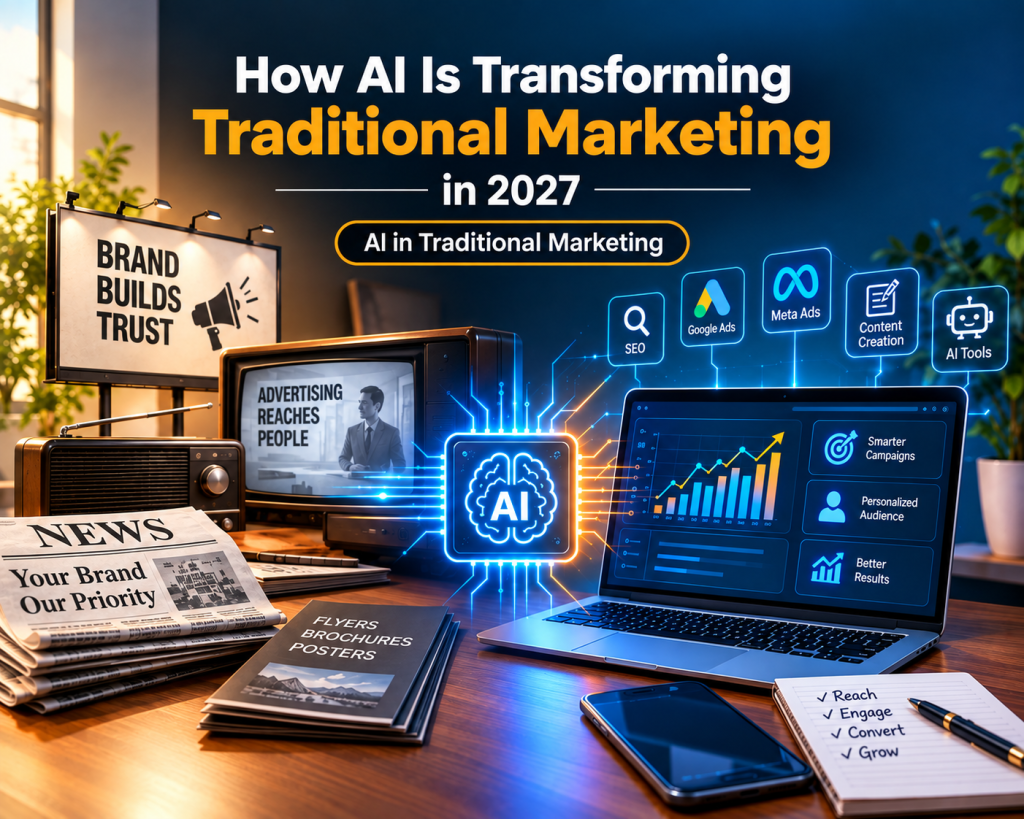
How AI Is Transforming Traditional Marketing in 2027
Artificial intelligence is no longer limited to technology companies, chatbots, or futuristic applications. Instead, it is becoming an important part of how businesses understand customers, create campaigns, distribute advertisements, and measure marketing performance. In 2027, AI in Traditional Marketing will play an increasingly important role in transforming conventional marketing methods such as television advertising, newspapers, radio, billboards, direct mail, events, and outdoor advertising. Rather than completely eliminating traditional marketing, AI is helping businesses make these channels more targeted, measurable, personalised, and efficient.
For decades, traditional marketing has been one of the most widely used ways to reach large audiences. However, conventional campaigns often depended on broad demographic assumptions, manual research, limited customer data, and delayed performance measurement. Consequently, marketers sometimes struggled to determine exactly which audience saw an advertisement, how customers responded to it, and which part of a campaign generated business results. AI is changing this situation by enabling marketers to analyse large amounts of information, identify patterns, predict customer behaviour, automate repetitive activities, and improve marketing decisions.
Therefore, understanding AI in Traditional Marketing is becoming increasingly important for students, marketers, business owners, advertising professionals, and organisations that want to remain competitive in 2027 and beyond.
What Is AI in Traditional Marketing?
AI in Traditional Marketing refers to the use of artificial intelligence technologies to improve conventional marketing channels and activities.
Traditional marketing generally includes:
- Television advertising
- Radio advertising
- Newspaper and magazine advertising
- Billboards and outdoor advertising
- Brochures and flyers
- Direct mail
- Telemarketing
- Events and exhibitions
- Print advertisements
- In-store promotions
- Product packaging and promotional materials
AI does not necessarily replace these channels. Instead, it can make them smarter.
For example, a company may traditionally place a billboard in a busy location. However, with AI-powered analysis, the business can study traffic patterns, audience demographics, weather conditions, location data, historical sales information, and customer behaviour to make better decisions about where and when the billboard should be displayed.
Similarly, a television advertiser can use AI-based audience analytics to understand which programmes, time slots, and audience segments are more relevant to its target customers.
As a result, traditional marketing can move from a largely broad-reach approach toward a more data-driven, predictive, personalised, and measurable approach.
Why Is AI Becoming Important in Traditional Marketing in 2027?
Marketing has changed significantly because customers now interact with businesses across multiple channels. A person may see a television advertisement in the morning, search for the product online, visit a social media page, read reviews, and finally purchase the product through a website or physical store.
Therefore, businesses can no longer treat traditional and digital marketing as completely separate activities.
AI provides an opportunity to connect these different customer touchpoints.
Moreover, businesses are generating enormous amounts of customer and campaign data. Manually analysing all this information is time-consuming and can lead to errors. AI, on the other hand, can process large datasets much faster and identify relationships that may not be immediately visible to humans.
Consequently, marketers can use AI to answer important questions such as:
- Which customers are most likely to respond to an advertisement?
- Which location is best for an outdoor campaign?
- Which television time slot is most effective?
- What type of message is likely to attract attention?
- When should an advertisement be displayed?
- Which customer segment has the highest purchase potential?
- How should the campaign budget be distributed?
- What factors are influencing customer behaviour?
- Which marketing activity is contributing to sales?
Thus, AI is gradually changing traditional marketing from “reach as many people as possible” to “reach the most relevant people in the most effective way.”
1. AI Is Making Audience Targeting More Accurate
One of the biggest limitations of traditional marketing has historically been broad audience targeting.
For example, when a company publishes an advertisement in a newspaper, thousands or even millions of people may see it. However, only a small percentage of those readers may actually be interested in the product.
AI can improve this process.
By analysing customer data, purchasing behaviour, demographic information, geographic patterns, interests, and previous interactions, AI systems can help marketers identify audiences that are more likely to respond to specific campaigns.
For instance, a local jewellery business planning a newspaper campaign can analyse historical customer information to understand:
- Which age groups purchase most frequently
- Which locations generate the highest sales
- Which products are most popular
- Which occasions generate demand
- Which customer segments respond to promotional offers
The business can then use these insights to select newspapers, locations, campaign timings, and messages more strategically.
Therefore, instead of depending entirely on assumptions, marketers can make traditional advertising decisions using data-supported insights.
2. AI Is Transforming Television Advertising
Television remains an important advertising medium because it offers strong visual impact and mass reach. However, television advertising can be expensive, making campaign efficiency extremely important.
AI can help advertisers analyse viewing behaviour, audience patterns, programme popularity, geographical data, historical campaign performance, and customer characteristics.
As a result, marketers can make more informed decisions regarding:
- Programme selection
- Advertising time slots
- Audience segments
- Frequency of advertisements
- Geographic targeting
- Creative messaging
- Campaign budget allocation
For example, if AI analysis indicates that a particular customer segment is more responsive during certain programmes or time periods, advertisers can prioritise those opportunities.
Furthermore, AI can help compare campaign performance across different regions. If a campaign performs strongly in one market but poorly in another, marketers can investigate the reasons and modify the strategy.
Thus, AI in Traditional Marketing can make television advertising more data-driven instead of relying only on historical assumptions.
3. AI Is Changing Radio Advertising
Radio is another traditional marketing channel that can benefit from artificial intelligence.
Traditionally, radio advertisers selected stations and time slots according to audience size, location, and demographic information. However, AI can provide deeper insights into listener behaviour and campaign effectiveness.
For example, AI can help marketers determine:
- Which programmes attract the desired audience
- Which time slots are more valuable
- Which geographic areas generate better responses
- Which advertising messages perform better
- How frequently an advertisement should be played
AI can also assist with analysing campaign results by connecting radio exposure with other customer activities.
For instance, if a business promotes a special offer through radio and subsequently observes an increase in searches, store visits, phone calls, or website activity, AI-based analytics can help identify potential relationships between the campaign and customer behaviour.
Therefore, radio marketing can become more measurable and strategically managed.
4. AI Is Improving Newspaper and Print Advertising
Newspapers, magazines, brochures, and flyers are traditional forms of marketing that continue to be useful for specific audiences and industries.
However, print advertising generally provides less immediate feedback than digital advertising.
AI can help solve part of this challenge.
Marketers can analyse historical campaign data to understand which publications, regions, topics, layouts, and messages have generated stronger responses.
For example, a real estate company may discover that advertisements placed in a particular local newspaper generate more enquiries from a specific geographic area. AI can analyse this historical information and identify patterns that can guide future campaigns.
Additionally, AI-powered design and content tools can help marketers develop multiple creative variations quickly.
For example, marketers can test different:
- Headlines
- Offers
- Calls to action
- Images
- Layouts
- Product descriptions
- Customer messages
Consequently, traditional print campaigns can become more responsive to customer preferences.
5. AI Is Revolutionising Outdoor Advertising
Billboards, hoardings, transit advertisements, digital displays, and other outdoor advertising formats are highly dependent on location.
A billboard in one location may generate significantly better results than another billboard even if both advertisements use the same creative.
AI can help businesses evaluate factors such as:
- Traffic volume
- Pedestrian movement
- Time of day
- Weather conditions
- Location demographics
- Historical campaign performance
- Nearby businesses
- Customer movement patterns
This information can help advertisers select locations more intelligently.
Moreover, digital outdoor advertising can become even more dynamic.
For example, an advertisement displayed on a digital billboard could potentially be adjusted according to factors such as time, weather, location, or audience characteristics.
A restaurant might promote breakfast during morning hours and dinner offers later in the day. Similarly, an umbrella brand could promote rain-related products when weather conditions indicate increased demand.
Therefore, AI can make outdoor advertising more contextual and responsive.
6. AI Is Helping Marketers Predict Customer Behaviour
One of the most valuable applications of artificial intelligence is predictive analysis.
Instead of simply examining what customers did in the past, AI can analyse historical information and identify patterns that may help predict future behaviour.
For example, AI may help businesses estimate:
- Which customers are likely to purchase
- Which products may experience higher demand
- Which locations may generate more enquiries
- Which promotional offers may work better
- When customer demand may increase
- Which customers may stop responding to a brand
This is particularly valuable for traditional marketing because large campaigns can require significant budgets.
If businesses can predict where demand is likely to come from, they can make more informed decisions before spending money.
For example, a retail brand planning a festive billboard campaign could analyse previous festive sales, geographic demand, customer profiles, and seasonal purchasing behaviour before selecting campaign locations.
Thus, predictive AI can help marketers reduce guesswork.
7. AI Is Making Marketing Personalisation Possible
Personalisation has traditionally been easier in digital marketing because digital platforms can track individual interactions.
However, AI is gradually bringing more personalised decision-making into traditional marketing.
For example, direct mail campaigns can be segmented according to customer characteristics and purchase history.
Instead of sending exactly the same message to every customer, a company can create different versions for different segments.
A premium customer may receive an exclusive offer, while a new customer may receive an introductory promotion.
Similarly, retail stores can use customer insights to develop region-specific promotions.
As a result, traditional marketing can become more relevant to individual customer groups.
8. AI Is Improving Marketing Content Creation
Content is a central component of every marketing campaign.
Whether the medium is television, radio, newspaper, billboard, brochure, or direct mail, marketers need effective messages.
AI can support marketers in developing:
- Headlines
- Advertising scripts
- Product descriptions
- Taglines
- Promotional messages
- Campaign concepts
- Storyboards
- Creative variations
- Voice-over scripts
- Customer communication
However, AI-generated content should not automatically be published without human review.
Human marketers are still required to understand:
- Brand identity
- Cultural context
- Customer emotions
- Business objectives
- Ethical considerations
- Accuracy
- Brand tone
Therefore, the strongest approach in 2027 will generally be AI-assisted creativity rather than completely AI-dependent creativity.
AI can accelerate the process, while human professionals provide strategy, originality, judgement, and emotional understanding.
9. AI Is Helping Marketers Optimise Advertising Budgets
Budget allocation is one of the biggest challenges in marketing.
A company may have a limited budget and need to decide whether to spend more on:
- Television
- Radio
- Newspapers
- Billboards
- Events
- Direct mail
- Digital advertising
AI can analyse historical performance and estimate which marketing activities may provide better results.
For example, if a business spends ₹10 lakh across several channels, AI-powered analytics can help compare:
- Leads generated
- Sales generated
- Customer acquisition cost
- Geographic performance
- Audience engagement
- Conversion patterns
Consequently, marketers can identify which activities deserve more investment.
This does not mean AI can guarantee future results. Instead, it provides data-driven insights that can support better decisions.
10. AI Is Improving Campaign Measurement
Measurement has traditionally been one of the major challenges of offline marketing.
For example, a company may know that it placed a billboard in a particular location, but determining exactly how many people eventually became customers because of that billboard can be difficult.
AI can improve attribution by combining information from multiple sources.
For example, marketers can compare:
- Website traffic
- Search behaviour
- Phone enquiries
- Store visits
- Coupon redemptions
- QR code scans
- Sales data
- Customer surveys
- Geographic information
Suppose a restaurant launches a billboard campaign with a unique promotional code. If customers begin using that code, the business gets a clearer indication of campaign response.
AI can then help analyse the resulting data alongside other marketing information.
Therefore, traditional marketing can become more measurable than it was in the past.
11. AI Is Connecting Traditional and Digital Marketing
Perhaps one of the most important changes in 2027 will be the integration of traditional and digital marketing.
Customers do not think in terms of marketing channels. They simply interact with brands.
For example:
Television Advertisement → Google Search → Website → Instagram → Store Visit → Purchase
Similarly:
Billboard → QR Code → Landing Page → WhatsApp Enquiry → Sales Call → Purchase
AI can help marketers understand these customer journeys.
Consequently, businesses can build integrated campaigns instead of treating every marketing channel as an isolated activity.
This is why professionals who understand both traditional marketing principles and digital technologies are likely to have an advantage.
12. AI Is Improving Customer Insights
Understanding customers is fundamental to marketing.
AI can process information from different sources and identify patterns in customer preferences.
For example, businesses can analyse:
- Purchase history
- Customer feedback
- Survey responses
- Reviews
- Search behaviour
- Demographic information
- Campaign responses
- Sales trends
Natural language processing can also help analyse large volumes of written feedback.
For example, if thousands of customers mention similar concerns in surveys or reviews, AI can identify recurring themes.
This information can then help businesses improve:
- Product positioning
- Advertising messages
- Customer service
- Promotional offers
- Product development
- Brand communication
Thus, AI can help marketers understand not only what customers buy, but also why they behave in particular ways.
13. AI Is Supporting Predictive Demand Forecasting
Businesses often need to predict demand before planning a marketing campaign.
For example, retailers may need to estimate demand during:
- Festivals
- Weddings
- Seasonal periods
- Holidays
- School admissions
- Sporting events
- Special occasions
AI can analyse historical sales data, seasonal patterns, market trends, customer behaviour, and other relevant variables.
Consequently, businesses can make better decisions regarding inventory, advertising, staffing, and promotional campaigns.
For example, if historical data indicates that demand for a particular product rises significantly before a festival, the company can increase promotional activity before the demand peak rather than after it.
Therefore, AI can connect marketing decisions with business forecasting.
14. AI Is Transforming Direct Marketing
Direct marketing includes activities such as direct mail, SMS campaigns, catalogues, telemarketing, and personalised promotional communication.
AI can help businesses segment customers based on behaviour and preferences.
For example, customers can be grouped into:
- New customers
- Returning customers
- High-value customers
- Inactive customers
- Frequent buyers
- Price-sensitive customers
Different groups can then receive different communication.
Furthermore, AI can help identify the best timing for communication.
For example, if historical data suggests that a particular customer segment responds better during certain periods, marketers can use those insights when planning campaigns.
As a result, direct marketing can become more relevant and less repetitive.
15. AI Is Improving Event Marketing
Events, exhibitions, seminars, trade shows, and conferences remain important traditional marketing activities.
AI can support event marketing before, during, and after an event.
1. Before the Event
AI can help identify potential audiences, analyse previous event data, and develop promotional messaging.
2. During the Event
Businesses can analyse registrations, visitor behaviour, engagement, and customer interactions.
3. After the Event
AI can help evaluate leads, classify prospects, analyse feedback, and identify follow-up opportunities.
For example, an exhibition may generate hundreds of leads. Instead of treating every lead equally, AI can help marketers prioritise prospects according to their potential value and engagement.
Consequently, sales teams can focus their efforts more efficiently.
16. AI Can Help Improve Marketing Automation
Traditional marketing has historically required considerable manual work.
Marketers may need to:
- Analyse spreadsheets
- Prepare reports
- Segment customers
- Create campaign variations
- Monitor performance
- Prepare presentations
- Review customer feedback
AI-powered tools can automate or accelerate many repetitive activities.
For example, AI can assist with data analysis, report generation, customer segmentation, content development, forecasting, and campaign monitoring.
However, automation should not eliminate human supervision.
Instead, marketers should use automation to spend less time on repetitive work and more time on strategy, creativity, customer understanding, and decision-making.
17. AI Is Changing the Role of Traditional Marketers
The role of a marketer is also changing.
Earlier, traditional marketers were primarily expected to understand:
- Advertising
- Branding
- Consumer behaviour
- Media planning
- Sales promotion
- Communication
In 2027, these skills will still matter. However, marketers increasingly need to understand technology and data as well.
Modern marketers may need knowledge of:
- Artificial intelligence
- Marketing analytics
- Customer data
- Automation
- Digital advertising
- Search marketing
- Social media
- Google Ads
- Meta Ads
- Content strategy
- Conversion optimisation
Therefore, the future marketer is likely to be a combination of a creative professional, strategist, analyst, and technology user.
AI in Traditional Marketing: Will AI Replace Traditional Marketing?
This is one of the most common questions businesses and marketers are asking as artificial intelligence becomes increasingly integrated into advertising and communication. The short answer is no—not completely. AI is transforming traditional marketing by improving audience research, campaign planning, content development, and decision-making; however, transformation is very different from total replacement. Instead, AI in Traditional Marketing is creating a more efficient combination of technology, creativity, human understanding, and traditional communication channels.
Traditional marketing continues to offer several advantages, particularly when businesses want to build broad awareness, establish local visibility, and create memorable offline experiences. Therefore, traditional marketing should not simply be viewed as an outdated approach. Instead, it can be strengthened with AI-powered insights and automation to deliver more relevant and effective campaigns.
1. Mass Reach
Television, radio, newspapers, and outdoor advertising can still reach large audiences within a relatively short period. Moreover, these channels are especially useful when a brand wants to create widespread awareness among people who may not actively search for its products or services online. With AI in Traditional Marketing, audience data can be analysed to identify suitable locations, timings, and customer segments for mass-media campaigns. As a result, traditional advertising can be planned more strategically instead of relying only on assumptions.
2. Local Visibility
Billboards, newspapers, radio advertisements, and local events can be highly valuable for businesses that depend on customers from a specific geographical area. Furthermore, AI can be used to analyse local customer behaviour, demographic patterns, purchasing trends, and campaign performance. Based on these insights, advertisements can be placed in locations and time periods where they are more likely to receive attention. Therefore, AI in Traditional Marketing can make local advertising more targeted while maintaining the strong physical presence of traditional media.
3. Brand Awareness
Traditional advertising has the ability to create strong visual and emotional brand recognition through television commercials, print advertisements, billboards, packaging, and other physical formats. In addition, repeated exposure can help a brand remain memorable to consumers over time. AI can support this process by analysing audience preferences and helping marketers develop messages, visuals, and campaign concepts that are more relevant to specific audiences. Consequently, AI in Traditional Marketing can enhance traditional brand-building activities without removing the human creativity behind them.
5. Physical Experience
Brochures, product packaging, retail stores, events, exhibitions, product displays, and physical advertisements provide customers with tangible experiences that digital platforms cannot always replicate. Moreover, these experiences can influence how customers perceive the quality, personality, and credibility of a brand. AI can assist marketers in designing better packaging concepts, predicting customer preferences, analysing feedback, and planning offline experiences. Therefore, the physical side of traditional marketing can be improved through technology while still retaining its human and sensory elements.
6. Trust and Familiarity
Certain audiences continue to trust established traditional channels such as newspapers, television, radio, and familiar local publications. This is particularly relevant when consumers have developed long-term relationships with specific media platforms or local brands. Furthermore, traditional advertising can provide a sense of credibility and familiarity that may take considerable time to establish through newer channels. With AI in Traditional Marketing, businesses can analyse which trusted channels perform best for their target audience and allocate marketing resources more effectively.
Therefore, rather than asking whether AI will eliminate traditional marketing, businesses should ask:
How can AI make traditional marketing more effective?
That is the more practical question for 2027. Instead of replacing every traditional marketing method, AI is more likely to work alongside television, radio, print, outdoor advertising, events, packaging, and other offline channels. As a result, businesses that successfully combine AI-powered insights with traditional marketing strategies may be able to improve efficiency, personalization, campaign performance, and customer engagement while preserving the human connection that makes marketing effective.
Benefits of AI in Traditional Marketing
Artificial intelligence is changing the way traditional marketing campaigns are planned, executed, and measured. With AI in Traditional Marketing, businesses can use customer data, market insights, and predictive technologies to improve the performance of offline advertising. Moreover, traditional marketing activities can be made more efficient while human creativity and strategic thinking continue to play an important role.
1. Better Decision-Making
AI can analyse large amounts of customer, market, and campaign information within a short period of time. As a result, valuable patterns and insights can be identified that might otherwise be difficult to discover manually. These insights can be used to support decisions related to advertising channels, campaign timing, messaging, and audience selection. Therefore, AI in Traditional Marketing can help businesses make more informed decisions instead of relying entirely on assumptions.
2. Improved Targeting
Traditional advertising can reach a large number of people; however, not everyone within that audience may be interested in a particular product or service. AI can analyse customer characteristics, interests, location, purchasing behaviour, and other available information to identify more relevant audience groups. Furthermore, campaigns can be planned according to the preferences of these segments. Consequently, traditional advertising can become more targeted and potentially more effective.
3. Greater Efficiency
Several marketing activities involve repetitive tasks, including data analysis, reporting, customer segmentation, and campaign evaluation. With the help of AI, these tasks can be automated or completed much faster than before. Moreover, valuable time can be saved, allowing marketers to focus more on strategy, creativity, and customer relationships. Thus, AI in Traditional Marketing can improve productivity while reducing the amount of manual work involved.
4. Better Personalisation
Customers are more likely to respond when marketing messages are relevant to their needs and interests. AI can analyse customer segments and identify differences in preferences, behaviour, and purchasing patterns. Based on these insights, marketing messages and offers can be adapted for different groups. Therefore, traditional campaigns can be made more personalised while a stronger connection with the target audience is created.
5. Improved Measurement
Measuring the exact impact of traditional advertising has often been challenging compared with digital campaigns. However, AI can help combine information from multiple sources, such as sales data, customer surveys, QR code scans, website visits, and digital interactions. As a result, marketers can develop a clearer understanding of how an offline campaign is performing. Moreover, AI in Traditional Marketing can be used to identify successful strategies and improve future campaigns.
6. Better Budget Management
Marketing budgets need to be allocated carefully because businesses often invest across television, radio, print, outdoor advertising, events, and digital channels. AI can analyse previous campaign results and identify areas where spending may be generating stronger outcomes. Furthermore, customer and market data can be considered when future budgets are being planned. Consequently, businesses can work towards using their marketing budgets more efficiently and reducing unnecessary expenditure.
7. Faster Content Development
Creating advertising content can require considerable time, especially when multiple concepts need to be developed and tested. AI tools can assist marketers in generating headlines, advertising copy, campaign concepts, scripts, and creative ideas within a shorter timeframe. In addition, several variations can be produced and evaluated before the final campaign is launched. However, human creativity and brand understanding should still be used to review and refine the content.
8. Predictive Capabilities
AI can analyse historical information to identify patterns that may indicate future market trends and customer behaviour. For example, previous sales, seasonal demand, customer preferences, and campaign responses can be studied to support future planning. As a result, businesses can prepare their marketing strategies more proactively instead of reacting only after a trend has already developed. Therefore, AI in Traditional Marketing can provide useful predictive insights for advertising, promotions, product launches, and events.
9. Better Customer Understanding
Understanding customer expectations is essential for developing effective marketing campaigns. AI can analyse customer reviews, survey responses, feedback, purchasing behaviour, and other available information to identify common patterns. Furthermore, positive and negative customer sentiments can be studied to understand how a brand or campaign is being perceived. Consequently, businesses can use these insights to create more relevant traditional marketing messages and improve customer experiences.
10. Stronger Integration
Traditional and digital marketing can no longer be treated as completely separate activities. With AI in Traditional Marketing, offline campaigns can be connected with digital touchpoints to create a more unified customer journey. For example, a customer may see a billboard, scan a QR code, visit a website, and later interact with the brand through social media. As a result, customer interactions across different channels can be connected and analysed, allowing businesses to create a more consistent marketing experience.
Challenges of Using AI in Traditional Marketing
Although AI in Traditional Marketing offers significant opportunities, its implementation can also create several challenges for businesses. AI systems require reliable data, suitable technology, skilled professionals, and proper supervision to deliver meaningful results. Moreover, businesses need to consider ethical and privacy-related responsibilities before AI is integrated into their marketing processes. Therefore, AI should be adopted strategically rather than being treated as a quick solution to every marketing problem.
1. Data Privacy
AI systems often depend on large amounts of customer information to generate useful insights and recommendations. Therefore, customer data must be collected, stored, and processed responsibly while applicable privacy requirements are followed. Furthermore, customers should be given appropriate transparency about how their information is being used. If data is handled carelessly, trust can be damaged and the business may face serious privacy-related consequences.
2. Data Quality
The quality of AI-generated insights depends heavily on the quality of the information being analysed. If the underlying data is incomplete, outdated, inaccurate, or biased, misleading conclusions may be produced by the system. Moreover, incorrect data can affect audience targeting, campaign planning, and customer analysis. Therefore, businesses should ensure that data is regularly reviewed, cleaned, and maintained before it is used with AI in Traditional Marketing.
3. Cost of Implementation
Advanced AI solutions may require considerable investment in software, technology, infrastructure, data systems, and employee training. For smaller businesses, these costs can sometimes make AI adoption difficult, particularly when immediate returns are not guaranteed. However, the investment can be managed by starting with practical AI applications that address specific marketing needs. Gradually, additional AI capabilities can be introduced as the business becomes more comfortable with the technology.
4. Lack of Skilled Professionals
AI tools may be easy to access, but using them effectively requires more than simply knowing how to operate a software platform. Professionals need to understand marketing principles as well as data, automation, AI capabilities, and ethical considerations. Furthermore, businesses may find it difficult to hire people who possess both marketing and AI-related skills. Therefore, existing marketing teams may need to be trained so that AI in Traditional Marketing can be implemented effectively.
5. Human Oversight
AI-generated content, predictions, and recommendations may sometimes contain errors or be based on incorrect assumptions. In addition, an AI system may not fully understand cultural context, emotions, humour, or the specific values of a brand. Therefore, human review should be maintained before AI-generated marketing content is published or used in a campaign. With proper human oversight, the efficiency of AI can be combined with human judgement and creativity.
6. Ethical Concerns
The use of AI in marketing also raises important ethical questions related to transparency, privacy, fairness, bias, and responsible communication. For example, customers may feel uncomfortable if their information is being used in ways they do not understand. Moreover, biased data can sometimes lead to unfair targeting or inaccurate customer assumptions. Therefore, businesses should establish clear guidelines for responsible AI usage and ensure that marketing decisions remain transparent and fair.
Therefore, successful adoption of AI in Traditional Marketing requires much more than simply purchasing an AI tool. A proper strategy needs to be developed, suitable processes need to be established, and employees need to be trained to use AI responsibly. Most importantly, human supervision should remain an essential part of the process. As AI continues to develop, businesses that combine technology with human judgement, creativity, ethics, and marketing expertise will be better positioned to use its potential effectively.
How Businesses Can Implement AI in Traditional Marketing
Businesses do not need to transform their entire marketing strategy at once. Instead, AI in Traditional Marketing can be introduced gradually by identifying specific areas where technology can provide measurable value. Moreover, a step-by-step approach allows businesses to test AI applications, evaluate their results, and make improvements before larger investments are made. The following process can help businesses integrate AI into their traditional marketing activities more effectively.
Step 1: Define the Marketing Objective
First, businesses should clearly determine what they want to achieve through their marketing campaign. For example, the objective could be to increase brand awareness, generate enquiries, increase store visits, improve sales, or reach a new market. A clearly defined objective makes it easier to select the right AI application and measure campaign performance. Therefore, AI should be used to support a specific marketing goal rather than being adopted simply because it is a new technology.
Step 2: Collect Relevant Data
Once the objective has been defined, relevant and reliable data should be collected from available sources. This may include customer information, sales records, previous campaign results, locations, feedback, and audience behaviour. Furthermore, the collected information should be reviewed to ensure that it is accurate, relevant, and suitable for analysis. High-quality data is particularly important because AI in Traditional Marketing can only provide useful insights when reliable information is available.
Step 3: Identify Suitable AI Applications
Businesses should then determine where AI can provide genuine value within their existing marketing activities. For instance, AI can be used for audience analysis, forecasting, content creation, customer segmentation, and campaign performance analysis. Moreover, not every marketing activity needs to be automated or replaced with AI. Therefore, businesses should focus on applications that can solve a specific problem or improve an existing process.
Step 4: Start With a Small Campaign
Instead of implementing AI across every marketing channel at the same time, businesses can begin with one campaign or a specific marketing activity. This approach allows the organisation to understand how the technology performs in a real-world situation without taking unnecessary risks. Furthermore, the initial campaign can be used as a testing phase where problems and opportunities are identified. As a result, AI in Traditional Marketing can be introduced gradually and more confidently.
Step 5: Measure Performance
After the campaign has been launched, its performance should be monitored using relevant marketing metrics. Depending on the objective, businesses may track enquiries, sales, store visits, customer responses, reach, engagement, or return on marketing investment. Moreover, the results can be compared with previous campaigns to determine whether AI has created a measurable improvement. Therefore, decisions should be based on actual performance data rather than assumptions.
Step 6: Optimise
Once sufficient performance data has been collected, the campaign can be improved based on the insights generated. For example, audience targeting, creative communication, budget allocation, advertising locations, and campaign timing can be adjusted. Furthermore, AI can help identify patterns that may not be immediately visible through manual analysis. Consequently, businesses can continuously refine their AI in Traditional Marketing strategies and improve campaign effectiveness over time.
Step 7: Scale Successful Strategies
If an AI-supported approach consistently demonstrates positive results, it can gradually be expanded to additional campaigns and marketing channels. However, scaling should be carried out carefully so that quality, customer experience, and human oversight are not compromised. Moreover, successful strategies can be adapted according to different audiences, locations, or marketing objectives. As a result, businesses can build a broader AI in Traditional Marketing strategy based on approaches that have already demonstrated practical value.
Skills Marketers Need to Learn for AI-Driven Marketing
As AI becomes increasingly integrated into marketing, professionals need to develop a broader and more practical skill set. Simply knowing how to use an AI tool is not enough to build a successful marketing career. Instead, marketers need to understand how AI can be combined with SEO, paid advertising, social media, content, analytics, and conversion strategies. Therefore, professionals who understand both marketing fundamentals and AI in Traditional Marketing can be better prepared for the changing marketing landscape.
1. Artificial Intelligence Fundamentals
Marketers should understand what artificial intelligence can and cannot do before using it in professional campaigns. This includes learning basic AI concepts, understanding how AI-generated outputs are produced, and recognising common limitations such as inaccurate information or biased results. Moreover, marketers should know when human judgement is required. This foundation allows AI in Traditional Marketing to be used more responsibly and effectively.
2. Prompting and AI Tools
Professionals should learn how to communicate clearly with AI tools to generate useful and relevant outputs. Effective prompting can be used for research, content ideas, campaign planning, audience analysis, and creative development. Furthermore, marketers should learn how to review and refine AI-generated results instead of accepting them without verification. As a result, strong AI tool usage can improve both productivity and creative workflows.
3. Data Analytics
Understanding data is essential because many AI systems depend on data to generate insights and recommendations. Marketers should be able to read basic reports, identify important trends, compare campaign results, and understand key performance indicators. Moreover, data-driven thinking helps professionals determine whether an AI-supported strategy is actually producing meaningful results. Therefore, analytics has become an important skill for anyone working with AI in Traditional Marketing.
4. Search Engine Marketing
Google Ads and other paid advertising platforms continue to play an important role in customer acquisition. Marketers should understand campaign structures, keyword research, bidding, audience targeting, ad copy, conversion tracking, and performance analysis. In addition, AI-powered features are increasingly being used to support campaign optimisation and targeting. Therefore, combining paid advertising knowledge with AI capabilities can help marketers create more efficient acquisition strategies.
5. SEO
Search engine optimisation remains an important skill for businesses that want to attract organic traffic and build long-term online visibility. Marketers should understand keyword research, on-page SEO, technical fundamentals, content optimisation, internal linking, and search intent. Furthermore, AI can be used to support research and content workflows, although quality and relevance still need to be maintained. As search behaviour continues to evolve, SEO knowledge can help marketers adapt their strategies effectively.
6. Social Media Marketing
Social media platforms continue to influence brand awareness, customer engagement, and purchasing decisions. Marketers should understand content planning, audience behaviour, platform-specific strategies, engagement, paid campaigns, and performance measurement. Moreover, AI tools can assist with content ideas, audience insights, creative variations, and campaign analysis. Consequently, professionals can use AI in Traditional Marketing alongside social media strategies to create more connected customer experiences.
7. Content Marketing
AI can help marketers generate ideas and accelerate parts of the content creation process; however, strong storytelling and communication skills remain essential. Marketers need to understand how to create content that is informative, engaging, relevant, and aligned with a brand’s objectives. Furthermore, AI-generated content should be reviewed and improved so that it reflects the brand’s voice and provides genuine value. Therefore, human creativity continues to remain an important part of AI-driven content marketing.
8. Conversion Optimisation
Generating attention is not enough because marketing ultimately needs to contribute to enquiries, leads, sales, or other business outcomes. Marketers should understand landing pages, calls to action, customer journeys, user behaviour, and factors that influence conversions. Moreover, AI can be used to analyse customer behaviour and identify opportunities for improvement. As a result, marketers can focus not only on attracting audiences but also on converting that attention into measurable business results.
9. Campaign Optimisation
Marketing campaigns should not simply be launched and left unchanged. Professionals need to continuously monitor performance, identify weak areas, test different approaches, and make data-driven improvements. Furthermore, AI can assist in identifying patterns and opportunities for optimisation across different marketing channels. Therefore, campaign optimisation skills are essential for marketers who want to use AI in Traditional Marketing and other AI-driven strategies effectively.
Therefore, future-ready marketers should not learn AI in isolation. They should understand how AI fits into the complete marketing ecosystem, including SEO, Google Ads, social media, content marketing, analytics, conversion optimisation, and traditional advertising. Moreover, the strongest professionals will be those who can combine AI tools with marketing strategy, creativity, data analysis, and human judgement. This broader skill set can help marketers remain adaptable as the industry continues to evolve.
Learn AI-Integrated Digital Marketing at HIDM (Hisar Institute of Digital Marketing)
For students and aspiring marketers who want to build practical skills for the changing marketing industry, an AI-integrated digital marketing course can provide a structured learning path.
HIDM, or Hisar Institute of Digital Marketing, focuses on digital marketing education with AI integration. The institute’s approach is designed to help learners understand modern marketing practices while also becoming familiar with AI tools and technologies that are increasingly influencing the industry.
An AI-integrated digital marketing learning path can be particularly useful for students, fresh graduates, working professionals, entrepreneurs, and individuals looking to build a career in digital marketing.
At HIDM, learners can develop knowledge across important areas of digital marketing, including:
- SEO
- SEM
- Google Ads
- Meta Ads
- Social Media Marketing
- Content Marketing
- AI tools
- Campaign optimisation
- Website-related marketing
- Practical project-based learning
The importance of this combination becomes clearer when we consider the future of marketing.
A marketer may understand traditional advertising, but if they do not understand data, AI, digital platforms, and performance marketing, they may find it difficult to compete in an increasingly technology-driven industry.
Similarly, someone who knows how to use AI tools but does not understand marketing fundamentals may struggle to develop effective campaigns.
Therefore, the strongest approach is to combine marketing fundamentals + digital marketing + AI skills + practical experience.
HIDM’s AI-integrated digital marketing course is positioned around this broader approach, helping learners understand how modern technologies can be used alongside established marketing concepts.
For someone starting from scratch, this type of structured learning can make it easier to understand how different marketing channels work together instead of learning individual tools without a clear strategy.
Who Should Learn AI-Integrated Digital Marketing?
Students
Students can begin developing career-oriented marketing skills before entering the job market.
Learning AI, digital advertising, SEO, social media, and analytics can help students build a broader professional skill set.
1. Fresh Graduates
Graduates from backgrounds such as B.Com, BBA, BA, MBA, and other disciplines can explore digital marketing as a career option.
They can also combine their existing academic knowledge with marketing and AI capabilities.
2. Working Professionals
Professionals can use digital marketing and AI skills to expand their existing career opportunities.
For example, someone working in sales, business development, communication, or advertising can use marketing technology to improve their professional capabilities.
3. Business Owners
Business owners can learn how marketing campaigns work and understand how AI can support customer acquisition, content creation, analysis, and optimisation.
4. Freelancers
Freelancers can develop multiple marketing skills and offer services to clients across different industries.
Career Opportunities After Learning AI and Digital Marketing
The increasing use of AI does not necessarily reduce the need for marketers. Instead, it is changing the type of skills employers and clients expect.
Potential career paths include:
- Digital Marketing Executive
- SEO Executive
- SEO Specialist
- Google Ads Specialist
- PPC Executive
- Google Ads Manager
- Performance Marketing Specialist
- Social Media Manager
- Content Marketing Specialist
- Digital Marketing Analyst
- Marketing Automation Specialist
- AI Marketing Specialist
- Digital Marketing Consultant
- Performance Marketing Manager
Professionals who combine marketing knowledge with analytical and AI capabilities can potentially build stronger long-term career profiles.
The Future of AI in Traditional Marketing
Looking beyond 2027, AI is likely to become increasingly integrated into marketing decision-making.
Future developments may include:
- More intelligent audience prediction
- Real-time campaign optimisation
- Advanced customer segmentation
- Greater personalisation
- AI-powered media planning
- Automated creative testing
- Predictive customer journeys
- Smarter outdoor advertising
- Advanced marketing attribution
- Greater integration between offline and online channels
However, human creativity and strategic thinking will remain important.
Marketing is ultimately about people.
AI can identify patterns, process data, generate ideas, and automate tasks. Nevertheless, marketers still need to understand emotions, culture, customer motivations, brand positioning, and business objectives.
Therefore, the future is unlikely to be simply AI versus humans.
Instead, it will increasingly be:
AI + Human Creativity + Marketing Strategy + Data
How Marketers Can Prepare for 2027
Marketing is changing rapidly as artificial intelligence becomes more deeply integrated into everyday workflows. Therefore, marketers who want to remain competitive in 2027 should start developing relevant skills before AI becomes a standard part of every marketing process. Instead of focusing only on AI tools, professionals should build a combination of marketing knowledge, analytical ability, practical experience, and technology skills. This approach will help marketers understand how AI in Traditional Marketing and digital marketing can work together effectively.
1. Learn AI Fundamentals
Marketers should begin by understanding the basic concepts behind artificial intelligence and how modern AI tools are being used in marketing. They should also learn what AI can do, where it performs well, and where human judgement is still required. Moreover, understanding the limitations of AI can help professionals avoid inaccurate or misleading outputs. As a result, marketers can use AI more confidently and responsibly in their daily work.
2. Learn Digital Marketing
A strong foundation in digital marketing remains essential even as AI becomes more powerful. Marketers should develop practical knowledge of SEO, SEM, social media marketing, content marketing, paid advertising, analytics, and conversion optimisation. Furthermore, these skills provide the marketing context needed to use AI effectively rather than depending on AI tools without understanding the strategy behind them. Therefore, digital marketing knowledge should be combined with an understanding of AI in Traditional Marketing.
3. Develop Data Skills
Data plays an increasingly important role in modern marketing decisions. Marketers should learn how to read campaign reports, understand important metrics, compare performance, and identify meaningful patterns within available data. Moreover, they should be able to distinguish between useful insights and information that may not have practical business value. Consequently, strong data skills allow marketers to make better decisions and use AI-generated insights more effectively.
4. Practise With Real Campaigns
Theory alone is not enough to become an effective marketer. Practical projects allow professionals to understand how campaign strategies are planned, implemented, monitored, and improved in real situations. Furthermore, real campaigns provide opportunities to learn from mistakes, analyse results, and understand actual customer behaviour. Therefore, marketers should gain hands-on experience with different campaigns and apply AI tools where they can provide genuine value.
5. Learn Google Ads
Google Ads remains an important skill because businesses need measurable ways to reach potential customers and generate enquiries or sales. Marketers should understand keyword research, campaign structure, bidding, targeting, ad copy, conversion tracking, and performance optimisation. In addition, AI-powered features are increasingly being integrated into advertising platforms to support targeting and campaign management. Therefore, learning Google Ads alongside AI can provide marketers with a valuable combination of performance marketing and technology skills.
6. Learn Meta Ads
Meta Ads can help businesses reach specific audience segments across platforms such as Facebook and Instagram. Marketers should understand audience targeting, campaign objectives, creative testing, retargeting, budgeting, and performance analysis. Moreover, AI-powered systems can assist with audience selection, creative delivery, and campaign optimisation. As a result, professionals who understand both Meta advertising and AI can create more data-driven social media campaigns.
7. Build Analytical Thinking
AI can process large amounts of information and provide recommendations; however, marketers still need to determine what those insights actually mean for a business. Analytical thinking helps professionals evaluate information, identify the most important factors, and connect marketing data with business objectives. Furthermore, marketers must question AI-generated recommendations when the information appears incomplete or unsuitable. Therefore, critical and analytical thinking will remain valuable even as AI capabilities continue to improve.
8. Continue Learning
AI technology is developing rapidly, and new tools, features, and marketing applications are being introduced regularly. Therefore, marketers cannot rely only on the skills they learn at the beginning of their careers. They should continuously experiment with new tools, follow industry developments, update their knowledge, and practise emerging techniques. Moreover, a continuous-learning mindset will help professionals adapt to changes in AI in Traditional Marketing, digital advertising, search, content creation, and customer behaviour.
Preparing for 2027 does not mean becoming completely dependent on artificial intelligence. Instead, marketers should learn how to combine AI capabilities with strong marketing fundamentals, practical experience, data analysis, creativity, and human judgement. As AI continues to influence the industry, professionals who develop this balanced skill set can remain more adaptable and valuable in the evolving marketing environment.
Final Thoughts
The growth of artificial intelligence does not mean that traditional marketing is disappearing. Instead, it is entering a new phase.
In 2027, AI in Traditional Marketing will increasingly help businesses understand audiences, predict customer behaviour, personalise communication, optimise advertising budgets, improve campaign measurement, and connect offline marketing with digital customer journeys.
At the same time, traditional marketing will continue to provide advantages such as mass reach, local visibility, physical experiences, emotional branding, and strong awareness-building opportunities.
Therefore, businesses should not think about traditional and digital marketing as completely separate worlds. The future belongs to integrated marketing strategies where traditional channels, digital platforms, data, artificial intelligence, and human creativity work together.
For marketers, this shift creates an important opportunity. Learning only one marketing channel may no longer be enough. Professionals who understand marketing fundamentals while also developing skills in AI, digital advertising, SEO, analytics, automation, and campaign optimisation can position themselves more effectively for the changing industry.
For students and aspiring professionals, an AI-integrated learning approach can provide a structured way to develop these capabilities. Institutions such as HIDM – Hisar Institute of Digital Marketing are helping learners explore digital marketing alongside modern AI tools and practical marketing skills.
Ultimately, the goal should not be to replace human marketers with AI. Instead, the goal should be to make marketers more intelligent, efficient, analytical, and creative through technology.
AI will provide the intelligence. Data will provide the direction. Human creativity will provide the connection. And marketing strategy will bring everything together.
That combination is what can define the future of marketing in 2027 and beyond.