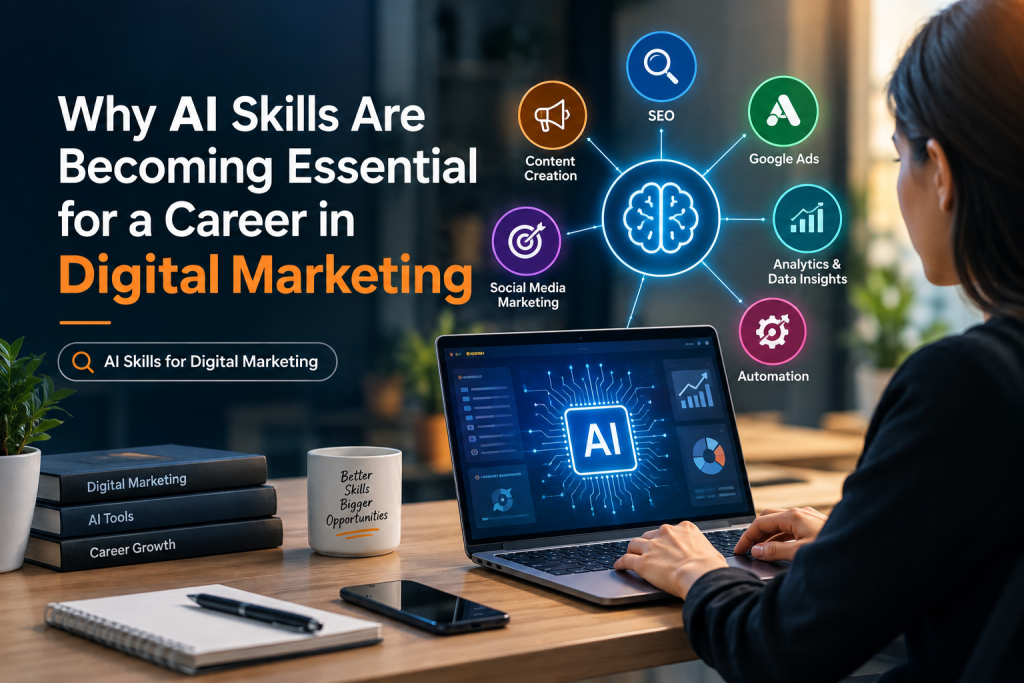
Why AI Skills Are Becoming Essential for a Career in Digital Marketing
Digital marketing is continuously evolving, and technology is playing a major role in this transformation. Among the latest developments, artificial intelligence has become an important part of modern marketing. As businesses increasingly depend on automation, data analysis, personalization, and AI-powered tools, professionals are expected to develop AI Skills for Digital Marketing to remain relevant and competitive.
In the past, digital marketers mainly focused on SEO, social media, content creation, email marketing, and paid advertising. However, these areas are now being supported by AI tools that can analyze large amounts of data, generate content ideas, identify customer patterns, optimize campaigns, and automate repetitive tasks. Therefore, learning AI is no longer limited to technology professionals. It is becoming an important skill for students, beginners, freelancers, and experienced digital marketers.
What Are AI Skills for Digital Marketing?
AI Skills for Digital Marketing refer to the ability to understand and use artificial intelligence tools and technologies for different marketing activities.
These skills do not necessarily mean that a digital marketer needs to become a programmer or AI developer. Instead, marketers should understand how AI can be applied to everyday marketing tasks.
For example, AI can be used for:
- Content research and ideation
- SEO analysis
- Keyword research
- Ad copy generation
- Audience analysis
- Campaign optimization
- Social media planning
- Customer personalization
- Marketing automation
- Data analysis and reporting
As a result, marketers who understand these applications can work more efficiently while making better use of available data.
Why Are AI Skills Becoming Important for Digital Marketers?
The digital marketing industry is becoming more data-driven and automated. At the same time, businesses are looking for professionals who can combine marketing knowledge with modern technology.
Therefore, several reasons are contributing to the growing importance of AI skills.
1. AI Improves Marketing Productivity
Digital marketers often spend considerable time performing repetitive activities. Content research, reporting, data organization, keyword analysis, and campaign monitoring can require many hours.
However, AI-powered tools can assist with several of these tasks. As a result, marketers can spend more time on strategy, creativity, customer understanding, and decision-making.
For instance, an AI tool can help generate multiple content ideas within minutes. These ideas can then be reviewed, improved, and adapted according to the brand’s requirements.
Therefore, AI Skills for Digital Marketing can help professionals improve productivity without completely replacing human creativity.
2. AI Is Changing Content Marketing
Content continues to play an important role in digital marketing. However, the process of researching, planning, creating, and optimizing content is being influenced by AI.
AI tools can be used to generate topic ideas, create content outlines, identify related questions, and improve readability. Furthermore, marketers can use AI to understand search intent and develop content around audience needs.
However, completely depending on AI-generated content is not recommended. Human expertise, originality, fact-checking, brand understanding, and editing are still required.
Consequently, marketers who know how to combine AI assistance with human creativity can create a more effective content workflow.
3. AI Is Transforming SEO
Search engine optimization is also being influenced by artificial intelligence. Search engines have become better at understanding context, intent, relationships between topics, and the overall quality of content.
At the same time, marketers are using AI for keyword research, content analysis, competitor research, technical SEO assistance, and content optimization.
Therefore, learning AI Skills for Digital Marketing can help SEO professionals understand how AI-powered tools can support their existing SEO processes.
However, AI-generated recommendations should not be accepted blindly. They should be reviewed against search intent, website data, search engine guidelines, and real user behaviour.
4. AI Helps With Paid Advertising
Paid advertising requires continuous monitoring and optimization. Campaign performance can change depending on audience behaviour, competition, budget, creative quality, and other factors.
AI is increasingly being incorporated into advertising platforms to help with bidding, targeting, creative variations, recommendations, and campaign optimization.
For digital marketers, this means that understanding AI-assisted advertising tools can become increasingly valuable.
A marketer who understands both advertising fundamentals and AI-powered campaign features can make more informed decisions and interpret platform recommendations more effectively.
5. AI Supports Data-Driven Decision Making
Data is one of the most valuable resources in digital marketing. However, large amounts of data can be difficult to analyze manually.
AI can help marketers identify patterns, summarize information, detect changes, and support data interpretation. Consequently, marketing decisions can be made with greater efficiency.
For example, a marketer can analyze campaign data to understand which audience segments are generating better engagement or conversions. Based on these insights, campaign strategies can be adjusted.
Therefore, AI knowledge combined with analytics skills can provide digital marketers with a stronger professional foundation.
6. Personalization Is Becoming More Important
Customers increasingly expect relevant experiences from brands. Generic messages may not always generate the same level of engagement as personalized communication.
AI can be used to analyze customer behaviour and support personalized recommendations, messages, content, and offers.
For example, an e-commerce business can use customer data to understand product interests and provide more relevant recommendations.
As a result, marketers who understand AI-based personalization can better support businesses in creating customer-focused marketing strategies.
What AI Skills Should Digital Marketers Learn?
Learning every AI tool available is not necessary. Instead, marketers should focus on practical skills that can be applied to real marketing activities.
1. AI Prompting
Prompting is an important skill because the quality of an AI output can depend significantly on how the instruction is written.
Digital marketers should learn how to provide clear context, goals, audience information, tone, examples, and constraints when working with AI tools.
2. AI-Assisted Content Creation
Marketers should understand how AI can support:
- Blog ideation
- Content outlines
- Social media posts
- Ad copy
- Email ideas
- Video scripts
- Content repurposing
However, human editing should still be included to maintain accuracy, originality, and brand consistency.
3. AI for SEO
AI can assist with keyword research, content planning, competitor analysis, topic clustering, and content optimization.
Therefore, marketers should learn how to use AI alongside traditional SEO knowledge rather than treating AI as a replacement for SEO fundamentals.
4. AI for Advertising
Marketers should understand how AI-powered features are being used in platforms such as Google Ads and Meta Ads.
This includes understanding automated bidding, campaign recommendations, audience signals, creative optimization, and performance analysis.
5. AI and Marketing Analytics
AI can assist marketers in interpreting large datasets and identifying useful patterns.
Consequently, learning basic analytics along with AI tools can help professionals understand campaign performance and make data-supported decisions.
AI Skills for Digital Marketing Can Improve Career Opportunities
The growing use of AI is also influencing digital marketing job roles. Employers increasingly look for professionals who can work with modern tools while understanding fundamental marketing principles.
A candidate with knowledge of SEO, Google Ads, Meta Ads, content marketing, analytics, and AI tools may be able to handle a wider range of marketing responsibilities.
For beginners, this can be particularly useful because practical AI knowledge can be demonstrated through projects, campaigns, content workflows, and case studies.
At the same time, experienced marketers can use AI skills to improve existing workflows and adapt to changing industry requirements.
Is AI Going to Replace Digital Marketers?
AI is changing digital marketing, but marketing still requires human judgment.
AI can process information quickly and automate certain activities. However, businesses still require people to understand customers, develop strategies, communicate brand values, evaluate ideas, manage campaigns, and make important decisions.
Therefore, the future of digital marketing is likely to involve greater collaboration between humans and AI-powered technologies.
Instead of focusing only on whether AI will replace marketers, professionals should focus on learning how to work effectively with AI.
How Beginners Can Start Learning AI Skills for Digital Marketing
Beginners do not need to learn every AI tool available in the market. Instead, a structured learning approach can make the process easier and more practical. Before using advanced AI tools, it is important to understand the fundamentals of digital marketing and then gradually learn how artificial intelligence can support different marketing activities.
By following the steps below, beginners can develop AI Skills for Digital Marketing and apply them to real-world marketing tasks.
Step 1: Learn Digital Marketing Fundamentals
The first step is to build a strong foundation in digital marketing. AI tools can make marketing tasks easier, but they cannot replace an understanding of basic marketing concepts.
Beginners should first learn important areas such as Search Engine Optimization (SEO), Search Engine Marketing (SEM), Social Media Marketing (SMM), content marketing, email marketing, web analytics, and paid advertising.
For example, before using AI for keyword research, a beginner should understand what keywords are, how search intent works, and why keywords are important for SEO. Similarly, before using AI for Google Ads, it is important to understand campaign objectives, keywords, bidding, ad groups, targeting, and conversion tracking.
Therefore, strong digital marketing fundamentals should be developed before moving toward advanced AI applications.
Step 2: Learn AI Fundamentals
Once the basic concepts of digital marketing have been understood, beginners can start learning the fundamentals of artificial intelligence.
At this stage, it is not necessary to learn programming or complex technical concepts. Instead, beginners should understand how technologies such as generative AI, machine learning, automation, natural language processing, and AI-powered marketing tools work at a practical level.
For example, generative AI can be used to create content ideas, summarize information, generate drafts, and assist with research. Similarly, AI-powered marketing platforms can help analyze data, identify patterns, automate repetitive tasks, and provide campaign recommendations.
Understanding these basic concepts will make it easier for beginners to identify where AI can actually be useful in their marketing workflow.
Step 3: Learn Prompting
Prompting is another important skill for anyone developing AI Skills for Digital Marketing.
A prompt is the instruction or input provided to an AI tool to generate a particular output. Better prompts can help produce more relevant and useful results.
Beginners should learn how to provide AI with proper context, objectives, target audience, tone, format, examples, and specific instructions.
For example, instead of simply asking an AI tool to “write a Facebook ad,” a marketer can provide information about the product, target audience, location, offer, tone, and desired call-to-action.
This approach can produce a more focused output that can then be reviewed and improved by the marketer.
However, prompting should not be treated as a replacement for marketing knowledge. The marketer still needs to evaluate the AI-generated response and make changes according to the campaign objective and brand requirements.
Step 4: Apply AI to Marketing Tasks
After learning the fundamentals, beginners should start using AI in practical marketing activities.
Instead of experimenting with AI tools randomly, they can select specific tasks and understand how AI can support them.
For example, AI can be used for:
Content Research: Generate topic ideas, content outlines, FAQs, and audience questions.
SEO: Assist with keyword ideas, topic clustering, content briefs, and competitor research.
Advertising: Create ad-copy variations, headline ideas, descriptions, and creative concepts.
Social Media: Develop content ideas, captions, posting themes, and content calendars.
Analytics: Help summarize marketing data and identify patterns that require further investigation.
Email Marketing: Assist with subject-line ideas, email drafts, personalization concepts, and campaign variations.
Marketing Automation: Support repetitive workflows and help organize certain marketing processes.
The important point is that AI-generated information should be reviewed before it is used. Facts should be verified, content should be edited, and marketing decisions should be based on reliable data.
Step 5: Build Practical Projects
Learning AI tools through tutorials is useful, but practical application is even more important.
Beginners should therefore create small projects where they can combine digital marketing knowledge with AI tools. These projects can be based on a real business, a hypothetical brand, or a personal project.
For example, a beginner could create a complete digital marketing project for a local restaurant. The project could include:
Keyword research and an SEO content plan
Social media content calendar
AI-assisted blog content
Google Ads campaign structure
Meta Ads creative concepts
Customer persona research
Basic performance analysis
AI-assisted reporting
Such projects help learners understand how AI can be integrated into an actual marketing workflow.
Furthermore, practical projects can be added to a portfolio. This can be particularly useful for students and beginners who do not yet have extensive professional experience. Instead of only saying that they know AI tools, they can demonstrate how those tools were used to solve specific marketing problems.
Step 6: Keep Practicing and Stay Updated
AI technology changes rapidly. New tools, features, automation capabilities, and marketing applications are introduced regularly.
Therefore, learning AI should not be treated as a one-time activity. Beginners should continue experimenting with new tools while strengthening their existing digital marketing knowledge.
However, learning every new AI tool is not necessary. It is more useful to understand the purpose of a tool and determine whether it can genuinely improve a marketing process.
By consistently practicing, reviewing results, and learning from real projects, beginners can gradually develop stronger AI Skills for Digital Marketing.
A Practical Learning Approach
A simple learning journey can therefore look like this:
Digital Marketing Fundamentals → AI Fundamentals → Prompting → AI Marketing Tools → Practical Projects → Portfolio → Continuous Learning
This step-by-step approach allows beginners to build their knowledge gradually instead of becoming overwhelmed by the large number of AI tools available today.
Most importantly, the goal should not be to simply learn how to use AI tools. The real objective should be to understand how AI can be used to solve marketing problems, improve efficiency, support decision-making, and create better customer experiences.
Learn AI-Integrated Digital Marketing at HIDM
For students and beginners who want to develop digital marketing skills along with modern AI knowledge, HIDM (Hisar Institute of Digital Marketing) offers an AI-integrated Digital Marketing Course.
The course is designed to provide comprehensive digital marketing training rather than focusing on only one marketing channel. Students can learn important areas such as SEO, SEM, Social Media Marketing, Google Ads, Meta Ads, content marketing, and AI tools.
Furthermore, practical learning is included so that students can understand how digital marketing concepts are applied in real-world situations.
HIDM’s AI-integrated approach allows learners to understand how AI tools can be incorporated into different marketing activities. Instead of learning AI separately from digital marketing, students can understand how both areas can work together.
The training also includes practical/live project exposure, mentor support, one-to-one sessions, and doubt-solving support. Consequently, learners can gradually move from basic concepts toward practical implementation.
For students planning to build a career in digital marketing, developing AI Skills for Digital Marketing alongside core marketing knowledge can provide a useful foundation for adapting to the changing industry.
What Is the Future of AI Skills in Digital Marketing?
The role of AI in digital marketing is expected to continue evolving. New tools, automation features, search experiences, advertising technologies, and data solutions are being introduced regularly.
Therefore, digital marketers will need to continue learning rather than relying only on the tools they know today.
The most valuable approach will be to develop a combination of:
- Digital marketing fundamentals
- AI tool knowledge
- Analytical thinking
- Creativity
- Communication skills
- Strategic thinking
- Practical experience
- Continuous learning
As technology develops, marketers who remain adaptable can better understand new tools and incorporate them into their workflows.
Conclusion
Artificial intelligence is becoming an important part of modern digital marketing. From SEO and content creation to paid advertising, analytics, personalization, and automation, AI is influencing how marketing activities are planned and executed.
Therefore, developing AI Skills for Digital Marketing can help students, beginners, freelancers, and experienced professionals adapt to the changing requirements of the industry.
However, AI should be viewed as a tool that supports marketing expertise rather than a complete replacement for human creativity and strategic thinking. By combining strong digital marketing fundamentals with practical AI knowledge, learners can prepare themselves for an industry that is becoming increasingly technology-driven.
For learners looking for structured training, HIDM’s AI-integrated Digital Marketing Course provides an opportunity to learn core digital marketing concepts while also understanding how AI tools can be applied to modern marketing activities.