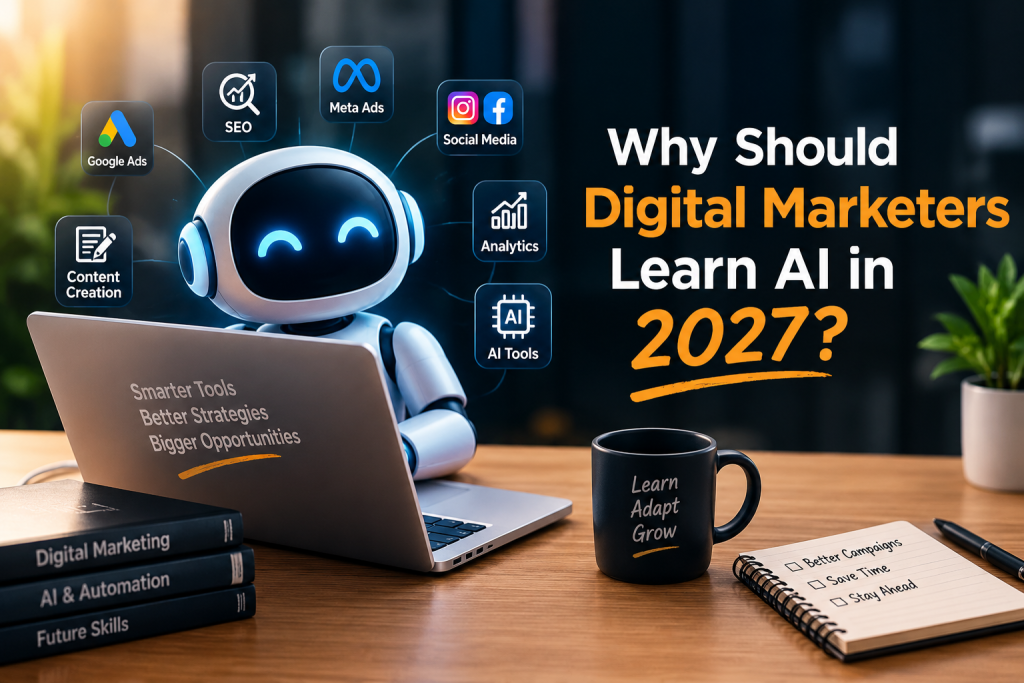
Why Should Digital Marketers Learn AI in 2027?
AI for Digital Marketers is becoming an essential skill as artificial intelligence continues to transform how businesses attract, engage, and convert customers. From content creation and search engine optimization to paid advertising, social media management, and data analysis, AI is changing the way digital marketing tasks are planned and executed. As a result, digital marketers who understand how to use AI effectively can work more efficiently while making better data-driven decisions.
However, learning AI does not mean replacing creativity, strategy, or human judgment. Instead, AI can be used as a powerful assistant that helps marketers save time, understand audiences, generate ideas, and optimize campaigns. Therefore, learning AI for Digital Marketers in 2027 can help professionals stay relevant in an increasingly technology-driven marketing environment.
What Is AI for Digital Marketers?
AI for Digital Marketers refers to the use of artificial intelligence tools and technologies to improve different areas of digital marketing. These technologies can analyze large amounts of data, identify patterns, generate content, automate repetitive activities, and provide insights that can support marketing decisions.
For example, AI can assist a marketer in generating content ideas, analyzing search intent, creating ad variations, identifying audience segments, and studying campaign performance. Consequently, marketers can spend less time on repetitive tasks and more time developing strategies.
Moreover, AI is not limited to one particular marketing channel. It can be applied across:
- Search Engine Optimization (SEO)
- Google Ads and paid advertising
- Social media marketing
- Content marketing
- Email marketing
- Market research
- Customer analysis
- Conversion optimization
- Marketing analytics
- Website personalization
As these applications continue to expand, AI knowledge is becoming increasingly valuable for modern digital marketers.
Why Should Digital Marketers Learn AI in 2027?
The digital marketing industry is constantly changing. Search engines are evolving, advertising platforms are becoming more automated, and customers are interacting with brands across multiple digital channels.
Therefore, marketers need to continuously upgrade their skills. Here are some important reasons why AI for Digital Marketers will matter in 2027.
1. AI Can Automate Repetitive Marketing Tasks
Digital marketers often spend considerable time performing repetitive activities. These may include creating content variations, organizing campaign data, generating reports, researching keywords, and preparing social media ideas.
AI tools can assist with many of these activities. As a result, marketers can reduce manual effort and focus more on planning, creativity, and optimization.
For instance, instead of manually creating multiple ad-copy variations, a marketer can use AI to generate initial versions and then improve them according to the brand’s tone and campaign objectives.
However, human review should still be maintained because AI-generated output may contain inaccuracies, generic messaging, or information that does not match the brand.
2. AI Can Improve Content Creation
Content continues to play an important role in digital marketing. Nevertheless, consistently producing useful and relevant content can be time-consuming.
This is where AI for Digital Marketers can become useful.
AI can support marketers during different stages of the content process, including:
- Topic research
- Content ideation
- Headline generation
- Content outlines
- Social media captions
- Ad copy variations
- Video scripts
- Content repurposing
- Content optimization
For example, a long-form blog can be converted into social media posts, video ideas, email content, and short-form scripts with the assistance of AI.
However, quality should remain the priority. AI-generated content should be reviewed, fact-checked, edited, and improved with genuine expertise and brand-specific insights.
3. AI Is Changing SEO and Search
Search engine optimization is also being influenced by artificial intelligence. Search engines increasingly understand context, intent, relationships between topics, and the overall usefulness of content.
Therefore, SEO professionals cannot rely only on traditional keyword placement.
A modern SEO strategy should focus on understanding:
- Search intent
- Topic relevance
- Content quality
- User experience
- Helpful information
- Website performance
- Entity and semantic relationships
- Real user needs
AI for Digital Marketers can help SEO professionals analyze search queries, discover content gaps, organize topics, and understand patterns in large datasets.
At the same time, AI should not be treated as a shortcut for producing large quantities of low-value content. Instead, it should be used to support research and strategic decision-making.
4. AI Can Support Google Ads and Performance Marketing
Paid advertising is another area where AI is becoming increasingly important.
Advertising platforms already use automation and machine learning to assist with bidding, targeting, optimization, and campaign performance. Consequently, digital marketers need to understand not only how to create campaigns but also how automated systems work.
With AI for Digital Marketers, professionals can use AI tools to assist with:
- Keyword research
- Ad-copy ideas
- Audience research
- Campaign analysis
- Performance reporting
- Search-term analysis
- Landing-page ideas
- Conversion analysis
For example, a Google Ads professional can use AI to organize campaign data and identify patterns that may require further investigation.
However, AI-generated recommendations should not automatically be accepted. Campaign goals, conversion quality, budget, audience behavior, and business objectives must still be evaluated by the marketer.
5. AI Can Help Marketers Understand Customers Better
Successful marketing begins with understanding the customer.
Previously, marketers often had to manually analyze large amounts of customer data. Today, AI can help identify patterns across customer interactions, search behavior, campaign responses, and other available data.
As a result, marketers can develop a better understanding of:
- Customer interests
- Common questions
- Buying behavior
- Content preferences
- Audience segments
- Customer pain points
- Campaign responses
For example, if a business receives hundreds of customer inquiries, AI-assisted analysis can help categorize common questions and identify frequently mentioned problems.
Consequently, marketing messages can be made more relevant and customer-focused.
6. AI Can Improve Marketing Personalization
Customers increasingly expect brands to provide relevant experiences. Generic communication may not always generate the same level of engagement.
Therefore, personalization has become an important part of modern marketing.
AI can help marketers analyze customer information and identify patterns that can be used to create more relevant marketing experiences.
For example, different customer groups can be presented with different content, offers, or communication based on their interests and behavior.
However, personalization should be implemented responsibly. Customer privacy, consent, data protection, and transparency should always be considered.
7. AI Skills Can Increase Digital Marketing Productivity
One of the biggest advantages of learning AI for Digital Marketers is improved productivity.
A marketer who knows how to use AI effectively can potentially complete certain tasks faster than someone who performs everything manually.
For instance, AI can assist with:
Research → Ideas → Drafting → Analysis → Optimization → Reporting
This does not mean that every marketing activity should be automated. Instead, AI should be used where it creates genuine efficiency.
As a result, marketers can dedicate more time to strategy, creative thinking, client communication, campaign planning, and business growth.
8. AI Knowledge Can Make Digital Marketers More Adaptable
Digital marketing is not a static career field. Platforms, algorithms, tools, consumer behavior, and advertising technologies continue to evolve.
Therefore, marketers who develop a learning mindset can adapt more easily to industry changes.
Learning AI for Digital Marketers is not simply about mastering one AI tool. Instead, it is about understanding how artificial intelligence can be applied to marketing problems.
Tools may change over time. However, the ability to understand technology, evaluate its output, and apply it strategically can remain valuable.
What AI Skills Should Digital Marketers Learn in 2027?
Digital marketers do not necessarily need to become AI engineers. Instead, they should focus on developing practical AI skills that can improve productivity, support better decision-making, and enhance marketing performance. As AI continues to evolve, these skills can help marketers stay updated with changing industry trends and technologies.
1. AI Prompting
AI prompting is one of the most important skills for modern marketers. It refers to the ability to give clear, specific, and detailed instructions to AI tools in order to generate useful outputs. A well-written prompt can help marketers create better content ideas, ad copies, social media captions, email drafts, keyword lists, and marketing strategies.
For example, instead of asking an AI tool to “write an ad,” marketers can provide detailed instructions regarding the target audience, tone, platform, objectives, and call-to-action. Consequently, the quality and relevance of the output can improve significantly. Therefore, learning prompt engineering can become a valuable skill for digital marketers in 2027.
2. AI-Assisted Content Creation
Content remains a key part of digital marketing, and AI can support marketers throughout the content creation process. AI tools can help generate blog outlines, social media captions, email campaigns, ad copies, video scripts, and content ideas within a short period of time.
However, AI should not be viewed as a replacement for creativity. Instead, it should be used as a tool that supports research, drafting, and idea generation. Human editing, fact-checking, and brand-specific customization should still be applied to ensure quality and authenticity. As a result, marketers can create content more efficiently while maintaining originality and relevance.
3. AI for SEO
Search engine optimization is evolving rapidly, and AI is becoming an important part of modern SEO strategies. AI tools can help marketers identify keyword opportunities, analyze search intent, discover content gaps, perform competitor analysis, and organize content into topic clusters.
In addition, AI can assist in understanding user behavior and identifying emerging search trends. However, successful SEO still depends on creating valuable, user-focused content rather than relying solely on automation. Therefore, marketers who understand how to combine AI insights with SEO best practices can improve their content strategies and adapt to future search engine changes.
4. AI for Advertising
AI is increasingly being used in digital advertising platforms such as Google Ads and Meta Ads. Marketers can use AI to generate ad-copy variations, analyze campaign performance, identify audience segments, and optimize advertising strategies.
Moreover, AI can support data-driven decisions by identifying patterns that may not be easily visible through manual analysis. However, campaign goals, budgets, and business objectives should always be evaluated by marketers before implementing AI recommendations. Therefore, understanding AI in advertising can help marketers improve campaign efficiency and make more informed decisions.
5. AI Data Analysis
Modern marketing generates a large amount of data, including website traffic, customer behavior, campaign performance, and audience interactions. Analyzing this information manually can be time-consuming.
AI can simplify data analysis by identifying trends, highlighting opportunities, and generating reports. For example, AI tools can help marketers understand which campaigns are performing better, which audience segments are more engaged, and where improvements can be made. Consequently, marketers can make faster and more accurate decisions based on available data.
6. AI Automation
Many marketing activities involve repetitive tasks such as scheduling social media posts, sending emails, generating reports, organizing leads, and updating customer information. AI-powered automation tools can simplify these processes and reduce manual effort.
As a result, marketers can save time and focus on strategic activities such as planning campaigns, improving customer experiences, and creating innovative marketing ideas. However, automation should be monitored carefully to ensure accuracy and maintain a human touch where needed.
In the future, marketers who understand AI automation can improve efficiency, increase productivity, and manage marketing workflows more effectively. Therefore, AI automation is expected to become an essential skill for digital marketers in 2027.
Will AI Replace Digital Marketers?
One of the biggest questions surrounding artificial intelligence is whether AI will replace digital marketers in the future. AI can already generate content, analyze marketing data, suggest keywords, create ad variations, and automate repetitive tasks. However, digital marketing involves much more than completing these activities. Successful marketing also requires creativity, strategic thinking, customer understanding, communication, brand knowledge, and the ability to make decisions according to specific business goals. For example, AI may suggest several advertising ideas, but a digital marketer still needs to decide which message is appropriate for the target audience, brand identity, budget, and campaign objective. Therefore, AI can assist marketers with execution and analysis, but human judgment remains an important part of effective marketing.
Instead of replacing digital marketers completely, AI is more likely to change how digital marketers work. Marketers who learn AI for Digital Marketers can use AI tools to reduce repetitive work, analyze information faster, generate ideas, and improve marketing workflows. Consequently, they can spend more time on strategy, creativity, campaign planning, customer relationships, and performance optimization. However, AI-generated information should still be reviewed, fact-checked, and refined before it is used professionally. In this way, the future of digital marketing is not simply about choosing between AI and human expertise; it is about combining AI capabilities with digital marketing knowledge and human creativity to create more effective and meaningful marketing strategies.
How Can Beginners Start Learning AI for Digital Marketing?
Beginners do not need to learn every AI tool available in the market. Since new tools are being introduced regularly, trying to master everything at once can create confusion. Instead, beginners should first build a strong foundation in digital marketing and then gradually learn how AI can be applied to different marketing activities. A practical, step-by-step approach can make the learning process easier and more effective.
Step 1: Learn Digital Marketing Fundamentals
Before learning AI, it is important to understand the fundamentals of digital marketing. Beginners should become familiar with SEO, social media marketing, Google Ads, Meta Ads, content marketing, email marketing, analytics, and conversion optimization. This foundation helps marketers understand where AI can actually be useful. Without basic marketing knowledge, it can be difficult to evaluate whether an AI-generated suggestion is relevant to a campaign or business objective.
Step 2: Understand AI Fundamentals
Once the digital marketing basics are clear, beginners can start learning how artificial intelligence works in a marketing context. They do not need advanced technical or programming knowledge initially. Instead, they should understand concepts such as generative AI, AI-powered tools, automation, machine learning, and AI-assisted data analysis. This knowledge can help marketers understand what AI can do, where it can be applied, and where human judgment is still required.
Step 3: Practice AI With Real Marketing Tasks
The best way to learn AI for Digital Marketers is through practical application. Instead of only watching tutorials or reading about AI tools, beginners should use them for actual marketing activities. For example, they can practice keyword research, content planning, social media ideas, ad-copy creation, competitor research, audience analysis, and campaign reporting. As they work on these tasks, they can gradually understand which AI tools and techniques are genuinely useful for different marketing situations.
Step 4: Review and Verify AI-Generated Output
AI can save time, but its output should not be accepted blindly. Sometimes, AI-generated information may be outdated, inaccurate, too generic, or unsuitable for a particular audience. Therefore, marketers should develop the habit of reviewing and fact-checking AI-generated content before using it professionally. Content should also be edited according to the brand’s tone, target audience, marketing objective, and industry requirements. This human review helps maintain accuracy, originality, and quality.
Step 5: Build Practical Marketing Projects
Finally, beginners should apply their knowledge by creating practical projects. They can develop a sample SEO strategy, create a Google Ads campaign plan, prepare a social media content calendar, analyze a marketing dataset, or build a complete AI-assisted digital marketing campaign. Working on such projects helps learners understand how different skills work together in real marketing situations. Moreover, these projects can become part of a portfolio and demonstrate practical knowledge to potential employers or clients.
By following these steps consistently, beginners can gradually develop both digital marketing expertise and AI skills. Rather than focusing on learning every new AI tool, the goal should be to understand how AI can solve real marketing problems and improve the overall effectiveness of digital marketing strategies.
Learn AI-Integrated Digital Marketing at HIDM
For students and beginners who want to build a career in digital marketing,Hisar Institute of Digital Marketing (HIDM)provides an AI-integrated Digital Marketing Course designed to combine digital marketing fundamentals with modern AI applications.
The course covers important areas of digital marketing, including SEO, SEM, Social Media Marketing, Google Ads, Meta Ads, and AI tools. In addition, students receive practical exposure through live projects and hands-on learning.
HIDM’s approach focuses on learning digital marketing from the basics and gradually developing practical skills. Furthermore, students can receive mentor support, one-to-one sessions, and doubt-clearing sessions during their learning journey.
For students who want to understand AI for Digital Marketers while developing practical digital marketing capabilities, an AI-integrated learning environment can provide a structured way to explore both areas together.
The objective should not be simply to learn AI tools. Instead, students should understand when, why, and how AI should be used in digital marketing.
The Future of AI for Digital Marketers
The relationship between artificial intelligence and digital marketing is expected to become even stronger. Marketing platforms will continue to introduce automation, while AI-powered tools will become more integrated into everyday workflows.
Consequently, digital marketers will need to develop a combination of marketing knowledge, analytical thinking, creativity, and AI skills.
Those who continuously learn and experiment with new technologies can adapt their workflows as the industry changes. However, technology alone will not create successful marketing campaigns. Human strategy, customer understanding, creativity, and responsible decision-making will continue to matter.
Therefore, AI for Digital Marketers should be viewed as a skill that complements marketing expertise rather than replacing it.
Conclusion
Learning AI for Digital Marketers in 2027 can help professionals improve productivity, understand customers, support SEO and advertising activities, analyze data, and adapt to changing digital marketing practices.
However, the real value of AI comes from using it strategically. Marketers should learn how to combine AI capabilities with human creativity, marketing fundamentals, critical thinking, and business understanding.
As digital marketing continues to evolve, learning AI can become an important part of staying professionally adaptable. For beginners, students, and working professionals, developing these skills through practical projects and structured training can create a stronger foundation for the future of digital marketing.
The future is not simply about AI replacing marketing. It is about marketers learning how to use AI effectively.