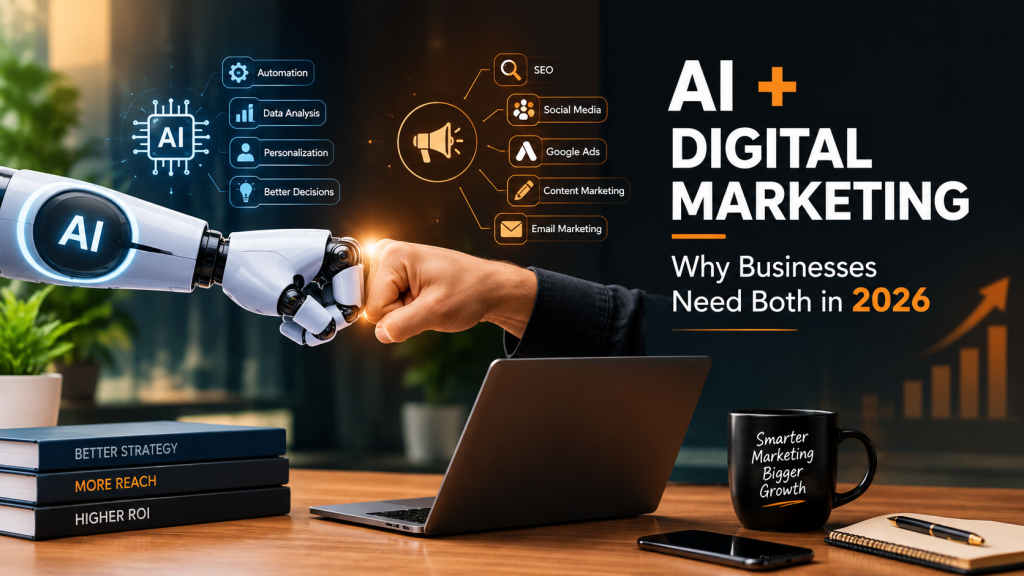
AI + Digital Marketing: Why Businesses Need Both in 2027
Businesses are increasingly adopting AI in Digital Marketing to improve efficiency, understand customers, create better campaigns, and make data-driven decisions. However, AI is not replacing digital marketing; instead, it is being integrated into existing marketing strategies to make them faster, smarter, and more scalable. In 2027, businesses that combine artificial intelligence with digital marketing are expected to have more opportunities to improve customer experiences and optimise their online presence.
Digital marketing already includes several important activities, such as SEO, paid advertising, social media marketing, content marketing, email marketing, website optimisation, and analytics. When AI is added to these activities, repetitive work can be automated, large amounts of data can be analysed more efficiently, and marketing decisions can be supported with useful insights.
Therefore, understanding the connection between AI in Digital Marketing and traditional marketing practices has become increasingly important for modern businesses.
What Is AI in Digital Marketing?
AI in Digital Marketing refers to the use of artificial intelligence technologies to support, automate, and improve different digital marketing activities.
AI-powered systems can be used to analyse customer behaviour, identify patterns, generate content ideas, assist with advertising, personalise experiences, and provide marketing insights.
For example, customer data can be analysed by AI tools to identify common behaviours and preferences. Similarly, advertising campaigns can be monitored so that areas requiring optimisation can be identified more quickly.
However, AI should be considered a marketing support system rather than a complete replacement for human expertise. Strategy, creativity, brand understanding, and decision-making are still important.
Why Do Businesses Need AI and Digital Marketing Together?
The digital marketplace has become increasingly competitive. As a result, businesses are expected to reach customers across search engines, social media platforms, websites, email, and paid advertising channels.
At the same time, customers expect relevant information and faster responses. Therefore, traditional digital marketing processes can be supported with AI to improve efficiency.
Here are some important reasons why businesses need both.
1. Faster Marketing Research
Market research can require a significant amount of time when it is performed manually. Customer behaviour, competitors, keywords, trends, and online conversations may need to be studied before a campaign is launched.
With AI in Digital Marketing, large amounts of information can be processed more efficiently.
For instance, AI tools can be used to identify content trends, analyse search behaviour, generate research ideas, and organise large datasets. As a result, marketers can spend more time developing strategies instead of performing repetitive research tasks.
2. Better Customer Understanding
Understanding customers is one of the most important parts of digital marketing.
Customer interactions are generated through websites, social media, advertisements, emails, and other digital channels. Therefore, a considerable amount of information can be collected.
AI can help this information to be analysed so that common patterns can be identified. Customer preferences, engagement behaviour, and possible interests can then be better understood.
Consequently, marketing messages can be made more relevant to specific audiences.
3. AI-Powered Content Creation
Content is still an important part of digital marketing. Blogs, social media posts, advertisements, product descriptions, videos, and emails are regularly created by businesses.
However, producing content consistently can require considerable time.
AI tools can be used to generate ideas, create initial drafts, develop headlines, prepare content outlines, and assist with editing. Therefore, the content creation process can be accelerated.
At the same time, human review should be maintained because brand voice, accuracy, originality, and audience understanding need to be controlled.
4. Improved SEO Strategies
Search engine optimisation continues to play an important role in online visibility.
With AI in Digital Marketing, several SEO tasks can be supported, including keyword research, content analysis, search intent analysis, competitor research, content optimisation, and topic discovery.
For example, AI can be used to identify related topics and questions that may be relevant to a target audience. These insights can then be incorporated into a properly structured SEO strategy.
However, SEO should not be reduced to simply producing AI-generated content. Quality, relevance, helpfulness, technical optimisation, and user experience still need to be considered.
5. Smarter Paid Advertising
Paid advertising requires continuous monitoring and optimisation.
Google Ads and Meta Ads campaigns generate large amounts of performance data. Therefore, AI can be used to assist marketers in identifying patterns and potential optimisation opportunities.
For example, campaign data can be analysed to understand which audiences, keywords, advertisements, or placements are generating better results.
As a result, advertising decisions can become more data-driven.
Still, campaign objectives and business goals should be defined by marketers before AI-supported optimisation is applied.
How AI Is Changing Different Areas of Digital Marketing
The impact of AI in Digital Marketing can be seen across multiple marketing channels.
1. AI in SEO
SEO strategies are becoming increasingly data-driven. AI can assist with keyword research, content planning, competitor analysis, search intent research, and optimisation.
Moreover, AI can help marketers discover content gaps and organise large keyword sets more efficiently.
2. AI in Social Media Marketing
Social media management involves content planning, audience engagement, performance analysis, and trend monitoring.
AI can assist with content ideas, captions, scheduling recommendations, audience analysis, and performance insights.
Consequently, social media teams can reduce repetitive work and focus more on creative strategy and community engagement.
3. AI in Google Ads
Google Ads campaigns can involve keyword research, ad copy creation, audience analysis, bidding strategies, and performance monitoring.
AI-powered features can assist with campaign optimisation and audience targeting. However, business objectives and campaign direction should still be monitored by experienced marketers.
4. AI in Meta Ads
Meta advertising also relies heavily on audience data and campaign performance.
AI can support creative variations, audience analysis, campaign optimisation, and performance interpretation. Therefore, advertisers can test and improve campaigns more efficiently.
5. AI in Email Marketing
Email marketing can also benefit from AI.
Customer behaviour can be analysed to identify suitable content, timing, and segmentation opportunities. Personalised email experiences can then be developed for different customer groups.
As a result, communication can become more relevant and targeted.
6. AI in Website Optimisation
A website is often the central point of a digital marketing strategy.
AI can assist with analysing user behaviour, identifying possible usability issues, generating content suggestions, and understanding website performance.
Therefore, website improvements can be planned using a combination of analytics and AI-supported insights.
Benefits of Using AI in Digital Marketing
The use of AI in Digital Marketing can help businesses improve the efficiency, accuracy, and scalability of their marketing activities. When artificial intelligence is integrated with a well-planned digital marketing strategy, repetitive tasks can be reduced, valuable insights can be identified, and customer experiences can be improved.
1. Increased Efficiency
Many digital marketing tasks are repetitive and time-consuming when performed manually. With AI-powered tools, tasks such as content research, data analysis, reporting, and campaign monitoring can be automated or completed more efficiently.
As a result, marketers can spend more time on strategic planning, creative development, and business decision-making rather than routine activities.
Data-Driven Decision-Making
A significant amount of data is generated through websites, search engines, social media platforms, and advertising campaigns. Analysing this information manually can be difficult and time-consuming.
However, AI in Digital Marketing can be used to process large volumes of data and identify useful patterns and trends. Consequently, marketers can make more informed decisions based on customer behaviour, campaign performance, and other relevant marketing data.
2. Better Personalisation
Customers increasingly expect brands to provide relevant and personalised experiences. AI can help businesses analyse customer interests, preferences, and online behaviour to develop more targeted marketing communication.
For example, content, advertisements, product recommendations, and email campaigns can be tailored for different audience segments. Therefore, customers can be presented with information that is more relevant to their needs and interests.
3. Improved Productivity
AI tools can support marketers throughout different stages of the marketing process. Content ideas can be generated, research can be organised, reports can be prepared, and campaign data can be analysed with greater efficiency.
As a result, marketing teams can complete more tasks within the same amount of time while maintaining greater focus on strategy and execution.
4. Scalable Marketing
As a business grows, its marketing activities also become more complex. More customers, campaigns, content, and data need to be managed across multiple digital channels.
AI can help businesses handle these increasing requirements by supporting repetitive processes and analysing larger volumes of information. Therefore, marketing operations can be scaled more efficiently without creating the same level of increase in manual workload.
5. Faster Customer Insights
Understanding customer behaviour is essential for creating effective marketing strategies. AI can help analyse interactions across different digital channels and identify patterns in customer behaviour.
Consequently, businesses can gain useful insights into what their audiences are searching for, engaging with, and responding to. These insights can then be used to improve content, advertising, and overall marketing strategies.
6. Improved Marketing Optimisation
Digital marketing campaigns require continuous monitoring and improvement. AI can assist marketers in identifying performance patterns and potential areas for optimisation.
For instance, advertising performance, audience engagement, website behaviour, and content performance can be analysed more efficiently. As a result, marketing strategies can be adjusted according to actual performance data rather than assumptions.
AI Does Not Replace Digital Marketers
One common misconception about AI in Digital Marketing is that artificial intelligence will completely replace digital marketers. However, AI is better understood as a powerful technology that can support marketers rather than replace their expertise.
AI can be used to process large amounts of information, identify patterns, automate repetitive tasks, generate ideas, and provide useful insights. At the same time, important marketing decisions still need to be guided by human experience and business objectives.
1. Human Expertise Still Matters
Although many marketing tasks can be supported by AI, human involvement is still required for areas such as brand positioning, creative direction, strategic planning, audience understanding, and ethical decision-making.
For example, an AI tool may be used to generate content ideas, but the final message should be reviewed according to the brand’s tone, target audience, and marketing goals. Similarly, campaign recommendations generated through AI should be evaluated before they are implemented.
2. AI and Marketers Can Work Together
Rather than replacing digital marketers, AI can be integrated into their existing workflows. Repetitive tasks can be automated, large datasets can be analysed, and useful insights can be generated more quickly. As a result, marketers can focus more on strategy, creativity, communication, and decision-making.
Moreover, the effectiveness of AI in Digital Marketing depends on how effectively it is used. When AI-generated outputs are reviewed, refined, and aligned with business goals, better marketing processes can be developed.
3. The Future of Digital Marketing
As AI technology continues to develop, digital marketers will increasingly be expected to understand how these tools can be used effectively. Therefore, learning AI alongside digital marketing skills can help marketers adapt to changing industry requirements.
Ultimately, AI should not be viewed simply as a replacement for digital marketers. Instead, it can be used as a productivity and decision-support technology that works alongside human expertise. The combination of AI capabilities and human creativity can help businesses build more efficient, relevant, and scalable digital marketing strategies.
Challenges of Using AI in Digital Marketing
Although AI in Digital Marketing can provide significant benefits, several challenges should also be considered before it is implemented. AI can improve efficiency and support decision-making; however, its outputs still need to be reviewed and managed carefully.
1. Accuracy and Reliability
AI-generated information may not always be completely accurate or relevant to a specific business situation. In some cases, incorrect information or outdated data may be generated.
Therefore, important information should be verified before it is published, shared with customers, or used for business decisions. In addition, AI-generated content should be reviewed by a knowledgeable professional to ensure that accuracy and quality are maintained.
2. Maintaining Brand Consistency
Every business has its own brand identity, communication style, and tone of voice. However, AI-generated content may not automatically reflect these characteristics.
As a result, content created with AI should be reviewed and edited according to established brand guidelines. Furthermore, human input should be maintained so that the brand’s personality, message, and values remain consistent across different digital channels.
3. Data Privacy and Security
AI tools often require data to generate insights and perform different marketing tasks. Therefore, customer and business information needs to be handled carefully.
Sensitive information should not be shared with AI tools without proper consideration of applicable privacy and security requirements. Moreover, businesses should establish clear guidelines for how customer data is collected, processed, stored, and used.
4. Risk of Overdependence on AI
Although many marketing activities can be automated with AI, excessive dependence on technology can create challenges. If every task is handled automatically, human creativity, critical thinking, and strategic decision-making may be reduced.
Therefore, AI should be used as a support system rather than as the only decision-maker. Instead, human expertise should be combined with AI capabilities so that marketing decisions remain strategic, creative, and aligned with business objectives.
5. Need for Human Review
AI can assist with research, content creation, analysis, and optimisation; however, human supervision is still important. AI-generated recommendations should be evaluated before they are implemented.
Consequently, businesses can benefit from the efficiency of AI in Digital Marketing while maintaining quality, accuracy, creativity, and responsible decision-making.
How Businesses Can Start Using AI in Digital Marketing
Businesses do not need to adopt every AI tool available in the market. Instead, AI in Digital Marketing can be introduced gradually by identifying specific business requirements and selecting tools that can provide practical value.
A structured approach should be followed so that AI can be integrated into existing marketing processes without creating unnecessary complexity. Moreover, its performance should be monitored regularly so that improvements can be made when required.
Step 1: Identify Repetitive and Time-Consuming Tasks
The first step is to identify marketing activities that require significant amounts of time and are performed repeatedly.
For example, content research, basic reporting, data organisation, keyword analysis, social media planning, and campaign monitoring may involve repetitive work. These activities should be reviewed to determine where AI can provide useful support.
As a result, businesses can focus their AI implementation on specific problems instead of trying to automate the entire marketing process at once.
Step 2: Select AI Tools According to Business Requirements
Once repetitive tasks have been identified, suitable AI tools should be selected according to the actual requirements of the business.
Different tools are designed for different purposes. Some can be used for content creation, while others can support data analysis, customer service, advertising, SEO, or workflow automation.
Therefore, tools should not be selected simply because they are popular or trending. Instead, their features, usability, security, cost, and potential business value should be evaluated before implementation.
Step 3: Combine AI With Human Expertise
AI should not be used as the only source of marketing decisions. Instead, AI-generated information and recommendations should be reviewed by experienced marketing professionals.
For example, an AI tool may generate a blog outline, advertisement copy, or campaign recommendation. However, the final output should be checked for accuracy, brand consistency, audience relevance, and business objectives.
Furthermore, human creativity and strategic thinking should be maintained throughout the process. This allows businesses to benefit from AI while ensuring that marketing activities remain aligned with their overall strategy.
Step 4: Measure Marketing Performance
After AI has been integrated into marketing activities, its effectiveness should be measured using relevant performance indicators.
Depending on the business objective, metrics such as website traffic, leads, conversions, engagement, advertising performance, cost per lead, and return on investment can be monitored.
For instance, if AI is being used to support paid advertising, changes in campaign performance can be compared before and after implementation. Consequently, businesses can identify whether the technology is actually contributing to better marketing outcomes.
Step 5: Improve and Optimise Continuously
AI technology is developing rapidly, and new tools and features are being introduced regularly. Therefore, businesses should not treat AI implementation as a one-time process.
Marketing workflows should be reviewed periodically, and the performance of AI-supported activities should be evaluated. In addition, ineffective tools or processes can be replaced when better solutions become available.
By continuously testing, measuring, and improving their approach, businesses can make AI in Digital Marketing a practical part of their long-term marketing strategy.
Why Businesses Need an AI-Integrated Digital Marketing Strategy in 2027
In 2027, digital marketing is expected to remain highly competitive. Businesses will need to manage multiple channels while also responding to changing customer behaviour.
Therefore, combining digital marketing fundamentals with AI capabilities can provide a structured way to improve marketing operations.
SEO can be supported by AI-driven research. Paid advertising can be assisted through data analysis. Social media content can be planned more efficiently. Customer behaviour can be studied at scale. Website performance can also be analysed more effectively.
However, successful implementation will depend on how strategically these technologies are used.
Jugaadin Digital Services Pvt. Ltd. – AI-Enabled Digital Marketing Services
For businesses looking to build a strong online presence, Jugaadin Digital Services Pvt. Ltd. (JDSPL) provides digital marketing services designed to support different online business requirements.
JDSPL works as a full-service digital marketing company, where multiple digital marketing services can be managed under one platform. AI tools and modern technologies can also be integrated into marketing workflows to improve research, content development, campaign management, analysis, and optimisation.
The services can include:
- Search Engine Optimisation (SEO)
- Google Ads Management
- Meta Ads Management
- Social Media Marketing
- Website Design and Development
- Content Creation and Marketing
- Lead Generation
- Online Brand Promotion
- Digital Marketing Strategy
- AI-assisted Marketing Solutions
By combining digital marketing expertise with AI-supported workflows, businesses can work towards improving their online visibility, generating leads, reaching relevant audiences, and building a stronger digital presence.
Instead of using AI separately from marketing, businesses can integrate it into their overall digital strategy. This approach allows technology and human expertise to work together.
Conclusion
AI in Digital Marketing is becoming an important part of modern business strategies. From SEO and content creation to paid advertising, social media, analytics, and customer personalisation, AI can support marketers across multiple areas.
However, AI should not be treated as a replacement for digital marketing expertise. Instead, it should be integrated with human creativity, strategic thinking, industry knowledge, and business objectives.
As businesses prepare for 2027, the combination of AI + Digital Marketing can be used to create more efficient, data-driven, and scalable marketing processes.
Businesses that want to strengthen their online presence can consider working with an experienced digital marketing service provider such as Jugaadin Digital Services Pvt. Ltd. (JDSPL), where digital marketing services can be supported through modern AI-enabled approaches.
The future of digital marketing is not simply about using AI. It is about using AI strategically to make digital marketing more effective.