Introduction
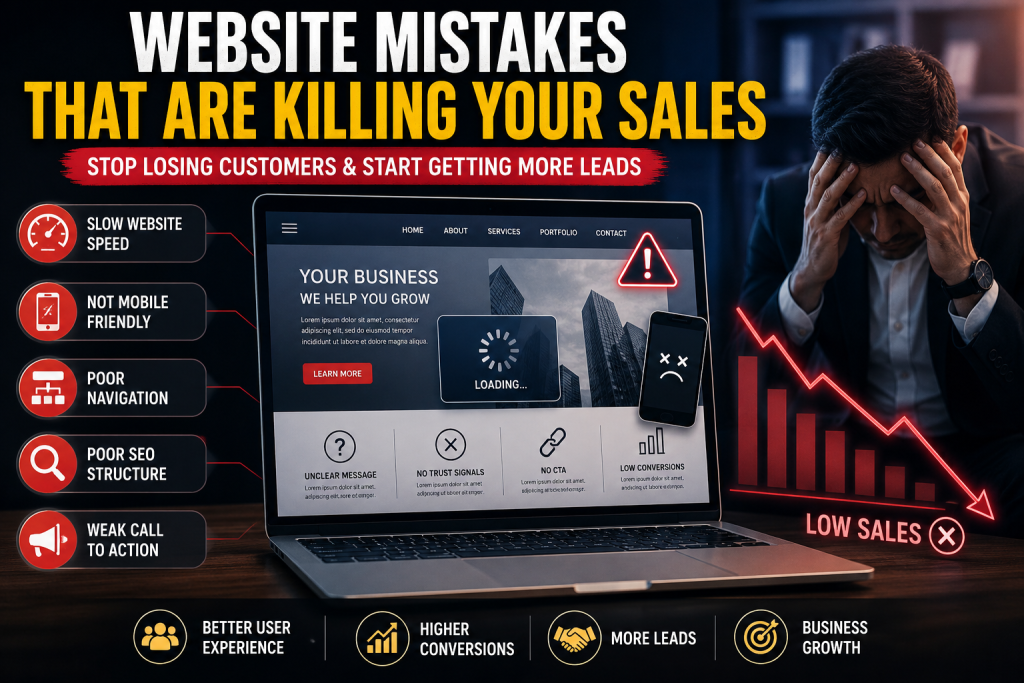
If your website is getting visitors but generating very few enquiries or customers, Website Mistakes could be the reason. A website is more than an online presence. It should attract the right audience, build trust, explain your services clearly and encourage visitors to take action. However, even small problems with design, SEO, speed, content or navigation can make potential customers leave without contacting your business. Therefore, identifying and fixing these website mistakes is essential for improving conversions and generating more leads.
For businesses investing in digital marketing, a high-performing website is especially important. After all, your SEO, Google Ads, social media and other marketing efforts ultimately bring users to your website. If the website fails to convert them, your marketing budget can be wasted.
In this guide, we will discuss the most common website mistakes that can hurt your sales and explain how you can fix them.
What Are Website Mistakes That Kill Sales?
Website mistakes are problems in website design, content, SEO, performance, navigation or user experience that prevent visitors from becoming leads or customers.
For example, a website may have excellent services, but if visitors cannot understand what the business offers within a few seconds, they may leave. Similarly, a slow website, confusing navigation or missing call-to-action can reduce conversions.
Therefore, businesses should regularly analyse their websites and identify areas that need improvement.
1. Having No Clear Call-to-Action
One of the biggest website mistakes is failing to tell visitors what they should do next.
A visitor may read your services, explore your website, and become interested in your business. However, if there is no clear next step, they may simply leave.
For example, buttons such as:
- Get a Free Consultation
- Call Us Today
- Request a Quote
- Talk to an Expert
- Get Started
- Contact Us
can encourage visitors to take action.
Therefore, every important page should have a relevant and visible call-to-action. Moreover, your CTA should match the visitor’s intent.
For example, a service page can use “Get a Free Consultation”, while a product page can use “Buy Now” or “Request a Quote.”
2. A Slow-Loading Website
Website speed has a direct impact on user experience. If your website takes too long to load, visitors may leave before they even see your content.
This is especially important because people increasingly browse websites using smartphones. Therefore, businesses need to make sure their pages load quickly across different devices and internet connections.
Large images, unnecessary scripts, excessive plugins, poor hosting, and unoptimized website elements can slow down a website.
Consequently, a slow website can result in:
- Higher bounce rates
- Fewer enquiries
- Poor user experience
- Lower search visibility
- Lost sales opportunities
You should regularly check your website performance and optimize images, code, caching, and other technical elements.
3. Poor Mobile Experience
Another major mistake is designing a website mainly for desktop users.
Today, potential customers often discover businesses through Google, social media, advertisements, and messaging platforms using their smartphones. Therefore, your website must provide a smooth mobile experience.
If text is too small, buttons are difficult to click, images do not fit the screen, or visitors need to scroll horizontally, they may quickly leave.
A mobile-friendly website should have:
- Responsive design
- Easy-to-read text
- Simple navigation
- Properly sized buttons
- Fast loading speed
- Mobile-friendly forms
Moreover, test your website on different screen sizes regularly instead of assuming that it works perfectly.
4. Complicated Website Navigation
Visitors should not have to search everywhere to find important information.
Complicated navigation is one of the website mistakes that can create unnecessary friction. If customers cannot quickly find your services, pricing, contact details, or important information, they may move to a competitor.
Keep your main navigation simple.
For example:
Home → About → Services → Portfolio → Blog → Contact
You can also use dropdown menus when you have multiple services. However, avoid adding too many menu options.
Furthermore, important pages should be accessible within a few clicks. The easier it is for users to find information, the more likely they are to stay and convert.
5. Weak or Unclear Website Content
A beautiful website cannot generate consistent leads if its content does not communicate value.
Many businesses use generic statements such as:
“We provide the best quality services.”
However, such statements do not explain why customers should choose the business.
Instead, your website content should answer three important questions:
What do you offer?
Who do you help?
Why should customers choose you?
For example, instead of simply saying that you provide digital marketing services, explain how your services can help businesses generate visibility, leads, enquiries, and growth.
Additionally, use simple language that your target audience understands.
6. Not Building Trust
Customers are more likely to contact businesses they trust.
Therefore, your website should provide evidence that your business is genuine and capable of delivering results.
Trust-building elements can include:
- Client testimonials
- Reviews
- Case studies
- Portfolio
- Certifications
- Awards
- Business information
- Real team photographs
- Previous project results
Moreover, keep your contact information clearly visible.
A professional website should make it easy for potential customers to understand who you are, what you do, and how they can contact you.
7. Ignoring SEO
A website cannot generate organic leads if potential customers cannot find it. Search engine optimization helps businesses improve their visibility when people search for relevant products and services. However, SEO is not simply about adding keywords to a page. It includes technical optimization, content quality, website structure, internal linking, page experience, local SEO, and many other factors.
For example, a local business should optimize its website for relevant location-based searches.
Instead of targeting extremely broad keywords, businesses can focus on relevant search terms that match their services and target customers. Therefore, SEO should be treated as a long-term lead-generation strategy rather than a one-time task.
8. No Dedicated Landing Pages
Sending every visitor to your homepage can reduce conversions.
For example, suppose you are running an advertisement for Google Ads services. If the advertisement takes users to a general homepage where they have to search for the service, there is a greater chance that they will leave.
Instead, create a dedicated landing page for the specific campaign.
A strong landing page should contain:
- Clear headline
- Specific service benefits
- Relevant information
- Social proof
- Strong CTA
- Simple enquiry form
- Contact options
As a result, visitors can immediately understand the offer and take action.
9. Long and Complicated Contact Forms
Another common mistake is asking visitors to provide too much information. A form asking for name, email, phone number, company size, address, job title, budget, industry, and several other details can discourage users. Instead, ask only for the information you genuinely need at the first stage.
For example:
Name + Phone Number + Requirement
may be enough to start a conversation.
Furthermore, provide alternative contact methods such as WhatsApp or phone calls when appropriate. The goal is to make contacting your business as easy as possible.
10. Not Tracking Leads and Conversions
You cannot improve what you do not measure. Many businesses look at website traffic but fail to track what happens after visitors arrive.
For example, you should know:
- How many visitors are coming to your website?
- Which pages receive the most traffic?
- Where are visitors coming from?
- How many people submit forms?
- How many people click WhatsApp?
- Which campaigns generate leads?
- Which pages generate the most enquiries?
Tools such as Google Analytics and Google Search Console can provide valuable insights. Moreover, conversion tracking can help you identify which marketing activities are actually producing business results.
11. Using Too Many Distracting Elements
Your website should guide visitors toward important actions. However, excessive pop-ups, animations, banners, advertisements, and unnecessary design elements can make the experience confusing.
A professional website does not need to be overloaded with visual effects.
Instead, focus on:
Clarity + Trust + Speed + Usability + Conversion
Every design element should have a purpose.
If an element does not help users understand your business or take action, consider removing it.
12. Not Updating Your Website
A website should not be treated as a one-time project.
Outdated information, broken links, old offers, expired promotions, incorrect contact details, and outdated content can damage credibility.
Therefore, review your website regularly.
Update your services, portfolio, testimonials, blog content, contact information, images, and offers whenever necessary.
Additionally, check for broken links and technical issues.
Regular maintenance can improve both user experience and website performance.
How JDSPL Can Help Fix These Website Mistakes
Fixing website problems often requires more than changing a few colours or adding new text. A successful website needs the right combination of web development, SEO, content, user experience and digital marketing.
JDSPL (Jugaadin Digital Services Pvt.Ltd.) can help businesses improve their online presence through digital marketing solutions designed around their business goals.
Whether your business needs better search visibility, more enquiries or stronger online branding, a strategic digital marketing approach can help. Instead of simply driving more traffic, the focus should be on attracting the right visitors and converting them into leads.
Ready to Improve Your Website?
If your website is getting traffic but not enough enquiries, it may be time for a professional website and digital marketing audit.
Contact JDSPL today to identify the problems affecting your website performance and discover opportunities to generate more qualified leads.
👉 Get in touch with JDSPL for a digital marketing consultation.
Conclusion
Your website should help your business generate opportunities, not drive potential customers away. Unfortunately, common website mistakes such as slow loading speed, poor mobile design, unclear CTAs, weak content, complicated navigation, lack of trust signals, and poor SEO can reduce your conversions.
Therefore, review your website regularly and identify the areas that may be preventing visitors from becoming customers.
If your website is getting traffic but not generating enough leads, it may be time to look beyond traffic numbers and focus on conversion-focused optimization.
JDSPL can help businesses build a stronger digital presence with practical digital marketing strategies focused on visibility, engagement, and lead generation.
Ready to turn your website into a lead-generating asset? Contact JDSPL ( Jugaadin Digital Services Pvt. Ltd.) today and discuss your digital marketing requirements.