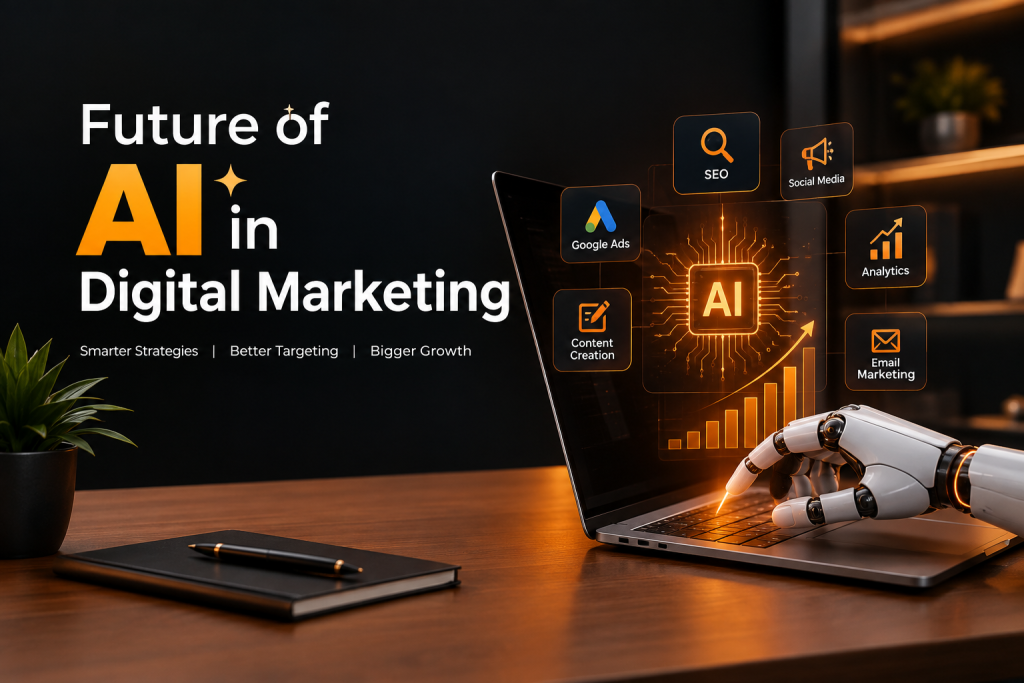
Future of AI in Digital Marketing: Trends, Benefits, Skills & Career Opportunities
Artificial Intelligence is changing the way businesses attract, understand, and engage with customers. Today, AI in Digital Marketing helps marketers research audiences, create content, analyze campaigns, automate repetitive tasks, and make faster data-driven decisions. As AI technology continues to improve, its role in digital marketing is expected to become even more important.
However, AI is not simply replacing traditional marketing methods. Instead, it is helping marketers work faster, understand customers better, and focus more on strategy and creativity. Therefore, students, professionals, business owners, and aspiring digital marketers need to understand how AI works and how they can use it effectively.
In this blog, we will explore the future of AI in Digital Marketing, its major applications, benefits, challenges, upcoming trends, required skills, and career opportunities. We will also understand why learning AI-integrated digital marketing can be a valuable step for anyone planning a career in this field.
What Is AI in Digital Marketing?
AI in Digital Marketing refers to the use of Artificial Intelligence technologies to improve marketing activities and decision-making.
In simple terms, AI enables software and marketing platforms to process large amounts of data, identify patterns, understand customer behaviour, and provide useful predictions or recommendations.
For example, marketers can use AI to:
- Find potential customer segments
- Analyse search and audience data
- Generate content ideas
- Improve advertising campaigns
- Personalise customer experiences
- Automate repetitive marketing tasks
- Analyse campaign performance
- Predict customer behaviour
- Create marketing visuals and videos
- Improve customer support through AI-powered systems
As a result, marketers can spend less time on repetitive work and more time on planning, creativity, and business growth.
Why Is AI Becoming Important in Digital Marketing?
Digital marketing is no longer limited to posting content or running advertisements. Today, businesses interact with customers across multiple platforms, including Google, websites, social media, email, and online advertising platforms. As a result, marketers generate and receive a large amount of data every day.
This data can provide valuable information about what customers are searching for, which products they prefer, which advertisements they respond to, and what type of content they engage with. However, analysing all this information manually can take a significant amount of time. This is where AI in Digital Marketing becomes increasingly important.
1. AI Helps Marketers Understand Large Amounts of Data
One of the biggest advantages of AI is its ability to process and analyse large amounts of data quickly.
For example, an online store may have thousands of website visitors every month. Each visitor can generate information through searches, page views, product clicks, purchases, and other interactions. Analysing all these activities manually can be difficult.
AI can identify patterns in this data and help marketers understand customer behaviour more efficiently. As a result, marketers can make better decisions based on data instead of relying only on assumptions.
2. AI Helps Deliver More Personalised Marketing
Customers do not all have the same interests or needs. Therefore, showing the same advertisement or message to everyone may not always produce the best results.
AI can analyse customer behaviour and help businesses provide more relevant experiences.
For instance, an e-commerce website can recommend products based on a customer’s previous searches, purchases, or interactions. Similarly, an advertising platform can use available signals to help show relevant ads to people who are more likely to take the desired action.
This level of personalisation can make marketing communication more useful and relevant to customers.
3. AI Saves Time Through Automation
Digital marketers often spend a considerable amount of time on repetitive activities such as analysing reports, generating content ideas, organising data, creating variations of ad copy, and monitoring campaigns.
AI can assist with many of these tasks. Consequently, marketers can reduce manual effort and spend more time on activities that require human judgement, creativity, and strategic thinking.
For example, instead of spending hours creating multiple headline variations manually, a marketer can use AI to generate different ideas and then select, edit, and improve the most suitable options.
4. AI Helps Improve Marketing Decisions
Marketing decisions are often based on data. However, large amounts of data can be difficult to understand without the right tools.
AI can help identify trends, patterns, and potential opportunities within marketing data. This can support marketers when they are deciding which audience to target, which content to improve, or where a campaign may need optimisation.
However, AI should not replace human decision-making completely. Instead, marketers should use AI-generated insights as support and combine them with their own knowledge, experience, and understanding of the business.
5. AI Helps Businesses Respond to Changing Customer Expectations
Customer expectations are also changing rapidly. People now expect quick responses, relevant recommendations, personalised content, and convenient online experiences.
For example, customers may want answers to their questions even outside normal business hours. AI-powered chatbots can help businesses respond to common queries instantly. Likewise, AI can support personalised recommendations and automated communication.
Therefore, AI allows businesses to respond to customers more efficiently while maintaining a more personalised experience.
6. AI Is Making Digital Marketing More Efficient
Overall, the importance of AI in Digital Marketing comes from its ability to combine data, automation, personalisation, and predictive insights.
AI can help marketers understand customers better, reduce repetitive work, analyse information faster, and improve marketing decisions. At the same time, human creativity, strategy, communication, and critical thinking remain essential.
Therefore, the future of digital marketing is not about replacing marketers with AI. Instead, it is about helping marketers become more productive and effective by using AI as a powerful supporting technology.
How AI Is Changing Digital Marketing
The impact of AI can already be seen across almost every major area of digital marketing.
1. AI in Search Engine Optimization
SEO is one of the areas where AI is creating significant changes.
Marketers can use AI-powered tools to support:
- Keyword research
- Search intent analysis
- Content planning
- Topic research
- Competitor analysis
- Content optimisation
- Technical SEO analysis
- Content gap identification
However, AI-generated content alone does not guarantee better rankings. Search engines continue to prioritise useful, relevant, trustworthy, and people-focused content.
Therefore, marketers should use AI as an assistant rather than relying on it blindly.
A good SEO professional can combine AI insights with human research, experience, originality, and strong understanding of search intent.
2. AI in Content Marketing
Content marketing requires constant research, planning, writing, editing, and optimisation. AI can support marketers throughout this process.
For example, AI tools can help generate:
- Blog topic ideas
- Content outlines
- Social media ideas
- Headlines
- Ad copy variations
- Email drafts
- Video scripts
- Product descriptions
Furthermore, AI can help marketers analyse existing content and identify opportunities for improvement.
However, human creativity remains essential. A marketer still needs to understand the target audience, brand voice, emotional messaging, facts, and business objectives.
Therefore, the future will not simply belong to people who can generate content with AI. Instead, it will favour people who know how to use AI strategically to create better content.
3. AI in Social Media Marketing
Social media marketers manage multiple platforms, content formats, audiences, and campaigns.
AI can make this process more efficient.
For example, marketers can use AI to brainstorm content ideas, analyse engagement patterns, identify audience interests, and create variations of social media copy.
In addition, AI-powered systems can help businesses understand which types of content perform better.
However, successful social media marketing still requires creativity and an understanding of human behaviour. Trends change quickly, and audiences respond to authentic communication.
Therefore, marketers should combine AI efficiency with human creativity and brand understanding.
4. AI in Google Ads and Paid Advertising
Paid advertising is another major area where AI is becoming increasingly important.
Modern advertising platforms use machine learning and automation to help advertisers optimise campaigns based on signals such as user behaviour, conversion data, and audience characteristics.
AI can support marketers with:
- Campaign optimisation
- Audience analysis
- Ad copy variations
- Conversion prediction
- Budget optimisation
- Performance analysis
- Creative testing
For example, instead of manually analysing every individual signal, marketers can use automated systems to identify patterns and optimise campaigns.
Nevertheless, marketers still need to understand campaign objectives, tracking, targeting, creative strategy, landing pages, and conversion quality.
Thus, AI knowledge and advertising fundamentals should work together.
5. AI in Meta Ads and Social Advertising
AI is also transforming advertising across social media platforms.
Meta’s advertising ecosystem uses machine learning to analyse signals and help deliver ads to people who are more likely to take the desired action.
Marketers can also use AI tools to develop multiple creative concepts, write copy variations, analyse campaign results, and identify potential optimisation opportunities.
However, successful campaigns require more than automated optimisation.
A marketer needs to understand:
- Customer psychology
- Creative strategy
- Offer positioning
- Audience research
- Funnel stages
- Conversion tracking
- Campaign objectives
Therefore, AI can improve execution, but strategic thinking remains extremely valuable.
6. AI-Powered Personalisation
One of the biggest opportunities in the future of AI in Digital Marketing is personalisation.
Different customers have different needs. Consequently, showing exactly the same message to everyone may not always produce the best results.
AI can analyse customer interactions and help businesses provide more relevant experiences.
For example:
A new visitor may receive educational content, while an existing customer may receive product recommendations or an offer based on previous interactions.
This approach can make marketing communication more relevant.
As businesses collect more customer data responsibly, AI-powered personalisation is likely to become an increasingly important marketing strategy.
7. AI Chatbots and Customer Support
AI-powered chatbots are already helping businesses respond to common customer questions.
A chatbot can assist with:
- Frequently asked questions
- Product information
- Service details
- Appointment enquiries
- Lead qualification
- Basic customer support
- Initial sales conversations
Moreover, chatbots can operate outside traditional business hours.
For lead-generation businesses, this can be particularly useful because potential customers may ask questions at any time.
However, businesses should still provide a clear path to human support when a conversation requires empathy, judgement, or specialised assistance.
8. AI in Email Marketing
Email marketing can also benefit from AI.
AI can help marketers analyse customer behaviour and create more relevant email campaigns.
For example, businesses can use AI to support:
- Subject-line generation
- Audience segmentation
- Content personalisation
- Send-time optimisation
- Campaign analysis
- Customer journey planning
As a result, email marketing can become more targeted rather than relying on the same message for every subscriber.
9. AI in Video and Visual Content Creation
Video has become an important part of digital marketing. At the same time, producing high-quality video content can require significant time and resources.
AI tools are making parts of the production process easier.
Marketers can use AI for:
- Script ideas
- Storyboards
- Visual concepts
- Voice generation
- Video editing assistance
- Captions
- Image generation
- Creative variations
Therefore, even small businesses can experiment with more content formats.
Still, marketers need to understand storytelling, branding, audience psychology, and visual communication. AI can accelerate production, but a strong concept remains essential.
Benefits of AI in Digital Marketing
The growing adoption of AI in Digital Marketing is mainly driven by the practical advantages it offers to businesses and marketers. From analysing customer data to optimising advertising campaigns, AI can help marketing teams make faster, more informed, and more effective decisions.
However, the biggest advantage of AI is not simply automation. It allows marketers to spend less time on repetitive tasks and more time on strategy, creativity, customer relationships, and business growth.
1. Faster Marketing Processes
One of the biggest benefits of AI in Digital Marketing is that it can make several marketing processes faster. Marketers regularly spend significant time on activities such as keyword research, competitor analysis, content ideas, audience research, reporting, and data organisation.
AI-powered tools can assist with many of these repetitive activities within a much shorter time. For example, AI can analyse large sets of keywords, identify content topics, summarise campaign data, or help generate initial content ideas.
As a result, marketers can reduce the time spent on routine work and focus more on planning and implementing effective marketing strategies.
2. Better Data Analysis and Decision-Making
Digital marketing generates a huge amount of data from websites, search engines, social media platforms, email campaigns, and advertising platforms. Analysing all this information manually can be time-consuming and may make it difficult to identify important patterns.
AI can process large volumes of data and identify trends, relationships, and unusual changes more efficiently. For instance, it can help marketers understand which audiences are responding to an advertisement, which content is performing well, or where users are dropping off during their customer journey.
Therefore, AI in Digital Marketing can support data-driven decision-making instead of relying only on assumptions or basic observations.
3. Improved Personalisation
Customers increasingly expect brands to provide experiences that are relevant to their interests and needs. Showing the same message to every customer may not always produce the best results.
AI can analyse information such as browsing behaviour, previous interactions, purchase history, and content engagement to help businesses understand different customer preferences.
For example, an e-commerce business can use AI to recommend products based on a customer’s previous activity. Similarly, an email campaign can be customised for different audience segments.
This level of personalisation can make marketing communication more relevant and can potentially improve engagement and customer experience.
4. Better Campaign Optimisation
Running a digital marketing campaign does not end after publishing an advertisement. Marketers need to continuously monitor important metrics such as clicks, impressions, conversions, cost per result, and return on advertising spend.
AI-powered advertising systems can analyse campaign performance and help identify opportunities for optimisation. Depending on the platform and setup, AI may assist with audience targeting, bidding, budget allocation, creative variations, or identifying patterns in campaign performance.
For marketers, this means they can spend more time understanding the overall strategy and business objectives while technology assists with certain optimisation tasks.
However, human supervision is still important because campaign decisions should always be evaluated according to the business goal, audience, and available data.
5. Increased Productivity
Marketing teams often spend a considerable amount of time performing repetitive activities. Creating initial content drafts, organising information, preparing reports, analysing data, and generating ideas can consume valuable working hours.
AI can assist marketers with these tasks and help reduce the amount of manual work involved.
For example, a marketer can use AI to create a first draft of a social media caption and then improve it according to the brand’s tone. Similarly, AI can help summarise campaign reports so the marketer can spend more time analysing what the results actually mean.
As a result, AI in Digital Marketing can improve productivity by allowing marketers to focus more on strategy, creativity, problem-solving, and client communication rather than repetitive execution.
6. Scalable Marketing
As a business grows, its marketing requirements also increase. A company may need to publish more content, manage more customer queries, analyse larger amounts of data, and run campaigns across multiple platforms.
Managing all these activities manually can become difficult as the workload increases. AI can help businesses handle certain repetitive and data-heavy processes at a larger scale.
For example, AI can assist with generating content variations, analysing customer interactions, segmenting audiences, and handling basic customer queries through AI-powered chatbots.
This allows businesses to expand their marketing activities without increasing manual work at exactly the same rate.
7. Better Customer Insights
Another important advantage of AI in Digital Marketing is its ability to help businesses understand their customers more deeply.
AI can analyse customer interactions across different digital channels and identify common behaviours, interests, preferences, and patterns. These insights can help marketers understand what customers are looking for and what type of content or offer may be more relevant to them.
For example, if a business notices that customers frequently search for a particular product feature, the marketing team can use that information to create content or campaigns around that topic.
Therefore, AI can help transform large amounts of customer data into useful marketing insights.
8. Faster Content Creation and Ideation
Content is an important part of digital marketing, but consistently coming up with new ideas can be challenging. Marketers may need to create blog topics, social media posts, ad copy, email ideas, video concepts, and other content formats regularly.
AI can help generate initial ideas, outlines, headlines, variations, and drafts. This does not mean marketers should publish AI-generated content without reviewing it. Instead, AI can work as an assistant during the creative process.
A marketer can provide the brand information, target audience, objective, and desired tone, and then use AI-generated suggestions as a starting point.
This can make the content creation process faster while still allowing humans to maintain creativity, originality, accuracy, and brand identity.
Will AI Replace Digital Marketers?
This is one of the most common questions about the future of AI in Digital Marketing.
The short answer is: AI is more likely to change digital marketing jobs than completely eliminate digital marketers.
AI can generate content, analyse data, automate tasks, and provide recommendations. However, businesses still need people who can understand customers, develop strategies, make decisions, manage campaigns, communicate with clients, and evaluate whether an idea makes business sense.
For example, an AI tool may generate ten advertising headlines. However, a skilled marketer needs to decide:
- Which headline fits the brand?
- Which one matches the target audience?
- Which offer is strongest?
- What should the landing page communicate?
- Which campaign objective should be selected?
- How should the results be evaluated?
Therefore, the future belongs to AI-skilled digital marketers, not marketers who completely ignore AI.
Skills Required for the Future of AI in Digital Marketing
The future of AI in Digital Marketing will not depend only on knowing how to use AI tools. Successful digital marketers will need a combination of marketing knowledge, AI skills, analytical thinking, creativity, and practical experience.
AI can help marketers perform many tasks faster, but marketers still need to understand the objective behind those tasks. Therefore, students and professionals should focus on building strong digital marketing fundamentals while gradually learning how AI can be applied to different marketing activities.
1. Digital Marketing Fundamentals
Before learning AI tools, it is important to understand the fundamentals of digital marketing. AI can assist with marketing tasks, but it cannot replace a strong understanding of how marketing actually works.
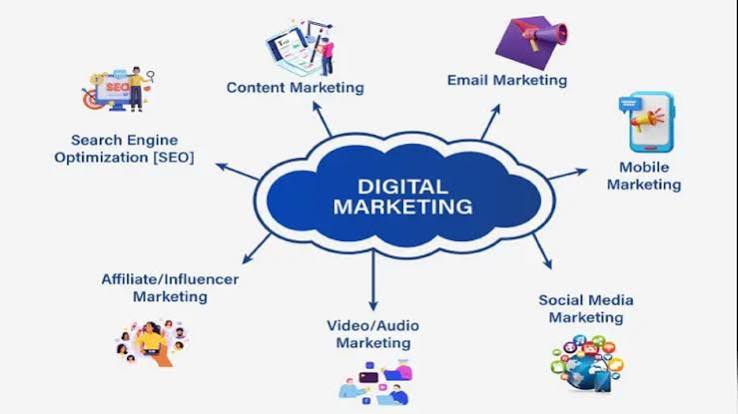
Marketers should have knowledge of SEO, SEM, social media marketing, content marketing, email marketing, Google Ads, Meta Ads, conversion optimisation, and online customer journeys.
For example, an AI tool may suggest keywords for an SEO campaign, but a marketer still needs to understand search intent, keyword relevance, competition, content quality, and the overall SEO strategy.
Therefore, strong digital marketing fundamentals should remain the foundation for anyone who wants to build a career in AI-driven marketing.
2. AI Tool Knowledge
As AI becomes more common in marketing, professionals should understand how different AI tools can support their daily work.
AI tools can assist with areas such as content creation, keyword research, customer analysis, image generation, video creation, data analysis, advertising, automation, and idea generation.
However, learning AI does not mean simply knowing the names of different tools. Marketers should understand when to use a particular tool, what information to provide, how to evaluate its output, and where human involvement is necessary.
For example, a marketer may use an AI tool to generate several ad-copy variations and then select and improve the version that best matches the brand and target audience.
3. Prompt Writing
Prompt writing is becoming an important skill for professionals working with generative AI. A good prompt helps an AI system understand the task, context, audience, objective, and expected output.
Instead of giving a vague instruction such as “Write an advertisement,” a marketer can provide details about the product, target audience, campaign objective, tone, platform, and call to action.
Better instructions generally make it easier to obtain useful and relevant results.
However, prompt writing is not about using complicated words. It is mainly about communicating the requirement clearly and providing sufficient context.

4. Data Analysis
Digital marketing produces a large amount of data. Marketers need to understand what that data means rather than simply looking at numbers.
Important metrics may include click-through rate, conversion rate, cost per click, cost per lead, engagement rate, bounce rate, traffic, and return on advertising spend.
AI can help identify patterns and summarise large datasets, but marketers still need to interpret the results.
For example, if an advertising campaign receives many clicks but very few conversions, a marketer should investigate possible reasons such as audience targeting, landing-page experience, offer, messaging, or tracking issues.
Therefore, data analysis and AI together can help marketers make more informed decisions.
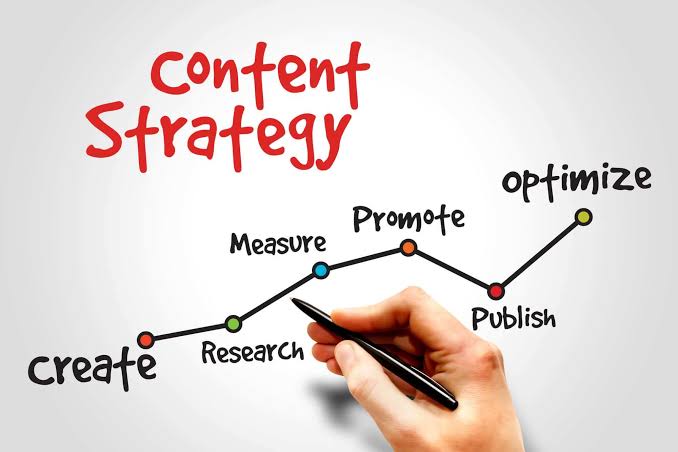
5. Content Strategy
AI can generate articles, captions, ideas, outlines, and other content quickly. However, producing a large amount of content does not automatically mean that the content will be useful or effective.
Future marketers will need strong content strategy skills to understand what the audience wants, what problems they are trying to solve, which topics are relevant, and what type of content should be created for each stage of the customer journey.
Search intent is also important for SEO. A marketer should understand whether a person is looking for information, comparing products, or ready to make a purchase.
AI can assist with content production, but the marketer needs to provide the strategy, direction, purpose, and quality control.
6. Paid Advertising Skills
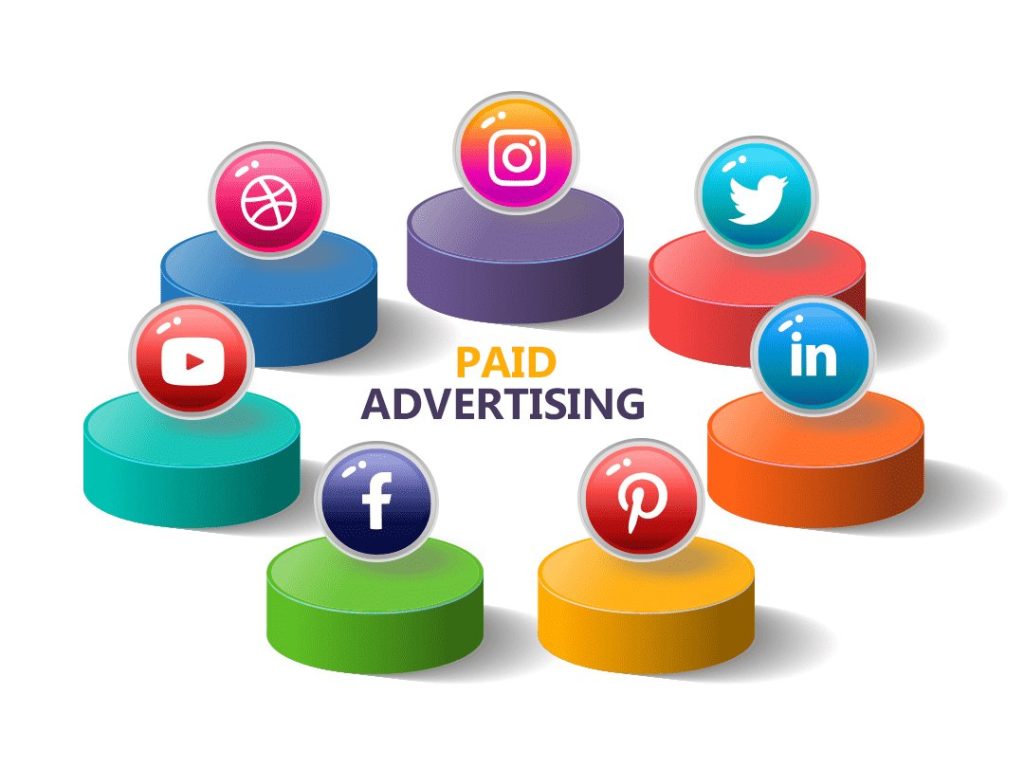
Paid advertising will continue to be an important part of digital marketing, even as advertising platforms become more AI-driven.
Marketers should understand platforms such as Google Ads and Meta Ads, including campaign structures, audience targeting, budgets, bidding, creatives, conversion tracking, and campaign optimisation.
Modern advertising platforms increasingly use automation and machine learning to help advertisers reach potential customers. However, marketers still need to understand business objectives, target audiences, offers, creative strategy, and campaign performance.
This knowledge allows marketers to work with AI-powered advertising systems rather than simply depending on automated recommendations.
7. Creativity
Creativity will remain one of the most valuable skills in the future of AI in Digital Marketing.
AI can generate hundreds of ideas, headlines, images, captions, or content variations within seconds. However, marketers still need to decide which idea is meaningful, original, relevant, and suitable for the brand.
For example, AI may provide several concepts for a social media campaign, but a creative marketer can combine those ideas with cultural understanding, storytelling, brand personality, and audience insights to create something more effective.
Therefore, AI may increase the speed of creative work, but human creativity and creative judgement will continue to play an important role.

8. Critical Thinking
One of the most important skills for future digital marketers will be the ability to critically evaluate AI-generated information.
AI tools can sometimes produce inaccurate information, outdated details, incorrect assumptions, or recommendations that may not be suitable for a particular business.
Therefore, marketers should not blindly accept every AI-generated output. They should verify important facts, check data, compare recommendations, understand the context, and evaluate whether the final decision makes business sense.
Critical thinking becomes especially important when AI is being used for advertising budgets, customer communication, SEO strategies, market research, or business decisions.
9. Adaptability and Continuous Learning
AI in Digital Marketing is developing rapidly. New tools, features, platforms, and workflows are introduced regularly. As a result, marketers cannot depend only on the skills they learn at the beginning of their careers.
Professionals should develop a habit of continuous learning and experimentation. They should regularly explore new AI features, understand changes in search and advertising platforms, and test new marketing approaches.
The ability to learn and adapt can become a major advantage because the most valuable AI skill today may not be the same a few years from now.

Future Trends of AI in Digital Marketing
The future of AI in Digital Marketing is likely to focus on deeper automation, personalisation, and predictive decision-making.
Some important trends include:
AI-Powered Marketing Automation
More repetitive marketing activities will become automated, allowing marketers to concentrate on higher-level strategy.
Predictive Marketing
AI will increasingly help businesses predict customer behaviour, demand, conversion probability, and potential opportunities.
Hyper-Personalisation
Marketing messages will become increasingly tailored to individual customer behaviour and preferences.
AI-Assisted Search
Search experiences are evolving beyond traditional lists of blue links. Therefore, marketers will need to understand how content can remain discoverable across changing search experiences.
AI Agents for Marketing Workflows
AI systems may increasingly handle multi-step tasks such as research, analysis, reporting, and workflow assistance with limited manual intervention.
AI + Human Creativity
Rather than choosing between AI and human creativity, successful marketers will combine both.
Challenges of Using AI in Digital Marketing
Although AI in Digital Marketing provides many advantages, it also comes with several challenges that businesses and marketers need to understand. AI can make marketing faster and more efficient, but it should not be used without proper supervision. Marketers need to understand its limitations and make sure that AI-generated content, data, and recommendations are reviewed before they are used in real marketing activities.
1. Accuracy and Reliability
One of the major challenges of using AI in Digital Marketing is maintaining accuracy. AI tools can sometimes generate information that appears correct but may actually be inaccurate, incomplete, outdated, or misleading. This can become a problem when AI is used for blogs, advertisements, product information, market research, or customer communication. Therefore, marketers should carefully review AI-generated information and verify important facts before publishing or using it. Human judgement is still necessary to ensure that the final information is reliable and suitable for the target audience.
2. Data Privacy and Security
AI-powered marketing often involves analysing customer behaviour, preferences, interactions, and other forms of data. While this can help businesses create better marketing experiences, it also creates responsibility around how customer information is collected, stored, and used. Businesses need to handle customer data responsibly and follow applicable privacy and data-protection requirements. Marketers should also be careful about sharing confidential business or customer information with AI tools. Proper data management is therefore an important part of using AI in Digital Marketing responsibly.
3. Lack of Originality
Another challenge is the possibility of losing originality. AI can generate social media captions, blog ideas, advertisements, email drafts, and other content within seconds. However, if marketers depend too heavily on AI, the resulting content may become repetitive, generic, or similar to content produced by other businesses. This can make it difficult for a brand to create a unique identity in a competitive digital environment. Therefore, marketers should use AI to support the content creation process while adding their own ideas, experiences, storytelling, and creative direction.
4. Maintaining Brand Voice
Every business has its own communication style, personality, values, and positioning. AI-generated content may not automatically match this unique brand voice. For example, a premium brand may require sophisticated communication, while a youth-focused brand may prefer a more friendly and conversational style. If AI-generated content is published without proper editing, it may sound different from the brand’s usual communication. Marketers should therefore provide clear instructions to AI and review the final content carefully to maintain consistency across websites, social media platforms, advertisements, and other marketing channels.
5. Skill Gap
The growing use of AI also creates a skill gap among digital marketing professionals. Simply knowing how to open an AI tool and write a basic prompt is not enough to use AI effectively. Marketers need to understand which tasks AI can handle, how to provide proper instructions, how to evaluate AI-generated results, and how to connect AI with existing marketing strategies. For example, generating an advertisement using AI may be easy, but understanding whether that advertisement is suitable for a particular audience requires knowledge of marketing, customer behaviour, and campaign objectives. Therefore, continuous learning and practical experience are becoming increasingly important.
6. Overdependence on AI
AI can make many marketing tasks easier, but excessive dependence on technology can create new problems. If marketers start accepting every AI-generated suggestion without analysing it themselves, they may lose opportunities to apply their own creativity, experience, and strategic thinking. AI does not fully understand every business situation, customer emotion, or brand objective. Therefore, marketers should use AI as an assistant that improves productivity rather than treating it as a complete replacement for human expertise.
7. Ethical and Responsible Use
The use of AI also raises important ethical considerations in digital marketing. Businesses need to think carefully about how they use AI-generated content, customer data, personalised marketing, and automated communication. Marketing should not become misleading or intrusive simply because technology makes it easier to target individual customers. Businesses should focus on transparency, accuracy, responsible data usage, and customer trust. Using AI in Digital Marketing effectively therefore means not only understanding what the technology can do but also understanding how it should be used responsibly.
Learn AI-Integrated Digital Marketing at HIDM
If you want to build a career in modern digital marketing, learning both digital marketing fundamentals and AI tools can give you a stronger foundation.
HIDM – Hisar Institute of Digital Marketing offers an AI-integrated Digital Marketing Course designed to help students understand digital marketing concepts while gaining practical exposure.
The learning journey can cover important areas such as:
- Search Engine Optimization (SEO)
- Search Engine Marketing (SEM)
- Social Media Marketing
- Google Ads
- Meta Ads
- AI tools for digital marketing
- Content creation
- Practical projects
- Campaign optimisation
- Marketing strategy
The key advantage of learning through a structured institute is that students can combine theoretical knowledge with practical implementation.
Therefore, if you are a student, graduate, fresher, or professional planning to enter the digital marketing industry, an AI-integrated learning approach can help you prepare for the changing requirements of the industry.
Want to learn Digital Marketing with AI and practical exposure? Explore the AI-integrated Digital Marketing Course at HIDM and take the next step toward building your digital marketing career.
Final Thoughts
The future of AI in Digital Marketing is not about humans versus machines. Instead, it is about how effectively marketers can combine technology with human intelligence.
AI can help marketers research faster, analyse more data, automate repetitive work, personalise communication, and improve campaign efficiency. However, strategy, creativity, communication, critical thinking, and customer understanding remain extremely important.
Therefore, aspiring digital marketers should not be afraid of AI. They should learn how to use it responsibly and strategically.
The marketers who continuously learn, experiment, analyse results, and adapt to new technologies will have a stronger opportunity to succeed in the evolving digital marketing industry.
If you are planning to start your digital marketing career, now is a good time to build your fundamentals and add AI skills to your marketing toolkit. With the right combination of digital marketing knowledge, AI skills, and practical experience, you can prepare yourself for the opportunities that the future of digital marketing brings.