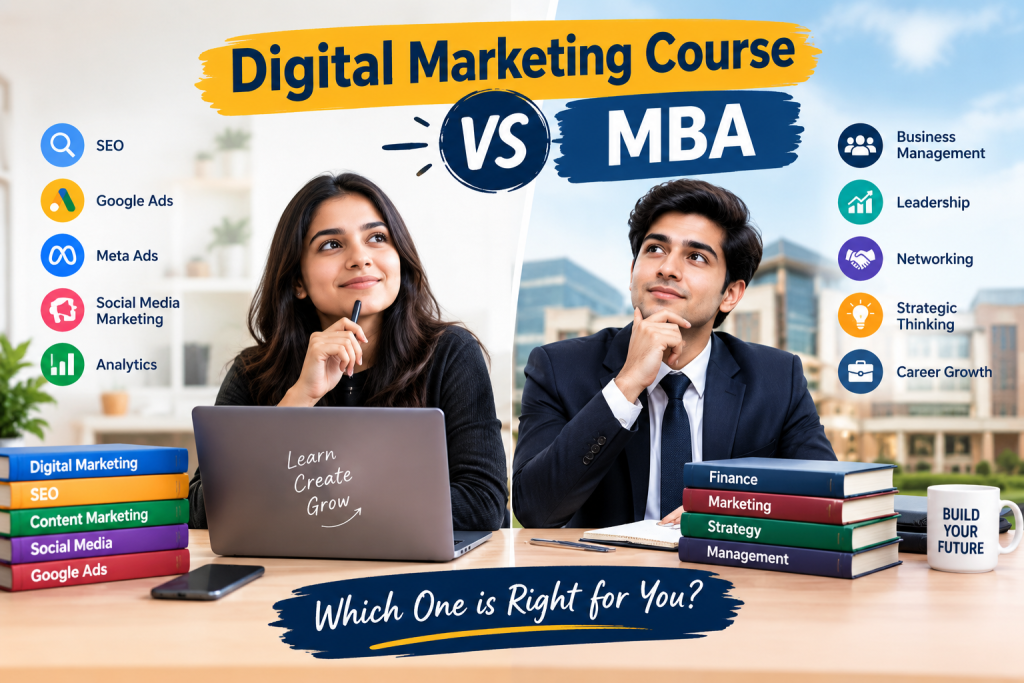
Digital Marketing Course vs MBA: Which Is Better for Your Career
Choosing the right career path after graduation can be challenging, especially when you are deciding between a Digital Marketing Course vs MBA. Both options can help students build successful careers; however, they are designed for different goals, learning styles, and career opportunities. An MBA generally focuses on business management, leadership, finance, marketing, operations, and strategy. On the other hand, a Digital Marketing Course focuses on practical marketing skills such as SEO, Google Ads, social media marketing, content marketing, email marketing, analytics, and AI-powered marketing.
Therefore, the better choice depends on your career goals, budget, time availability, and the type of work you want to do. Moreover, as businesses increasingly depend on digital platforms to attract customers and generate revenue, digital marketing has become an important career option for graduates and working professionals.
Digital Marketing Course vs MBA: Understanding the Difference
Before choosing between a Digital Marketing Course vs MBA, it is important to understand what each program offers.
An MBA, or Master of Business Administration, is a postgraduate management degree. It usually takes around two years in India and covers several areas of business management. Depending on the specialization, students may study marketing, finance, human resources, business analytics, operations, international business, and entrepreneurship.
In comparison, a Digital Marketing Course is designed to develop specialized digital marketing skills. Depending on the institute and course structure, students can learn SEO, SEM, Google Ads, Meta Ads, social media marketing, content marketing, website optimization, lead generation, email marketing, analytics, and artificial intelligence tools.
As a result, an MBA provides broader business knowledge, while a Digital Marketing Course provides more specialized and practical marketing knowledge.
Lorem ipsum dolor sit amet, consectetur adipiscing elit. Ut elit tellus, luctus nec ullamcorper mattis, pulvinar dapibus leo.
What Is a Digital Marketing Course?
A Digital Marketing Course teaches students how businesses can use online platforms to reach potential customers, build brand awareness, generate leads, and increase sales.
Unlike traditional marketing, digital marketing uses channels such as search engines, social media, websites, online advertising platforms, email, and content platforms.
A comprehensive course can cover areas such as:
- Search Engine Optimization (SEO)
- Search Engine Marketing (SEM)
- Google Ads
- Meta Ads
- Social Media Marketing
- Content Marketing
- Email Marketing
- Website and landing page optimization
- Google Analytics and marketing analytics
- Lead generation
- Conversion optimization
- Online reputation management
- AI tools for digital marketing
- Marketing automation
Furthermore, a practical Digital Marketing Course allows students to understand how marketing campaigns work in real business situations. Therefore, students can build skills that are directly applicable to jobs, freelancing, internships, and entrepreneurship.
What Is an MBA?
An MBA is a postgraduate management degree designed to develop business and managerial knowledge.
Generally, MBA programs cover multiple business functions. Students may learn about:
- Marketing management
- Financial management
- Human resource management
- Business strategy
- Operations management
- Business communication
- Economics
- Entrepreneurship
- Business analytics
- Organizational behavior
Consequently, an MBA can be useful for students who want to develop a broader understanding of how organizations operate.
However, an MBA requires a significant investment of time and money. Moreover, the value of an MBA can vary depending on the college, specialization, curriculum, placement opportunities, and the student’s professional experience.
Digital Marketing Course vs MBA: Key Differences
When comparing Digital Marketing Course vs MBA, it is important to look beyond the qualification and understand the differences in duration, curriculum, learning approach, career opportunities, practical exposure, and future scope. Although both can lead to successful careers, they prepare students for different professional paths.
1. Course Duration
Digital Marketing Course:
A Digital Marketing Course is generally shorter than an MBA. Depending on the institute and curriculum, it can range from a few months to one year. This makes it a suitable option for students and graduates who want to develop specialized skills and enter the digital marketing industry in a relatively shorter time.
MBA:
An MBA is generally a two-year postgraduate degree in India. It provides students with a broader understanding of business management and usually requires a longer academic commitment.
2. Area of Focus
Digital Marketing Course:
The primary focus is on digital marketing and online customer acquisition. Students can learn areas such as SEO, SEM, Google Ads, Meta Ads, Social Media Marketing, Content Marketing, Email Marketing, Analytics, Lead Generation, and AI-powered marketing.
MBA:
n MBA focuses on broader business and management concepts. Depending on the specialization, students may study Marketing, Finance, Human Resources, Operations, Business Analytics, Entrepreneurship, and Business Strategy.
Therefore, a Digital Marketing Course provides specialized marketing knowledge, whereas an MBA offers a broader business perspective.
3. Learning Approach
Digital Marketing Course:
Digital marketing is a highly practical field. Therefore, a good Digital Marketing Course focuses on hands-on learning through marketing tools, campaign exercises, projects, website optimization, advertising platforms, and analytics.
MBA:
An MBA generally combines theoretical knowledge with case studies, presentations, group projects, business analysis, and management concepts. As a result, students develop a broader understanding of how businesses operate and make strategic decisions.
4. Skills You Can Develop
Digital Marketing Course:
Students can develop specific skills required to plan, execute, and analyze digital marketing campaigns. These may include keyword research, SEO optimization, paid advertising, social media management, content strategy, lead generation, analytics, and AI-assisted marketing.
MBA:
Students can develop skills related to management, leadership, communication, business strategy, financial decision-making, problem-solving, and organizational management.
Consequently, the skills developed through each program are different because their career objectives are different.
5. Career Opportunities
Digital Marketing Course:
After developing relevant skills and gaining practical experience, students can explore roles such as:
- Digital Marketing Executive
- SEO Executive or SEO Specialist
- Google Ads/PPC Specialist
- Social Media Manager
- Content Marketing Executive
- Performance Marketing Executive
- Digital Marketing Manager
- Freelance Digital Marketer
Moreover, digital marketing skills can also help individuals work with clients independently or promote their own online business.
MBA:
MBA graduates can explore career opportunities in areas such as:
- Marketing Management
- Finance
- Human Resources
- Business Development
- Operations
- Consulting
- Business Analytics
- Entrepreneurship
Therefore, an MBA can provide access to a wider range of business functions, while a Digital Marketing Course is more focused on digital marketing careers.
6. Practical Industry Exposure
Digital Marketing Course:
Practical exposure is particularly important in digital marketing because platforms and strategies are constantly changing. Students can benefit from working with tools such as Google Ads, Meta Ads, SEO tools, analytics platforms, and AI tools.
MBA:
MBA programs can provide industry exposure through internships, case studies, presentations, projects, and corporate interactions. However, the level of practical exposure can vary significantly depending on the institute and program.
7. AI Integration
AI has become an important part of modern marketing. Therefore, AI integration is another important factor when comparing Digital Marketing Course vs MBA.
A modern AI-integrated Digital Marketing Course can teach students how to use AI for content research, keyword research, campaign analysis, customer insights, creative development, marketing automation, and performance optimization.
In an MBA, AI exposure depends largely on the curriculum and specialization of the particular institution. Some programs may include AI, analytics, or emerging technologies, while others may focus more heavily on traditional management concepts.
8. Career Entry and Flexibility
Digital Marketing Course:
Because the course is generally shorter and skill-focused, students can start building their portfolio, applying for internships, exploring jobs, or taking freelance projects while developing their expertise.
MBA:
An MBA generally requires a longer commitment. However, it can be valuable for individuals who want to develop management expertise and pursue broader corporate or leadership-oriented career paths.
9. Freelancing and Entrepreneurship
Digital Marketing Course:
Digital marketing skills can be particularly useful for freelancing and entrepreneurship. A skilled digital marketer can provide services such as SEO, Google Ads management, social media marketing, content marketing, and lead generation to different businesses.
Furthermore, entrepreneurs can use these skills to promote their own websites, products, services, or online businesses.
MBA:
An MBA can provide valuable knowledge about business planning, finance, operations, strategy, and management. Therefore, it can also be beneficial for entrepreneurs, particularly those who want to understand the broader business side of running an organization.
10. Which One Offers a More Specialized Career Path?
The answer depends on your career objective.
If you want to specialize specifically in digital marketing, SEO, paid advertising, social media, content marketing, performance marketing, or AI-powered marketing, a Digital Marketing Course can provide a more focused learning path.
On the other hand, if you want to explore business management, leadership, finance, HR, operations, consulting, or broader corporate roles, an MBA may be a better fit.
Digital Marketing Course vs MBA: Which Has Better Career Opportunities?
Career opportunities are one of the biggest reasons students compare Digital Marketing Course vs MBA.
Digital marketing has created opportunities across startups, agencies, e-commerce companies, education companies, real estate businesses, healthcare brands, financial services, and many other industries.
After completing a Digital Marketing Course, students can explore roles such as:
- Digital Marketing Executive
- SEO Executive
- SEO Specialist
- Google Ads Specialist
- Performance Marketing Executive
- Social Media Executive
- Social Media Manager
- Content Marketing Executive
- PPC Specialist
- Email Marketing Specialist
- Digital Marketing Manager
- Freelance Digital Marketer
Furthermore, digital marketing skills can be used to build a freelance career. Professionals can work with clients, manage campaigns, create content strategies, optimize websites, and generate leads.
On the other hand, an MBA can open opportunities in management-related positions. Depending on the specialization, graduates may pursue careers in marketing, finance, HR, operations, consulting, sales, analytics, and business development.
Thus, both options can lead to strong careers, but their career paths are different.
Digital Marketing Course vs MBA: Practical Skills vs Management Knowledge
One of the most important differences in the Digital Marketing Course vs MBA comparison is the learning approach.
A Digital Marketing Course generally focuses on practical implementation. For example, students may learn how to conduct keyword research, optimize a website, create Google Ads campaigns, manage Meta Ads, analyze campaign performance, and generate leads.
Therefore, students can start applying these skills while they are still learning.
An MBA, however, focuses more broadly on business concepts and management principles. Students learn how organizations make decisions, manage employees, develop strategies, analyze markets, and manage financial resources.
Consequently, an MBA can be valuable for people who want a broader management perspective, while digital marketing education can be more suitable for people who want specialized marketing skills.
Digital Marketing Course vs MBA: The Role of A
The growth of artificial intelligence has changed the digital marketing industry significantly. Therefore, AI has become an important consideration when comparing a Digital Marketing Course vs MBA.
Modern digital marketers can use AI tools for:
- Content research
- Keyword research
- Content ideation
- Customer research
- Ad copy creation
- Data analysis
- Marketing automation
- Audience segmentation
- Campaign optimization
- Competitor research
- Creative generation
However, simply knowing how to use AI tools is not enough. Digital marketers also need marketing fundamentals, strategic thinking, creativity, data interpretation, and the ability to make informed decisions.
This is why an AI-integrated Digital Marketing Course can provide additional value. Instead of treating AI as a separate technology, students can learn how AI can be integrated into different stages of digital marketing.
Why Choose an AI-Integrated Digital Marketing Course?
An AI-integrated course can help students understand both traditional digital marketing techniques and modern AI-powered workflows.
For example, students can learn how to combine SEO knowledge with AI-assisted research, or how paid advertising platforms can be supported by AI-based analysis and optimization.
Similarly, AI can support content planning, social media strategies, customer research, and marketing analytics.
Therefore, students who learn digital marketing along with AI tools can develop a more modern skill set for the changing marketing industry.
Digital Marketing Course vs MBA: What About HIDM?
For students specifically looking for practical digital marketing education, HIDM (Hisar Institute of Digital Marketing) is an option worth considering.
HIDM focuses on digital marketing education and provides an AI-integrated Digital Marketing Course. The course is designed to help students understand important areas of digital marketing while also becoming familiar with modern AI tools and workflows.
The learning areas can include important digital marketing disciplines such as SEO, SEM, Google Ads, Meta Ads, social media marketing, content marketing, analytics, and AI-based marketing practices.
Moreover, practical learning is particularly important in digital marketing because knowing theoretical concepts alone does not necessarily make someone ready to manage real campaigns.
Therefore, students should consider institutes that provide opportunities to work on practical assignments, projects, campaign exercises, and real-world marketing scenarios.
For students in or around Hisar, Haryana, HIDM can be considered when evaluating practical digital marketing training alongside the broader MBA route.
Digital Marketing Course vs MBA: Which Is More Affordable?
Cost is another major factor in the Digital Marketing Course vs MBA decision.
An MBA can require a substantial financial investment, particularly when students choose premium business schools or private institutions. In addition to tuition fees, students may need to consider accommodation, transportation, study materials, and other expenses.
In comparison, many Digital Marketing Courses are shorter and generally require a lower overall investment.
As a result, students who want to enter the digital marketing industry quickly may find a specialized course more accessible.
However, cost should not be the only deciding factor. Students should also evaluate the course curriculum, practical training, faculty, projects, placement assistance, industry exposure, and AI integration before enrolling.
Digital Marketing Course vs MBA: Which Is Better for Freshers?
For freshers, the decision between Digital Marketing Course vs MBA depends largely on their career objective.
If a student wants to enter digital marketing quickly, a practical Digital Marketing Course can be a suitable starting point. This is because students can focus directly on skills that are used in digital marketing jobs.
For example, a graduate can learn SEO, Google Ads, Meta Ads, social media marketing, analytics, and content marketing and then build a portfolio around these skills.
On the other hand, students who are interested in business management, consulting, finance, HR, operations, or leadership roles may prefer an MBA.
Therefore, there is no universal answer. The better choice depends on the career you want to build.
Can You Do Digital Marketing After an MBA?
Yes. An MBA and digital marketing skills do not have to be competing choices.
In fact, combining business management knowledge with digital marketing expertise can create a valuable skill set.
For example, an MBA graduate specializing in marketing can strengthen their profile by learning SEO, performance marketing, Google Ads, Meta Ads, analytics, and AI-powered marketing.
Similarly, an experienced digital marketer can benefit from management knowledge when moving toward leadership, strategy, or business development roles.
Consequently, students should not always think of the decision as Digital Marketing Course vs MBA. In some cases, the two can complement each other.
Digital Marketing Course vs MBA: Which One Should You Choose?
Your decision can become easier if you consider your career objective.
Choose a Digital Marketing Course if:
- You want to enter the digital marketing industry.
- You prefer practical and skill-based learning.
- You want to start working within a shorter period.
- You are interested in SEO, Google Ads, Meta Ads, social media, or content marketing.
- You want to explore freelancing.
- You want to build your own online business.
- You want to learn AI-powered marketing tools.
- You want a specialized marketing skill set.
Choose an MBA if:
- You want a broader understanding of business.
- You are interested in management roles.
- You want to specialize in finance, HR, operations, marketing, or business analytics.
- You want to pursue traditional corporate management careers.
- You are prepared for a longer academic program.
- You want to develop business strategy and leadership skills.
Therefore, your personal career goal should be the starting point of the decision.
Digital Marketing Course vs MBA: Final Verdict
Choosing between a Digital Marketing Course vs MBA ultimately depends on the career you want to build. An MBA is a strong choice for students who want to develop broad knowledge of business management, leadership, strategy, finance, and other areas of corporate management. However, if your goal is to build a career specifically in digital marketing, a specialized course can provide more focused and practical learning in areas such as SEO, Google Ads, Meta Ads, social media marketing, content marketing, analytics, and AI-powered marketing.
Today, digital skills are becoming increasingly important as businesses continue to move their marketing and customer engagement online. Therefore, learning digital marketing along with modern AI tools can give students a practical skill set that can be applied across jobs, freelancing, agencies, and online businesses. Institutes such as HIDM (Hisar Institute of Digital Marketing) are helping students learn digital marketing through an AI-integrated approach, making the learning process more aligned with the changing requirements of the industry.
So, rather than asking which option is universally better, students should ask which option is better for their own career goals. If you are interested in specialized marketing skills and want to start building practical experience in the digital industry, a Digital Marketing Course can be the right direction. On the other hand, if you are aiming for broader management and leadership opportunities, an MBA may be a better fit. Ultimately, the right decision is the one that helps you develop relevant skills, gain practical experience, and move confidently toward your long-term career goals.