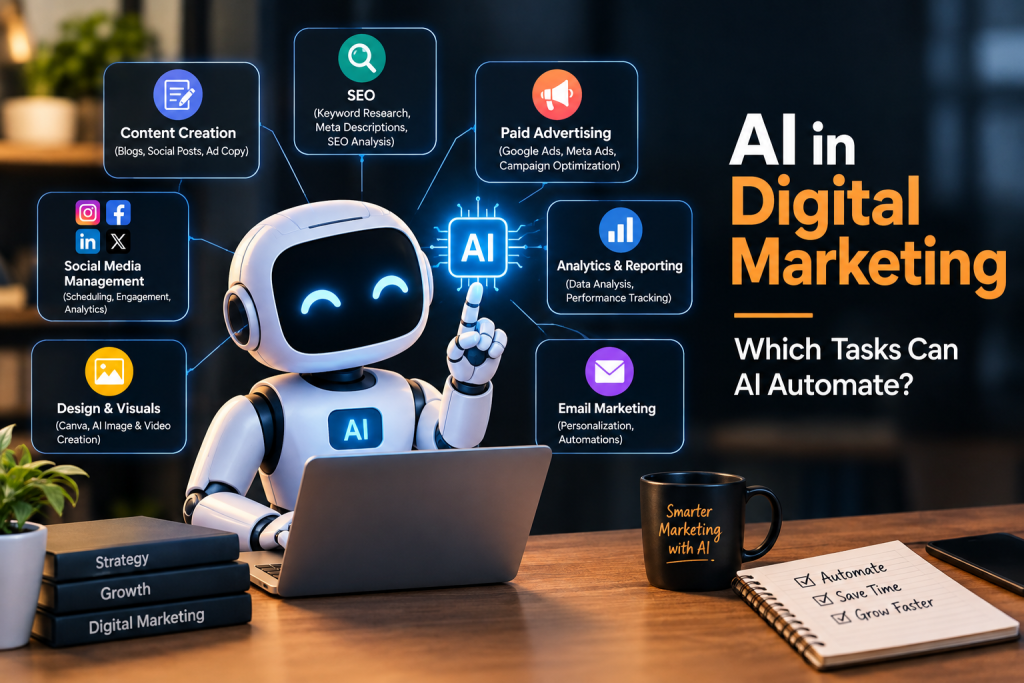
AI in Digital Marketing: Which Tasks Can AI Automate?
AI in Digital Marketing is changing how businesses plan, create, manage, and measure their online marketing activities. From content creation and SEO research to advertising, customer communication, and performance analysis, several repetitive tasks can now be supported or automated with artificial intelligence. As a result, marketers can save time, improve efficiency, and focus more on strategy and creative decision-making.
However, AI is not designed to replace every marketing activity. Instead, it can be used to handle repetitive and data-heavy processes while human expertise remains important for strategy, creativity, brand communication, and decision-making. Therefore, businesses should understand which digital marketing tasks can be automated and where human involvement is still required.
What Is AI in Digital Marketing?
AI in Digital Marketing refers to the use of artificial intelligence technologies to support marketing activities, analyse data, generate content, automate processes, and improve customer experiences.
Traditionally, marketers have spent significant time performing repetitive activities such as keyword research, writing initial content drafts, analysing campaign data, preparing reports, scheduling social media posts, and responding to common customer questions.
With AI-powered tools, many of these processes can now be automated or assisted. Moreover, large amounts of information can be processed quickly, allowing marketers to identify patterns and make more informed decisions.
However, AI-generated outputs should still be reviewed by marketing professionals. This is because context, brand voice, customer expectations, and business objectives cannot always be understood accurately by an automated system.
Why Is AI Becoming Important in Digital Marketing?
Digital marketing involves multiple channels, large datasets, and continuous content production. Therefore, managing everything manually can become time-consuming.
AI can help businesses by automating repetitive processes and supporting marketers with faster analysis. In addition, campaigns can be monitored more efficiently, while customer data can be processed at scale.
Some important benefits include:
- Faster content production
- Automated data analysis
- Improved campaign monitoring
- Personalised customer communication
- Better workflow efficiency
- Faster reporting
- Support for SEO research
- Improved productivity
As a result, marketers can spend more time developing strategies instead of repeatedly performing manual tasks.
Which Digital Marketing Tasks Can AI Automate?
There are several areas where AI in Digital Marketing can be effectively used. However, the level of automation depends on the business, tools, marketing channel, and complexity of the task.
1. Content Creation
Content creation is one of the most common areas where AI is being used.
AI tools can generate initial drafts for blogs, social media captions, email campaigns, product descriptions, ad copy, and other marketing content. Furthermore, existing content can be summarised, expanded, or rewritten for different platforms.
For example, a marketer can provide a topic and basic information to an AI tool. An initial article structure can then be generated within minutes.
However, the final content should be reviewed and edited. Brand messaging, factual accuracy, originality, and audience relevance should be checked before publication.
Therefore, AI can automate the first stage of content production, while human expertise can be used for final editing and approval.
2. SEO Research and Analysis
SEO involves many repetitive research activities. Consequently, AI can be used to support several parts of the SEO workflow.
AI tools can assist with:
- Keyword research
- Search intent analysis
- Content topic generation
- Meta title suggestions
- Meta description drafts
- Content gap analysis
- Internal linking suggestions
- Competitor content analysis
For example, marketers can use AI to organise keyword ideas according to search intent. Similarly, existing content can be analysed to identify topics that may need further coverage.
Nevertheless, SEO decisions should not be completely automated. Search engine behaviour, competition, website authority, technical SEO, and user intent must still be evaluated by an experienced professional.
3. Social Media Management
Social media marketing requires regular content creation, scheduling, monitoring, and reporting. Therefore, AI can reduce the amount of repetitive work involved.
AI can help generate social media captions, post ideas, content calendars, hashtags, and variations of promotional messages. In addition, social media management platforms can be used to schedule posts across different channels.
Engagement data can also be analysed to identify patterns in audience behaviour.
However, social media communication should not be fully automated. Comments, complaints, sensitive questions, and important customer conversations should be handled carefully by humans.
4. Email Marketing Automation
Email marketing is another area where automation can be highly useful.
AI-powered systems can assist with customer segmentation, subject-line generation, personalised messaging, and campaign optimisation. Furthermore, automated workflows can be created for actions such as welcome emails, abandoned-cart reminders, follow-ups, and customer re-engagement.
For example, customers can be divided into different groups according to their behaviour. Relevant messages can then be delivered to each group.
As a result, businesses can communicate with large audiences without manually sending every individual email.
5. Paid Advertising
AI is increasingly being used in paid advertising platforms to analyse signals, optimise campaigns, and automate certain bidding and targeting processes.
In platforms such as Google Ads and Meta Ads, automation can support tasks related to bidding, audience signals, campaign optimisation, creative variations, and performance analysis.
AI can also help marketers identify which advertisements are performing well and which areas may require improvement.
However, campaign objectives, budgets, targeting strategy, creative direction, and business priorities should be monitored by a marketing professional. Automated recommendations should therefore be reviewed before major decisions are implemented.
6. Data Analysis and Reporting
Digital marketing generates a large amount of data. Website traffic, leads, conversions, engagement, advertising costs, and customer behaviour all need to be monitored.
AI can help analyse this information much faster than manual processes.
For example, AI-powered systems can identify patterns, highlight unusual changes, summarise campaign performance, and help prepare marketing reports.
Instead of spending hours collecting and organising data, marketers can focus on understanding what the data means.
Therefore, AI in Digital Marketing can make reporting more efficient while allowing marketers to spend more time on strategic analysis.
7. Customer Support and Chatbots
Customer communication can also be automated through AI-powered chatbots.
Chatbots can answer frequently asked questions, provide basic information, collect customer details, and guide visitors towards relevant pages or services.
For example, a business website can use an AI chatbot to answer questions about services, pricing, availability, or basic processes.
However, complex customer problems should still be transferred to a human representative. This approach creates a balance between automation and personalised support.
8. Personalisation
Personalisation has become an important part of modern digital marketing. Customers are more likely to engage with content that is relevant to their interests and behaviour.
AI can analyse customer interactions and help businesses deliver personalised recommendations, messages, advertisements, and content.
For instance, an e-commerce website can recommend products based on previous browsing or purchasing behaviour.
Consequently, customer experiences can become more relevant while marketing communication can be delivered at scale.
9. Marketing Workflow Automation
Apart from individual tasks, AI can also support complete marketing workflows.
For example, a lead-generation process can be structured as follows:
Advertisement → Landing Page → Lead Form → CRM → Automated Follow-Up → Sales Team
AI and automation tools can assist with several stages of this process. Leads can be categorised, information can be organised, follow-up messages can be triggered, and performance can be tracked.
As a result, businesses can reduce manual work and create more organised marketing operations.
Which Digital Marketing Tasks Should Not Be Fully Automated?
Although AI can automate many repetitive and time-consuming marketing tasks, some activities still require human judgment, creativity, experience, and emotional understanding. Completely automating these areas can affect brand identity, customer relationships, and marketing effectiveness.
1. Marketing Strategy
A marketing strategy should not be created entirely through automation because every business has different goals, target audiences, competitors, budgets, and market conditions. AI can analyze data, identify trends, and suggest strategies, but human marketers are needed to decide which approach is most suitable for the business.
2. Brand Voice
AI can generate content quickly, but the brand’s personality and communication style should be defined by people. A strong brand voice helps businesses communicate consistently across websites, social media, advertisements, and other marketing channels. Human oversight ensures that AI-generated content matches the brand’s values and tone.
3. Creative Decision-Making
Creative concepts, campaign ideas, storytelling, visual direction, and brand positioning often require originality and human understanding. AI can provide ideas and variations, but marketers should make the final creative decisions based on the audience, cultural context, and campaign objectives.
4. Sensitive Customer Communication
Complaints, negative reviews, complex questions, and sensitive customer situations should not be handled entirely by AI. Such interactions may require empathy, patience, and careful judgment. Trained professionals can understand the situation and provide a more appropriate and personalized response.
5. Final Quality Control
AI-generated content, advertisements, recommendations, and marketing materials should always be reviewed before they are published or implemented. Human quality control can help identify incorrect information, inappropriate wording, factual errors, brand inconsistencies, or other issues that AI may overlook.
Benefits of Using AI in Digital Marketing
When implemented properly, AI can provide several practical benefits for businesses and digital marketers. It can reduce repetitive work, improve efficiency, support data-driven decisions, and help businesses manage marketing activities at a larger scale.
1. Saves Time
AI can automate repetitive and time-consuming marketing tasks, such as content drafts, data collection, reporting, keyword analysis, and basic customer responses. As a result, marketers can spend more time on strategy, creativity, campaign planning, and other higher-value activities.
2. Improves Productivity
AI tools can support multiple marketing activities simultaneously. For example, marketers can use AI to assist with content creation, campaign analysis, audience research, and performance reporting. This can make marketing workflows more organised and efficient while reducing the time required for routine tasks.
3. Supports Better Data Analysis
Digital marketing generates large amounts of data from websites, search engines, social media platforms, and advertising campaigns. AI can process this information quickly and help identify patterns, trends, customer behaviour, and campaign performance. These insights can support marketers in making more informed decisions.
4. Enables Personalisation
AI can analyse customer data and behaviour to help businesses deliver more relevant content, advertisements, product recommendations, and communication. Personalised marketing can make customer experiences more relevant and help businesses communicate with different audience segments more effectively.
5. Supports Scalability
AI can help businesses manage larger volumes of content, campaigns, customer queries, and marketing data without requiring every task to be handled manually. This makes it easier for businesses to expand their marketing activities while maintaining more efficient workflows.
How Businesses Can Start Using AI in Digital Marketing
Businesses do not need to automate their entire marketing process at once. Instead, AI can be introduced gradually by identifying suitable tasks, selecting relevant tools, and monitoring their performance. A step-by-step approach can help businesses adopt AI without unnecessarily disrupting their existing marketing operations.
1. Identify Repetitive Tasks
First, businesses should review their existing marketing workflows and identify tasks that consume significant time but do not always require complex human decision-making. These may include content drafting, basic reporting, data organisation, social media scheduling, or repetitive customer queries.
Identifying these tasks helps businesses determine where AI can provide practical support without replacing important human responsibilities.
2. Select Relevant AI Tools
Next, businesses should select AI tools according to their specific marketing requirements. Different tools are designed for different purposes, such as content creation, SEO analysis, advertising, customer support, data analysis, or social media management.
Instead of using multiple tools without a clear purpose, businesses should focus on solutions that address their actual needs and fit their existing workflows.
3. Start With Low-Risk Activities
Businesses can initially introduce AI into tasks where mistakes are easier to identify and correct. For example, AI can be used for creating content drafts, preparing reports, organising basic data, generating ideas, or scheduling marketing activities.
Starting with low-risk tasks allows teams to understand how AI performs before it is introduced into more important marketing processes.
4. Review AI Outputs
AI-generated content and recommendations should not automatically be published or implemented without review. Marketers should check important outputs for accuracy, relevance, originality, brand consistency, and overall quality.
Human review is particularly important when AI is used for customer communication, advertising claims, business information, or content that directly represents the brand.
5. Measure the Results
Finally, businesses should measure the impact of AI after implementation. Relevant metrics may include time saved, productivity, content output, campaign performance, customer response, and overall marketing efficiency.
By comparing results before and after AI adoption, businesses can determine whether a particular tool is providing meaningful value and make improvements where necessary.
How JDSPL Can Help Businesses With Digital Marketing
Jugaadin Digital Services Pvt. Ltd. (JDSPL) provides digital marketing services that can help businesses build and manage their online presence.
As AI becomes an important part of modern marketing, businesses can use technology alongside professional digital marketing strategies. JDSPL offers services such as SEO, Google Ads, Meta Ads, website development, social media marketing, content marketing, and digital marketing solutions.
AI can support several marketing processes; however, effective results still require proper strategy, execution, monitoring, and optimisation. Therefore, businesses can combine AI-powered workflows with professional digital marketing services to create a more organised online marketing system.
The Future of AI in Digital Marketing
The role of AI in marketing is expected to continue expanding as businesses adopt more advanced automation and data-driven technologies.
More marketing activities may become partially automated. At the same time, human skills such as strategic thinking, creativity, communication, critical evaluation, and decision-making will remain important.
Therefore, marketers should not focus only on learning AI tools. Instead, they should understand how these tools can be integrated with fundamental marketing principles.
The future will likely involve marketers and AI systems working together rather than operating separately.
Conclusion
AI in Digital Marketing can automate or support a wide range of activities, including content creation, SEO research, social media management, email marketing, paid advertising, analytics, customer support, personalisation, and workflow automation.
However, automation should not mean removing humans from the marketing process. Instead, repetitive tasks can be handled by AI while strategy, creativity, quality control, and important customer decisions remain under human supervision.
For businesses, the key is to identify the right tasks to automate and use AI where it can genuinely improve efficiency. When AI technology is combined with strong digital marketing expertise, businesses can create faster, more organised, and scalable marketing processes.