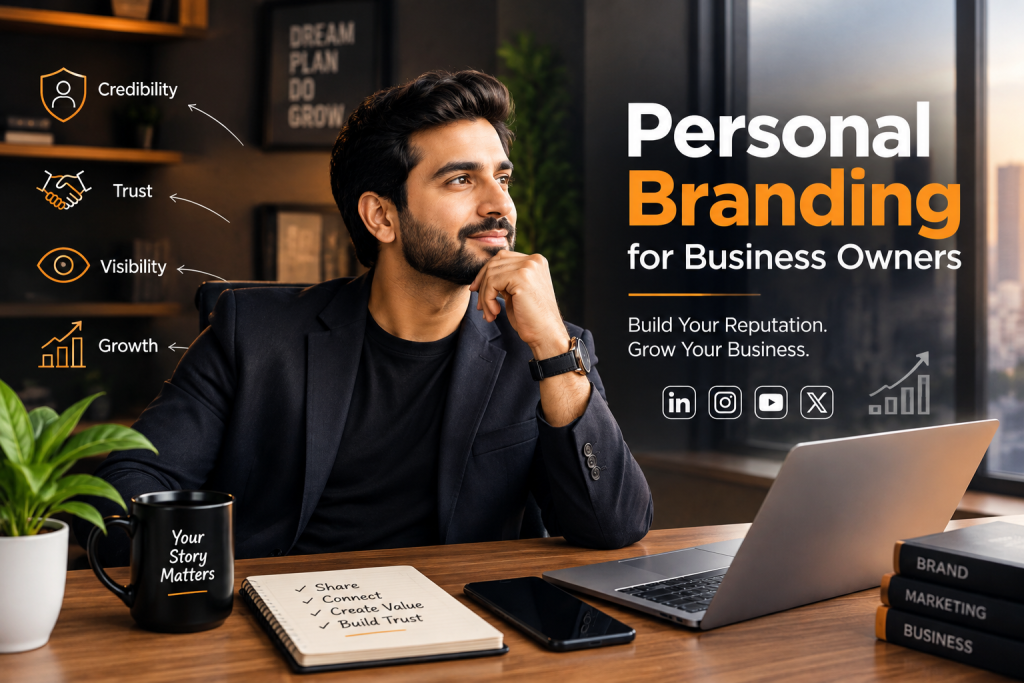
Personal Branding for Business Owners: Build a Strong Brand That Drives Business Growth
In today’s competitive digital market, Personal Branding has become an important part of building trust, authority, and long-term business growth. Customers no longer look only at a company’s products or services. Instead, they also want to know the people behind the business, their expertise, values, experience, and approach.
For business owners, Personal Branding can help create a stronger connection with potential customers. When people recognize and trust the person behind a business, they are more likely to engage with the brand, explore its services, and eventually become customers.
Therefore, building a strong Personal Branding strategy is not simply about posting regularly on social media. It is about creating a consistent professional identity that represents your knowledge, personality, experience, and business values across digital platforms.
What Is Personal Branding?
Personal Branding is the process of creating and communicating a professional identity around an individual. It helps people understand who you are, what you know, what you offer, and why they should trust your expertise.
For business owners, Personal Branding connects the individual with the business. Instead of allowing the company to exist as just another name in the market, a business owner can become a recognizable face associated with the brand.
For example, a digital marketing agency may offer SEO, Google Ads, website development, and social media services. However, when the owner regularly shares useful marketing knowledge, industry insights, case studies, and business experiences, people may begin to recognize that person as an expert in the field.
As a result, Personal Branding can support both personal credibility and business visibility.
Why Personal Branding Matters for Business Owners
A strong Personal Branding strategy can influence how customers perceive a business. In addition, it can help business owners stand out in industries where many companies offer similar services.
1. Personal Branding Builds Trust
Trust plays an important role in the buying process. Before purchasing a service, customers often want to know whether the person or company behind it is reliable.
Therefore, consistently sharing valuable information through Personal Branding can help demonstrate expertise and credibility.
For instance, a business owner who regularly explains industry trends, answers common questions, and shares practical experiences can gradually develop a trusted professional image.
2. Personal Branding Helps You Stand Out
Many businesses compete for attention using similar advertisements, offers, and marketing messages. Consequently, it can become difficult for customers to remember one company from another.
Personal Branding provides an opportunity to differentiate yourself through your knowledge, personality, communication style, and professional experience.
Instead of competing only on products or prices, business owners can create a recognizable identity that customers remember.
3. Personal Branding Supports Business Growth
Your personal reputation can directly support your company’s visibility. When your audience trusts you, that trust can also influence how they perceive your business.
For example, if you consistently discuss digital marketing strategies and your agency provides digital marketing services, your personal content can naturally introduce potential customers to your business.
In this way, Personal Branding can work alongside traditional business marketing rather than replacing it.
Personal Branding and Social Media
Social media has become one of the most accessible platforms for developing Personal Branding. Business owners can use platforms such as LinkedIn, Instagram, Facebook, and YouTube to communicate directly with their target audience.
However, simply being active on social media is not enough.
A professional Personal Branding strategy should have a clear purpose. Your content should communicate your expertise while also giving people a reason to follow, engage with, and trust you.
For example, your content can include:
- Industry knowledge and practical tips
- Educational videos
- Frequently asked questions
- Client success stories
- Business experiences
- Industry trends
- Behind-the-scenes content
- Professional opinions on relevant topics
- Case studies and project insights
- Lessons learned from your experience
Furthermore, maintaining consistency in your profile image, design style, tone, and messaging can make your Personal Branding more recognizable.
How to Build a Strong Personal Branding Strategy
Building Personal Branding does not happen overnight. Instead, it requires consistency, clarity, and a proper strategy.
1. Define Your Professional Identity
First, identify what you want to be known for.
Ask yourself:
- What are my strongest skills?
- What industry do I work in?
- What problems can I solve?
- Who is my target audience?
- What makes my experience different?
- What type of expertise do I want to communicate?
Once these questions are clear, your Personal Branding becomes easier to structure.
2. Understand Your Target Audience
Your content should be created for a specific audience rather than everyone.
For example, a business consultant may create content for startup founders, while a real estate professional may focus on property buyers and investors.
Similarly, your Personal Branding should address the questions, challenges, and interests of the people you want to attract.
As a result, your content becomes more relevant and valuable.
3. Create Valuable Content
Content is one of the most important elements of Personal Branding.
However, the objective should not be to publish content simply to remain active. Instead, focus on creating content that educates, informs, solves problems, or provides useful insights.
For example, instead of posting only promotional messages, a business owner can explain common industry mistakes, share practical strategies, or discuss lessons from real projects.
Over time, valuable content can help establish authority within your industry.
4. Maintain a Consistent Online Presence
Consistency is another important part of Personal Branding.
You do not necessarily need to publish content every day. Nevertheless, you should maintain a realistic schedule that you can follow consistently.
Moreover, your profile information, visual identity, communication style, and content topics should remain reasonably consistent across platforms.
This consistency makes your professional identity easier for people to recognize.
Personal Branding Through LinkedIn
For many business owners and professionals, LinkedIn can be an important platform for Personal Branding.
LinkedIn allows you to share professional knowledge, business experiences, industry insights, achievements, and opinions with a professional audience.
A strong LinkedIn profile should generally include:
- A professional profile photo
- A clear headline
- A useful About section
- Relevant experience
- Skills and expertise
- Business or company information
- Valuable professional content
Furthermore, commenting thoughtfully on industry discussions can help increase visibility and create professional connections.
Personal Branding Through Instagram and Video Content
While LinkedIn focuses heavily on professional networking, Instagram and video platforms can provide more opportunities for visual communication.
Business owners can use short-form videos, educational reels, carousels, and longer videos to explain their expertise.
For example, a business owner can create a short video answering one common customer question. Similarly, a carousel can explain a complicated industry topic in a simple format.
Consequently, Personal Branding can become more engaging when information is presented in formats that are easy to understand and consume.
How Digital Marketing Supports Personal Branding
A strong Personal Branding strategy can benefit significantly from digital marketing.
Search engine optimization, social media marketing, paid advertising, content marketing, website development, and analytics can work together to improve online visibility.
For example, SEO can help your content reach people who are actively searching for information. Similarly, social media marketing can help you build an engaged audience.
Paid advertising can also be used to reach specific audiences with relevant content. Meanwhile, a professional website can provide a central place where visitors can learn about your expertise, services, achievements, and business.
Therefore, Personal Branding should not be viewed as a single social media activity. Instead, it can become part of a complete digital marketing strategy.
Grow Your Personal Brand with Jugaadin Digital Services Pvt. Ltd. (JDSPL)
Building a strong Personal Branding presence requires more than simply creating social media posts. It requires strategy, consistent content, creative execution, audience targeting, and digital visibility.
Jugaadin Digital Services Pvt. Ltd. (JDSPL) provides digital marketing services designed to help businesses and professionals strengthen their online presence. Through services such as SEO, Google Ads, Meta Ads, social media marketing, website development, content creation, and other digital marketing solutions, businesses can build a stronger digital presence.
For business owners who want to grow their Personal Branding, digital services can help connect their expertise with the right audience through multiple online channels.
You can explore the digital marketing services offered by Jugaadin Digital Services Pvt. Ltd. at https://jdspl.in/.
Common Personal Branding Mistakes to Avoid
Although Personal Branding can provide significant opportunities, several mistakes can reduce its effectiveness.
1. Being Inconsistent
Posting frequently for a short period and then disappearing for months can make it difficult to build a strong audience.
Therefore, create a content schedule that is realistic and sustainable.
2. Talking Only About Your Business
Your audience may not want to see promotional content in every post.
Instead, follow a balanced approach. Share knowledge, experiences, opinions, educational content, and business updates along with promotional posts.
3. Copying Other Personal Brands
Taking inspiration from successful creators is useful. However, completely copying their style can make your brand feel less authentic.
Your Personal Branding should reflect your own expertise, personality, experience, and communication style.
4. Focusing Only on Followers
A large follower count does not automatically mean strong business results.
Instead, focus on relevant audiences, meaningful engagement, website visits, enquiries, relationships, and other business objectives.
5. Ignoring Your Online Reputation
Everything you publish online can contribute to how people perceive your professional identity.
Therefore, review your content carefully and make sure it reflects the image you want to build.
How Long Does Personal Branding Take?
Personal Branding is a long-term process rather than a quick marketing campaign.
The time required to build recognition depends on several factors, including content quality, consistency, audience size, industry competition, platform selection, and the strength of your digital marketing strategy.
Initially, your content may receive limited attention. However, consistent and valuable communication can gradually increase visibility and credibility.
Therefore, business owners should focus on building a sustainable presence instead of expecting immediate results.
Measure Your Personal Branding Performance
Like any other digital marketing activity, Personal Branding should be measured using relevant metrics.
Depending on your goals, you can monitor:
- Profile visits
- Website traffic
- Content engagement
- Video views
- Audience growth
- Search visibility
- Leads and enquiries
- Direct messages
- Brand mentions
- Business conversions
However, numbers should always be interpreted according to your objectives.
For example, a business owner focused on generating leads may consider qualified enquiries more important than simply increasing followers.
The Future of Personal Branding for Business Owners
As digital platforms continue to evolve, Personal Branding is likely to remain an important part of online business communication.
Customers have access to more information than ever before. Consequently, businesses need more than products and services to build meaningful relationships with their audiences.
A recognizable founder or business owner can provide a human connection that traditional corporate communication may not always create.
Moreover, the growth of video content, AI-powered tools, social media platforms, search engines, and creator-driven marketing is creating new opportunities for business owners to communicate their expertise.
Therefore, developing a clear and authentic Personal Branding strategy can help business owners remain visible and connected in an increasingly competitive digital environment.
Conclusion
Personal Branding has become an important digital asset for modern business owners. It helps communicate expertise, build trust, create recognition, and support business visibility.
However, successful Personal Branding requires more than simply posting content. It involves defining a clear professional identity, understanding your audience, creating valuable content, maintaining consistency, and using digital marketing strategically.
When personal expertise and business marketing work together, business owners can create a stronger and more recognizable digital presence.
Ultimately, your personal brand represents more than your name. It represents what you know, what you stand for, the value you provide, and the experience people associate with your business.