Building a High-Converting Marketing Funnel
Marketing Funnel is one of the most important frameworks for turning potential customers into paying customers. However, simply attracting visitors is not enough. Businesses need to understand what people want at every stage, provide the right information, build trust, and finally encourage them to take action.
A well-planned marketing funnel helps businesses guide their audience from the first interaction to the final purchase. Moreover, it gives marketers a clear structure for creating content, running advertising campaigns, generating leads, and improving conversions. Therefore, understanding how a marketing funnel works can help both businesses and digital marketers achieve better results.
What Is a Marketing Funnel?
A Marketing Funnel represents the journey a potential customer takes before making a purchase. At the beginning, a business attracts a large audience. However, only some of those people show interest, while an even smaller group eventually becomes customers.
In simple terms, the funnel moves people through different stages:
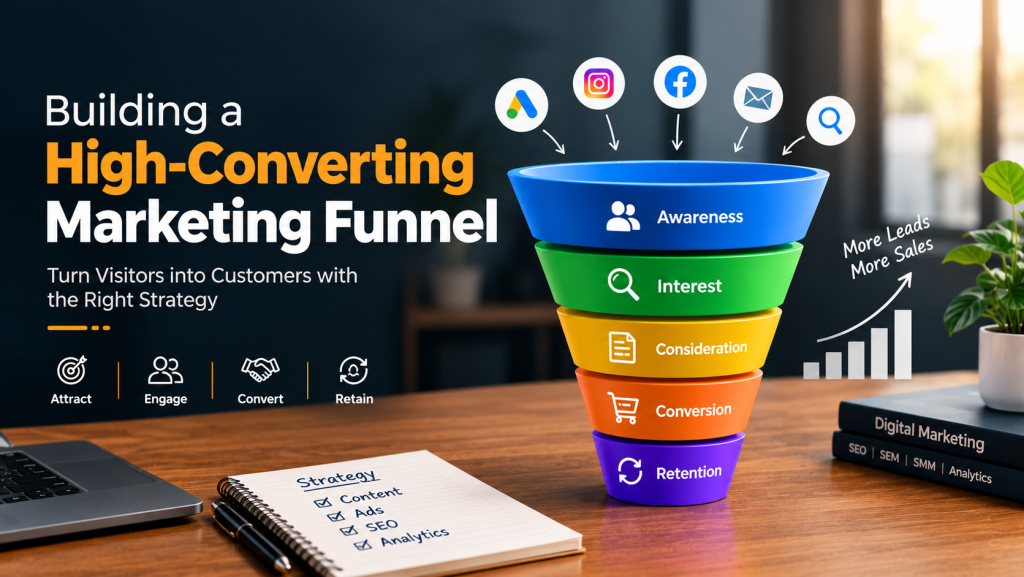
Awareness → Interest → Consideration → Conversion → Retention
Each stage has a different purpose. Therefore, marketers should not use the same message for everyone. Instead, they should create strategies according to the customer’s position in the funnel.
For example, someone discovering a brand for the first time needs useful information. On the other hand, someone who has already visited the website may need reviews, comparisons, offers, or a strong reason to purchase.
Why Is a Marketing Funnel Important?
A Marketing Funnel helps businesses understand how customers move from awareness to conversion. Without a proper funnel, marketing activities can become disconnected and difficult to measure.
Moreover, a funnel helps marketers identify where potential customers leave the buying journey. For instance, a business may receive thousands of website visitors but generate very few leads. In that situation, the problem may exist between the awareness and consideration stages.
A properly designed funnel can help businesses:
- Attract relevant audiences
- Generate qualified leads
- Build customer trust
- Improve conversion rates
- Reduce marketing waste
- Personalize communication
- Measure campaign performance
- Increase customer retention
As a result, businesses can make better marketing decisions instead of relying only on assumptions.
Stages of a Marketing Funnel
Understanding each stage is essential for building a high-converting Marketing Funnel. Therefore, let’s look at the major stages and the strategies marketers can use at each step.
1. Awareness: Attract the Right Audience
The awareness stage is where the customer first discovers your brand. At this point, most people are not ready to purchase. Instead, they are looking for information, solutions, or answers to their problems.
Therefore, the primary goal should be attracting the right audience rather than immediately selling something.
Businesses can use:
- SEO-optimized blogs
- Social media content
- YouTube videos
- Google Ads
- Meta Ads
- Educational reels
- Infographics
- Industry guides
For example, a digital marketing institute could create content around topics such as “How to Start a Career in Digital Marketing” or “Google Ads Skills Every Beginner Should Learn.”
Consequently, people searching for these topics may discover the institute and become potential leads.
2. Interest: Turn Visitors Into Prospects
Once people become aware of your business, the next step is developing their interest.
At this stage, users want to understand whether your business can actually solve their problems. Therefore, your content should provide more detailed and useful information.
For example, you can offer:
- Detailed blog posts
- Case studies
- Free guides
- Webinars
- Email newsletters
- Educational videos
- Free consultations
Additionally, businesses should make it easy for visitors to take the next step. A clear call-to-action can encourage users to subscribe, download a resource, contact the business, or request more information.
Thus, the interest stage moves users deeper into the Marketing Funnel.
3. Consideration: Build Trust
At the consideration stage, potential customers are actively evaluating their options.
They may compare different companies, courses, products, or services before making a decision. Therefore, trust becomes extremely important.
Businesses can strengthen trust through:
- Customer testimonials
- Reviews
- Case studies
- Product demonstrations
- FAQs
- Expert content
- Transparent pricing
- Portfolio examples
Moreover, marketers should address common objections before customers ask about them.
For instance, if someone is considering a digital marketing course, they may want to know about the syllabus, practical training, certifications, projects, mentor support, and career opportunities.
Providing these answers can reduce uncertainty and help prospects move toward conversion.
4. Conversion: Turn Prospects Into Customers
The conversion stage is where a prospect takes the desired action.
That action could be:
- Making a purchase
- Booking a consultation
- Enrolling in a course
- Filling out a lead form
- Calling a business
- Requesting a quotation
However, a complicated conversion process can cause potential customers to leave.
Therefore, businesses should keep their landing pages simple and focused. Use a strong headline, clear benefits, relevant information, trust signals, and a visible call-to-action.
For example:
Learn Digital Marketing with Practical Training → Enquire Now
A clear CTA tells users exactly what they should do next. As a result, the conversion process becomes easier and more direct.
5. Retention: Keep Customers Engaged
A high-converting Marketing Funnel should not end after the purchase.
Instead, businesses should continue communicating with customers and provide value after conversion. This approach can improve customer satisfaction and encourage repeat purchases.
Businesses can use:
- Email marketing
- WhatsApp communication
- Loyalty programs
- Exclusive offers
- Educational content
- Customer support
- Personalized recommendations
Furthermore, satisfied customers can become brand advocates. They may recommend your business to friends, colleagues, or other potential customers.
Therefore, retention can contribute to long-term business growth.
How to Build a High-Converting Marketing Funnel
Now that we understand the different stages, let’s look at how you can build an effective Marketing Funnel from scratch.
Step 1: Define Your Target Audience
First, identify exactly who you want to reach.
Understand their:
- Age
- Location
- Interests
- Problems
- Goals
- Buying behavior
- Budget
- Search intent
The more clearly you understand your audience, the easier it becomes to create relevant marketing campaigns.
For example, a digital marketing institute targeting college students should communicate differently from an agency targeting established business owners.
Step 2: Create Valuable Content
Next, create content that answers your audience’s questions.
However, avoid creating content only for search engines. Instead, focus on solving real problems.
Your content strategy can include:
Top-of-Funnel Content:
Blogs, reels, videos, social media posts and educational guides.
Middle-of-Funnel Content:
Case studies, webinars, comparison articles and detailed guides.
Bottom-of-Funnel Content:
Testimonials, demos, consultations, offers and product-specific pages.
As a result, your content can support customers throughout the entire Marketing Funnel.
Step 3: Use SEO and Paid Advertising
SEO and paid advertising can work together to bring relevant traffic into your funnel.
SEO helps businesses attract users through organic search results. Meanwhile, Google Ads and Meta Ads can help businesses reach specific audiences faster.
For example, a business can use SEO to target informational searches while using Google Ads to target high-intent keywords.
Similarly, Meta Ads can help generate awareness and retarget users who have already interacted with the brand.
Therefore, combining organic and paid strategies can create multiple entry points into your Marketing Funnel.
Step 4: Create a Strong Landing Page
Once visitors arrive through your campaigns, your landing page needs to continue the conversation.
A strong landing page should include:
- A clear headline
- Relevant benefits
- Supporting information
- Social proof
- Simple navigation
- Strong CTA
- Easy-to-use form
Additionally, the landing page should match the message used in the advertisement.
For example, if your Google Ad promotes a specific digital marketing course, the landing page should immediately explain that same course instead of sending users to an unrelated page.
This consistency can improve the overall user experience.
Step 5: Add Lead Nurturing
Not every visitor will convert immediately.
Some prospects need more information before they make a decision. Therefore, lead nurturing plays an important role in a successful Marketing Funnel.
You can nurture leads through:
- Email campaigns
- WhatsApp messages
- Retargeting advertisements
- Follow-up calls
- Educational content
- Special offers
Moreover, personalized communication can make prospects feel understood rather than constantly targeted with advertisements.
Step 6: Track Your Funnel Performance
A Marketing Funnel cannot improve without proper measurement and continuous analysis. Therefore, marketers should regularly monitor important metrics at every stage of the funnel to understand how users are interacting with their campaigns. At the awareness stage, metrics such as impressions, reach, and website traffic can show how effectively a business is attracting potential customers. Similarly, engagement, time on page, and clicks can help measure user interest. At the consideration stage, marketers can track leads, enquiries, and sign-ups to understand how many users are moving closer to a purchase. Furthermore, sales, conversion rate, and cost per acquisition (CPA) are important metrics for evaluating the conversion stage. For retention, businesses can monitor repeat purchases and customer retention rates.
Tools such as Google Analytics, Google Ads, Meta Ads Manager, and CRM platforms can provide valuable data about campaign performance and customer behaviour. Moreover, marketers should regularly identify where users are dropping out of the Marketing Funnel. Once a weak point is identified, they can test different headlines, ad creatives, landing pages, calls-to-action, offers, and audience segments. As a result, continuous tracking, testing, and optimization can help businesses create a more effective and high-converting Marketing Funnel.
Common Marketing Funnel Mistakes to Avoid
Even a well-planned Marketing Funnel can perform poorly when businesses make avoidable mistakes. A funnel is not only about bringing more visitors; instead, it is about guiding the right people through each stage of their customer journey. Therefore, marketers should identify common problems and continuously improve their strategies.
1. Targeting Everyone
One of the most common mistakes is trying to target everyone with the same marketing message. When a business targets a very broad audience, its content may become too general and fail to connect with specific customer needs. Instead, define a clear target audience based on factors such as interests, location, behaviour, problems, and buying intent. As a result, your content and advertising campaigns can become more relevant and attract people who are genuinely interested in your product or service.
2. Focusing Only on Sales
Another common mistake is focusing on sales at every stage of the Marketing Funnel. Not every visitor is ready to make a purchase immediately. Therefore, constantly showing promotional messages can make the audience lose interest or trust in the brand. Instead, provide useful information, educational content, helpful guides, and solutions to their problems. Once you build trust and demonstrate value, potential customers are more likely to consider your offer.
3. Using a Complicated Landing Page
A landing page plays an important role in converting visitors into leads or customers. However, too many buttons, messages, images, forms, or unrelated links can distract visitors from the main objective. Therefore, keep your landing page simple, clear, and focused. Use a strong headline, explain the key benefits, include relevant trust signals, and add a clear call-to-action. This approach makes it easier for visitors to understand what you are offering and what action they should take next.
4. Ignoring Mobile Users
Many people browse websites, interact with advertisements, and complete forms using smartphones. Therefore, businesses should make sure that every part of their Marketing Funnel works smoothly on mobile devices. A poorly designed mobile page can create a frustrating experience and may cause potential customers to leave before completing an action. Make sure your website loads properly, text remains readable, buttons are easy to tap, and forms are simple to complete on smaller screens.
5. Not Following Up With Leads
Generating a lead does not always mean generating an immediate customer. In many cases, prospects need additional information, reminders, or communication before making a decision. Consequently, businesses that fail to follow up may lose valuable opportunities. Use appropriate follow-up methods such as email, WhatsApp, phone calls, or remarketing campaigns. Moreover, personalize your communication according to the prospect’s interests and previous interactions with your business.
6. Not Testing and Optimizing Campaigns
A Marketing Funnel should never be treated as a one-time setup. Customer behaviour, advertising performance, and market conditions can change over time. Therefore, marketers should continuously test different elements of their campaigns. You can experiment with headlines, ad creatives, landing pages, CTAs, offers, audience segments, and content formats. By comparing the results, you can identify what performs better and make data-driven improvements. Ultimately, regular testing and optimization can help create a more efficient funnel and improve the overall customer journey.
How HIDM Can Help You Learn Marketing Funnel Strategies
Building and managing a Marketing Funnel requires practical knowledge of multiple digital marketing channels. This is where proper digital marketing education can make a difference.
HIDM (Hisar Institute of Digital Marketing) offers a comprehensive digital marketing course designed to help students understand different areas of digital marketing and apply their knowledge practically.
The course covers important areas such as:
- SEO
- SEM
- Google Ads
- Meta Ads
- Social Media Marketing
- Content Marketing
- Website Designing
- AI Tools
- Practical Projects
Moreover, students can learn how different digital marketing channels work together. This understanding is particularly useful when creating a complete Marketing Funnel, because successful funnels often require SEO, paid advertising, social media, content, landing pages, analytics, and lead nurturing.
HIDM also focuses on practical and live project-based learning. Therefore, students can move beyond theoretical concepts and understand how digital marketing strategies work in real-world situations.
For students, freshers, graduates, and aspiring digital marketers, learning these skills can provide a stronger foundation for building campaigns and understanding the complete customer journey.
Final Thoughts
A successful Marketing Funnel is not simply a series of advertisements. Instead, it is a complete customer journey that connects awareness, interest, consideration, conversion, and retention.
First, attract the right audience. Then, provide valuable information. Next, build trust and remove objections. After that, make the conversion process simple. Finally, continue engaging with customers after the purchase.
Most importantly, keep measuring your results and improving each stage.
When businesses combine the right audience, valuable content, effective advertising, strong landing pages, lead nurturing, and consistent optimization, they can build a Marketing Funnel that supports sustainable growth.
For aspiring digital marketers, learning how these elements work together is equally important. A practical digital marketing course such as the comprehensive program offered by HIDM (Hisar Institute of Digital Marketing) can help learners develop knowledge across SEO, Google Ads, Meta Ads, social media, content, AI tools, and other essential areas needed to understand modern digital marketing.
Start learning. Start experimenting. And build funnels that turn attention into meaningful business results.