How Search Engines Work in 2026: A Complete Guide
Understanding How Search Engines Work is one of the most important concepts for anyone learning digital marketing, SEO, or website optimisation. Every day, millions of people use search engines to find information, products, services, businesses, and answers to their questions. However, very few users understand what happens behind the search box before a result appears on their screen.
Search engines have become significantly more sophisticated over the years. In 2026, they do much more than simply match keywords with web pages. Instead, modern search systems analyse content, understand context and search intent, evaluate quality, consider user experience, and use advanced technologies to provide more relevant answers.
Therefore, understanding How Search Engines Work can help businesses, content creators, SEO professionals, and digital marketing students create content that is easier for search engines to discover, understand, and rank.
What Is a Search Engine?
A search engine is an online tool that helps users find useful information on the internet quickly and efficiently. In simple terms, it works like a digital information finder. Whenever users enter a question, keyword, or phrase, the search engine analyses the query and tries to understand what they actually want to find.
For example, Google, Bing, and other search engines handle billions of web pages every day. However, they do not simply match the words entered by a user with words found on web pages. Instead, they use advanced algorithms and automated systems to understand the meaning, context, and intent behind a search.
As a result, search engines can provide more useful results instead of showing random pages. Moreover, they continuously discover new content, organise information, and evaluate web pages so that users can find relevant answers more easily.
For example, if a user searches for:
“Best digital marketing course in Hisar”
the search engine does not simply look for pages containing those exact words. Instead, it tries to understand that the user may be looking for information about digital marketing courses available in Hisar. Therefore, factors such as relevance, content quality, location, search intent, and many other signals can influence which pages appear in the results.
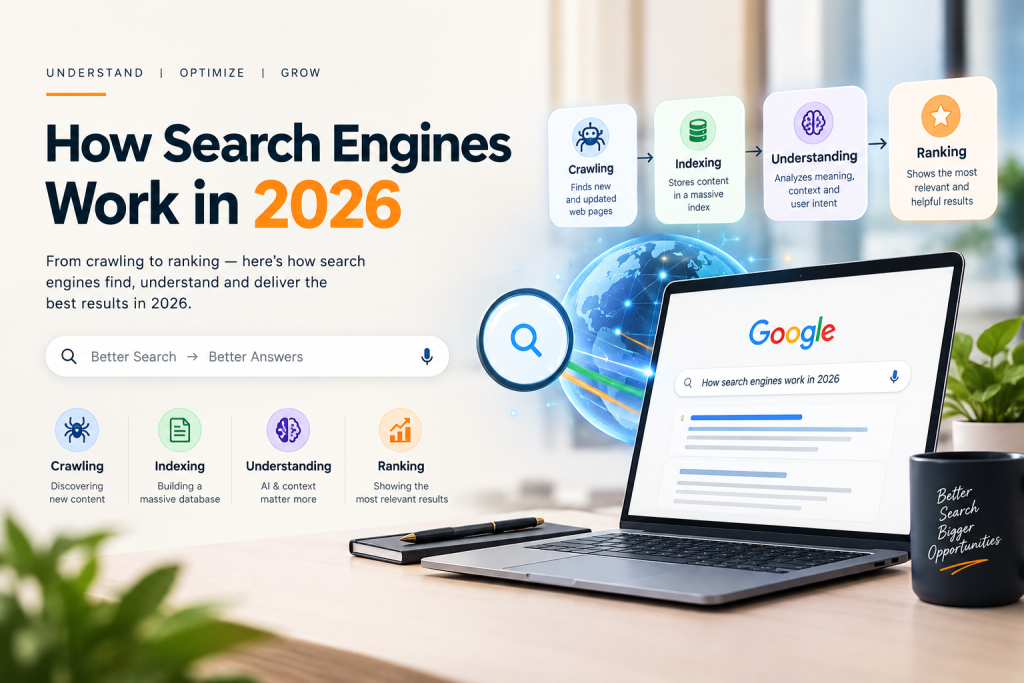
Behind every search, several processes work together. First, search engines discover web pages through crawling. Next, they store and organise information through indexing. After that, they process the user’s query and determine which pages are relevant. Finally, they rank and display the most useful results on the search engine results page (SERP).
These processes can broadly be understood as:
- Crawling
- Indexing
- Understanding and processing search queries
- Ranking
- Displaying relevant search results
How Search Engines Work: The Main Process
The basic process of How Search Engines Work begins when search engine systems discover web pages. They then analyse and store information about those pages. When a user performs a search, the search engine processes the query and determines which available results are most relevant.
Although the technology behind modern search engines is highly complex, the overall process can be understood through the following stages.
1. Crawling: Discovering Web Pages
Crawling is one of the first steps in understanding How Search Engines Work.
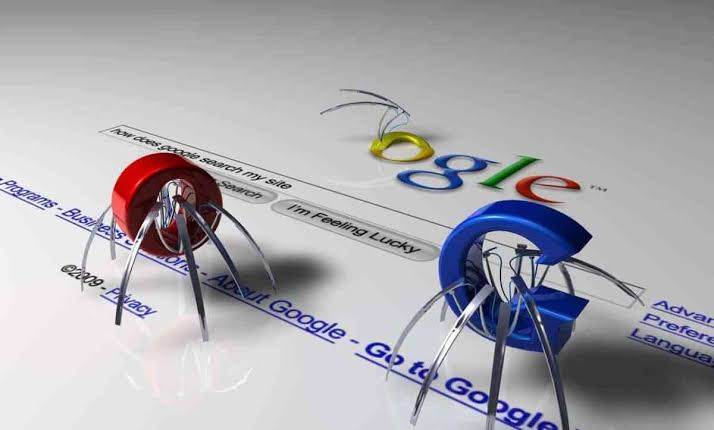
Search engines use automated programs commonly known as crawlers, bots, or spiders to discover web pages and updated content. These systems follow links from pages they already know about and can also discover URLs through other signals, such as XML sitemaps.
For example, suppose a business publishes a new blog about SEO. A search engine crawler may discover that page through the website’s internal links or sitemap.
However, discovering a page does not automatically mean that it will rank in search results.
Therefore, website owners should make it easy for search engine crawlers to access important pages.
How to Improve Website Crawling
Businesses and website owners can support crawling by:
- Creating a clear website structure
- Using relevant internal links
- Maintaining an XML sitemap
- Avoiding unnecessary technical barriers
- Keeping important pages accessible
- Fixing broken links
- Using appropriate robots.txt directives
Moreover, a well-organised website helps both search engines and users navigate content more efficiently.
2. Indexing: Storing and Understanding Content
After a search engine discovers a page, the next important stage is indexing.
Indexing means that the search engine analyses information from a page and stores relevant information in its index. This allows the system to retrieve the page when it may be useful for a particular search query.
During this process, search engines can analyse different elements, including:
- Page content
- Titles and headings
- Images and their context
- Links
- Structured data
- Language
- Content relationships
- Other relevant page information
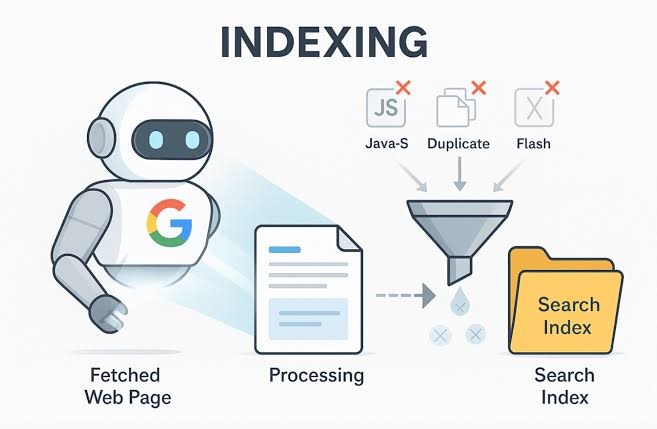
However, not every discovered page will necessarily appear in the search index.
For instance, duplicate pages, inaccessible pages, low-value content, or pages blocked from indexing may not be eligible to appear in search results.
Consequently, SEO professionals need to pay attention to both content quality and technical SEO.
Crawling vs Indexing
Crawling and indexing are related, but they are not the same.
Crawling:
means discovering and accessing web pages.
Indexing:
means analysing and storing information about those pages so that they can potentially be retrieved for relevant searches.
Therefore, a page can be discovered by a crawler without necessarily being indexed.
3. Search Engines Understand the User’s Query
Modern search engines do not rely only on exact keyword matching. Instead, they try to understand what the user actually means.
This is particularly important when explaining How Search Engines Work in 2026.
For example, a person may search:
“how to improve website visibility”
Another person may search:
“ways to get more people to find my website on Google”
Although the wording is different, both searches may represent a similar underlying intent.
Therefore, modern search systems analyse language, context, relationships between words, and the likely purpose behind a query.
1. What Is Search Intent?
Search intent refers to the reason behind a user’s search.
Generally, search intent can be divided into several categories:
2. Informational Intent
The user wants to learn something.
Example:
“How does SEO work?”
3. Navigational Intent
The user wants to reach a specific website or page.
Example:
“HIDM digital marketing course”
4. Commercial Investigation
The user is researching options before making a decision.
Example:
“Best digital marketing course in Haryana”
5. Transactional Intent
The user is ready to take an action, such as buying, registering, or booking.
Example:
“Join digital marketing course in Hisar”
Therefore, understanding search intent is essential when creating SEO content.
4. Search Engines Analyse Content Relevance
Once a search query is understood, search systems identify content that may be relevant to that query.
However, relevance is not simply about using a keyword repeatedly.
Instead, search engines can consider whether the page actually addresses the user’s question and provides useful information.
For example, a page targeting the topic “How Search Engines Work” should ideally explain crawling, indexing, query processing, ranking, search intent, content quality, and other relevant concepts.
Consequently, content creators should focus on covering a topic comprehensively instead of inserting the same keyword unnaturally throughout an article.
Why Keyword Relevance Still Matters
Keywords remain useful because they help communicate the topic of a page.
Nevertheless, modern SEO requires a broader approach.
Instead of repeatedly using one keyword, content should naturally include:
- Primary keywords
- Related terms
- Relevant subtopics
- Questions users commonly ask
- Contextual information
- Clear explanations
As a result, the content becomes useful for readers while also providing search engines with stronger contextual signals.
5. Search Engines Evaluate Quality and Helpfulness
Relevance alone is not enough.
Search engines aim to provide results that are useful, reliable, and appropriate for the user’s query. Therefore, content quality plays an important role in modern SEO.
High-quality content should generally be:
- Original
- Accurate
- Well researched
- Easy to understand
- Relevant to the search query
- Clearly organised
- Helpful to the intended audience
Furthermore, content should demonstrate genuine knowledge and provide value instead of simply being created to manipulate rankings.
For businesses, this means SEO should not be treated as a keyword-placement exercise. Instead, SEO should support a broader content strategy focused on solving customer problems.
6. User Experience and Technical SEO Matter
Another important part of How Search Engines Work is the technical quality of a website.
Even excellent content can struggle if users cannot properly access or navigate the website.
Therefore, website owners should pay attention to areas such as:
- Mobile usability
- Page loading performance
- Website security
- Clear navigation
- Internal linking
- Proper HTML structure
- Indexability
- Accessibility
- Core Web Vitals and other page experience considerations
Moreover, a technically healthy website makes it easier for search engines to discover and process content.
However, technical SEO should work together with strong content rather than replacing it.
7. Search Engines Rank Results
After analysing the query and identifying potentially relevant pages, search engines determine which results should appear and in what order.
This is where ranking comes into the process.
Search engines use sophisticated systems and many signals to determine which results may be most useful for a particular query.
These signals can relate to factors such as:
- Relevance
- Content quality
- Search intent
- Website and page context
- Links and authority-related signals
- Freshness where appropriate
- Location
- Language
- Device
- User query context
- Page experience
Importantly, there is no single factor that guarantees a particular ranking position.
Therefore, SEO professionals need to take a comprehensive approach rather than looking for one shortcut.
How Search Engines Work With AI in 2026
Artificial Intelligence (AI) has become an increasingly important part of modern search technology. In 2026, search engines use advanced AI and machine-learning systems to understand not only the words users enter but also the meaning and intent behind their searches.
Traditionally, search engines relied heavily on keywords and other signals to identify relevant web pages. However, modern search systems can analyse language, context, relationships between concepts, and the overall purpose of a query. This allows them to provide more relevant results, especially when users ask detailed or conversational questions.
For example, a user might search for:
“What is the best digital marketing course for a B.Com graduate who wants to start a career in SEO?”
This query contains several ideas at once. The search engine needs to understand the user’s education background, career goal, subject interest, and search intent. Instead of matching each word separately, AI-powered systems can analyse the relationship between these concepts and identify content that addresses the user’s actual requirement.
1. AI Helps Search Engines Understand Search Intent
One of the biggest changes brought by AI is the ability to understand search intent more effectively. Search intent refers to the reason behind a user’s search.
For instance, someone searching for “SEO course in Hisar” may want to compare courses, check course fees, find an institute, or learn about available training options. Therefore, search engines consider the context of the query and other available signals to determine which results may be most useful.
Similarly, conversational searches have become more common. Users can ask complete questions instead of entering only two or three keywords. As a result, search systems need to understand natural language and provide information that matches the actual question.
2. AI Can Connect Information From Different Sources
AI also helps search systems identify connections between different pieces of information. For example, a search about a digital marketing career may involve skills, courses, certifications, salary information, job opportunities, and industry requirements.
Rather than treating every topic as completely separate, modern search systems can understand how these concepts relate to one another. Consequently, search results can become more useful for complex searches where users need information from multiple perspectives.
3. AI-Powered Search and Direct Answers
Another important development is the growth of AI-powered search experiences. In some cases, search engines can provide summaries, direct answers, related information, or conversational responses alongside traditional search results.
This can help users understand a topic without opening several websites immediately. At the same time, websites still play an important role because AI-powered search systems need reliable information and sources to generate useful responses.
However, the exact appearance and functionality of AI-powered search can vary between search engines and search experiences. Therefore, businesses should not focus only on appearing in one specific type of search feature. Instead, they should continue building strong, useful, and trustworthy online content.
Does AI Mean Traditional SEO Is Dead?
No. AI has changed how search engines understand and present information, but it has not eliminated SEO. In fact, SEO has become more focused on the overall quality and usefulness of a website.
Modern SEO should focus on:
- Helpful and original content that genuinely answers users’ questions
- Strong topical relevance so search engines can understand what a website covers
- Clear and well-structured information that is easy for both users and search systems to understand
- Demonstrated expertise through accurate and valuable content
- Technical accessibility so search engines can crawl and understand web pages
- Search intent so content matches what users actually want
- Trust and credibility to establish confidence in the information provided
- Strong user experience through readable, useful, and easy-to-navigate pages
Moreover, businesses should avoid creating content only to manipulate search rankings. Instead, they should provide genuine value to their audience. When content clearly answers questions, demonstrates knowledge, and provides a good experience, it becomes more useful to both users and modern search systems.
How Search Engines Work With Links
Links are another important part of understanding How Search Engines Work. They help search engines discover new pages, move between different pieces of content, and understand how information across the web connects.
In simple terms, a link works like a pathway from one web page to another. When search engine crawlers find a link on a page, they can follow it to discover additional content. As a result, links can play an important role in helping search engines explore and understand websites.
Internal Links
Internal links connect one page of a website to another page on the same website. For example, a blog about SEO might link to another article about keyword research, technical SEO, or on-page optimisation.
These links help users discover related information without having to return to the search results. At the same time, they help search engines understand the structure of a website and the relationship between different pages.
Moreover, internal linking can help distribute authority and relevance across important pages. A well-organised internal linking structure can therefore make it easier for both users and search engine crawlers to navigate a website.
External Links
External links connect one website to another. For instance, a digital marketing article might link to an official Google resource when explaining a search-related concept.
External links can provide additional context and help users access reliable sources. Therefore, linking to relevant and trustworthy resources can improve the usefulness of content.
However, website owners should not add external links simply to increase the number of links on a page. Instead, every link should serve a genuine purpose and provide additional value to the reader.
Backlinks and Their Importance
A backlink is a link that another website places on its page pointing to your website. For example, if a respected marketing website publishes an article and links to your SEO guide, your website receives a backlink.
Backlinks can help search engines understand relationships between websites and content across the wider web. Furthermore, links from relevant and trustworthy websites can act as valuable signals about the credibility and authority of a page.
However, not all backlinks carry the same value. A large number of low-quality or irrelevant links does not automatically make a website more authoritative. Search engines can evaluate different characteristics of links, including their relevance, context, and the quality of the websites involved.
Quality Matters More Than Quantity
In the past, some marketers focused heavily on acquiring as many backlinks as possible. However, modern SEO requires a more quality-focused approach.
For example, one relevant backlink from a trusted website within your industry may be more valuable than many unrelated or low-quality links. Consequently, businesses should focus on creating useful content that other websites genuinely want to reference.
Businesses can earn relevant links by:
- Publishing original and useful content
- Creating research, guides, or valuable resources
- Building relationships within their industry
- Contributing meaningful expert insights
- Promoting high-quality content to relevant audiences
Most importantly, businesses should avoid manipulative link-building practices such as buying links purely to influence rankings, creating artificial link networks, or acquiring large numbers of irrelevant backlinks.
Ultimately, links help connect the web together. Internal links improve website navigation, external links provide additional context, and relevant backlinks can help search engines understand the authority and relationships surrounding a website.
Therefore, businesses should focus on building a natural, relevant, and trustworthy link profile rather than simply trying to collect as many links as possible.
How Search Engines Decide Which Result Is Best
A common misconception is that the first result is simply the website with the most keywords.
In reality, ranking systems are much more sophisticated.
When someone searches for something, search engines can evaluate numerous pieces of information to determine which results are most appropriate for that particular query.
For example, consider the search:
“Best restaurant near me”
The results may depend on factors such as relevance, location, business information, reviews, website content, and other contextual signals.
Similarly, for an informational query such as:
“How Search Engines Work”
the search engine may prioritise pages that clearly explain the subject and satisfy the user’s informational intent.
Therefore, SEO success requires understanding both the search engine and the person using it.
How to Optimise a Website for Search Engines in 2026
Now that we understand How Search Engines Work, the next step is to apply this knowledge to SEO. Search engine optimisation involves improving different aspects of a website so that search engines can crawl, understand, and rank its pages more effectively.
However, SEO is not limited to adding keywords to web pages. A successful SEO strategy combines useful content, technical optimisation, website structure, search intent, authority, and user experience.
Businesses can improve their search visibility by following a structured and user-focused approach.
1. Create Helpful Content
First, create content that answers real questions and solves genuine problems. Users visit websites because they want information, solutions, products, services, or answers. Therefore, content should focus on meeting those needs rather than simply targeting search engines.
For example, instead of writing an article only because a particular keyword has search volume, understand what users actually want to learn. Then, create comprehensive content that answers their questions clearly and provides useful information.
Moreover, original insights, practical examples, accurate information, and clear explanations can make content more valuable to readers.
2. Use Keywords Naturally
Keywords still play an important role in SEO because they help search engines understand the main topic of a page. However, marketers should use keywords naturally instead of repeating them unnecessarily.
A primary keyword can appear in important locations such as the page title, introduction, relevant headings, URL, and appropriate sections of the content. At the same time, related terms and natural language can help provide additional context.
Most importantly, write for people first. Excessive keyword repetition can make content difficult to read and may create an unnatural experience.
3. Improve Internal Linking
Internal links connect related pages within the same website. For example, a page about digital marketing can link to relevant content about SEO, Google Ads, social media marketing, or content marketing.
As a result, users can discover additional information more easily. Furthermore, internal links help search engine crawlers navigate a website and understand the relationship between different pages.
A well-planned internal linking structure can also help important pages receive more visibility within the website.
4. Optimise Technical SEO
Technical SEO ensures that search engines can access, crawl, and understand important pages on a website. Therefore, businesses should regularly check technical aspects that can affect search visibility and user experience.
Important areas include:
- Crawlability and indexability
- Mobile usability
- Website loading speed
- Site architecture and navigation
- HTTPS and website security
- XML sitemaps
- Structured data where appropriate
- Broken links and technical errors
- Core Web Vitals and overall page experience
Additionally, websites should maintain a clear and logical structure so that both users and search engines can find important content without unnecessary difficulty.
5. Build Authority and Trust
Search visibility also depends on the overall credibility and usefulness of a website. For this reason, businesses should consistently publish accurate, valuable, and well-researched information.
Furthermore, earning relevant mentions, citations, and links from credible websites can strengthen a site’s reputation. However, businesses should focus on genuine authority rather than trying to manipulate search rankings through artificial techniques.
For example, an industry website that publishes original research, expert insights, and practical resources can naturally attract references from other relevant websites.
6. Keep Content Updated
Online information can become outdated over time. This is especially important for topics such as technology, SEO, digital marketing, finance, software, and industry regulations.
Therefore, businesses should regularly review older content and update information when necessary. This may include updating statistics, examples, screenshots, links, product details, or recommendations.
As a result, older pages can continue to provide accurate and useful information to visitors instead of becoming outdated resources.
7. Common SEO Mistakes to Avoid
Understanding How Search Engines Work also helps marketers identify and avoid common SEO mistakes. Although these mistakes may appear minor, they can negatively affect content quality, user experience, and overall search performance.
8. Keyword Stuffing
Keyword stuffing occurs when a website uses the same keyword excessively or unnaturally throughout its content.
For example, repeating the same phrase in almost every sentence can make an article difficult to read. Instead, use keywords naturally and focus on explaining the topic clearly.
9. Duplicate Content
Duplicate content refers to substantially similar content appearing across multiple pages or websites. Although similar information can sometimes be necessary, creating multiple pages with little meaningful difference can make it difficult to establish the unique purpose of each page.
Therefore, every important page should offer a clear reason for existing and provide distinct value to users.
10. Ignoring Search Intent
Targeting a keyword does not automatically guarantee useful content. A page may contain the right keyword but still fail to satisfy what users actually want.
For instance, someone searching for “digital marketing course fees” is likely looking for pricing information. If the page only explains what digital marketing is without discussing fees, it may not properly satisfy the user’s intent.
Consequently, marketers should understand whether users want to learn, compare, buy, find a specific website, or complete another action before creating content.
11. Poor Website Structure
A confusing website structure can make navigation difficult for both users and search engine crawlers. For this reason, websites should organise content into logical categories and create clear navigation paths.
A simple structure also makes it easier for visitors to move between related pages and find important information.
12. Creating Content Only for Rankings
Content should not exist solely to manipulate search rankings. Instead, businesses should create genuinely useful resources that answer questions and provide solutions.
When content focuses on user needs, it has a better opportunity to attract engagement, references, and long-term organic visibility.
13. Ignoring Mobile Users
Many users access websites through smartphones and other mobile devices. Therefore, a website should provide a smooth experience across different screen sizes.
Businesses should check mobile readability, navigation, buttons, images, forms, and page loading performance. Moreover, a responsive design ensures that visitors can access important information without unnecessary scrolling, zooming, or navigation problems.
14. Focusing Only on Rankings
Another common mistake is treating rankings as the only measure of SEO success. However, strong SEO should ultimately help a business achieve meaningful outcomes such as relevant traffic, engagement, leads, sales, or other business goals.
Therefore, marketers should look beyond rankings and evaluate whether their organic traffic actually reaches the right audience and supports the website’s objectives.
Ultimately, effective SEO in 2026 requires a balanced approach. Businesses should focus on helpful content, natural keyword usage, strong internal linking, technical accessibility, authority, user experience, and regular content improvements. By following these principles, websites can create a stronger foundation for sustainable organic search visibility.
Learn Digital Marketing With Practical and AI-Integrated Training at HIDM (Hisar Institute of Digital Marketing)
Understanding How Search Engines Work is only one part of becoming a successful digital marketer. In practice, marketers also need to learn SEO, Google Ads, Meta Ads, social media marketing, content creation, analytics, and modern AI tools.
This is where practical training can make a significant difference.
HIDM (Hisar Institute of Digital Marketing) offers an AI-integrated Digital Marketing Course designed to help students understand digital marketing concepts while developing practical skills.
The course covers important areas such as:
- SEO
- Search Engine Marketing
- Social Media Marketing
- Google Ads
- Meta Ads
- AI tools for digital marketing
- Content creation
- Practical projects
- Live project training
- One-to-one sessions
- Doubt-solving support
- Mentor guidance
Moreover, the training combines digital marketing fundamentals with practical exposure, helping students understand how marketing strategies are applied in real-world situations.
For students, graduates, career switchers, entrepreneurs, and aspiring digital marketers, learning these skills can provide a stronger foundation for entering the digital marketing industry.
Ready to Build Your Digital Marketing Skills?
The digital marketing industry continues to evolve rapidly. Search engines are becoming smarter, AI is changing marketing workflows, and businesses increasingly need professionals who can combine marketing knowledge with practical digital skills.
Therefore, simply knowing definitions may not be enough.
If you want to learn SEO, Google Ads, Meta Ads, social media marketing, AI tools, and other essential digital marketing skills through practical training, explore the AI-integrated Digital Marketing Course at HIDM.
Don’t wait until the industry changes again to start learning. Start building the skills businesses are looking for today.
👉 Explore the HIDM Digital Marketing Course and take the next step toward your digital marketing career.
Conclusion
Understanding How Search Engines Work is essential for anyone who wants to build a career in SEO or digital marketing.
The process begins with crawling, followed by indexing, query understanding, relevance analysis, quality evaluation, and ranking. At the same time, modern search systems increasingly use AI and advanced technologies to understand language, context, and user intent.
However, successful SEO is not about finding a single ranking trick. Instead, it requires a combination of useful content, strong technical foundations, clear website structure, relevant keywords, good user experience, and a genuine understanding of what users are searching for.
As search continues to evolve in 2026, digital marketers who understand these fundamentals will be better prepared to adapt to new search experiences and changing user behaviour.
And if you want to turn this knowledge into practical digital marketing skills, HIDM’s AI-integrated Digital Marketing Course can help you take the next step toward becoming a job-ready digital marketer.