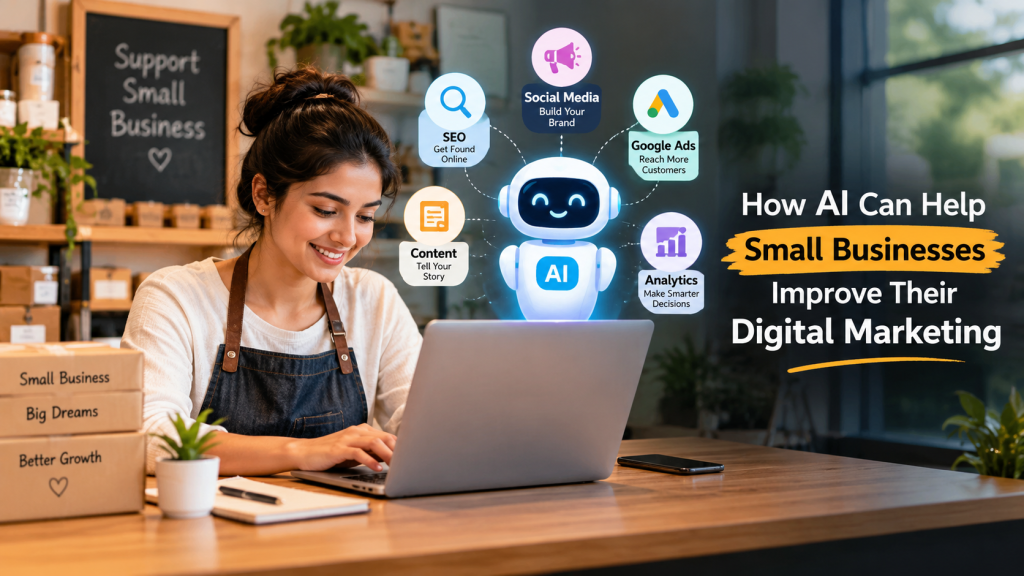
How AI Can Help Small Businesses Improve Their Digital Marketing
Small businesses often have limited time, marketing budgets, and resources. However, digital marketing has become essential for reaching new customers and building a strong online presence. This is where AI for Small Businesses can make a practical difference. AI tools can help businesses create content, understand customers, improve advertising, analyze data, and manage repetitive marketing tasks more efficiently.
Moreover, AI does not mean that businesses need to replace their marketing teams or completely automate their operations. Instead, it can support marketers by reducing repetitive work and providing useful insights. As a result, small businesses can spend more time on strategy, customer relationships, and business growth.
What Is AI for Small Businesses?
AI for Small Businesses refers to the use of artificial intelligence tools and technologies to improve business operations and marketing activities. These tools can analyze large amounts of information, identify patterns, generate content, and assist with everyday marketing tasks.
For example, a small business can use AI to generate content ideas, analyze customer behavior, improve website content, create advertising variations, or summarize campaign performance. Therefore, AI can help smaller businesses access capabilities that previously required more time, people, or resources.
However, businesses should use AI as a support system rather than relying on it for every decision. Human creativity, experience, and customer understanding still play an important role in successful marketing.
Why Small Businesses Need AI in Digital Marketing
Digital marketing involves several activities, including SEO, social media, paid advertising, content creation, email marketing, website optimization, and analytics. Consequently, managing all these activities can become difficult for a small business.
AI can simplify many of these processes. Furthermore, it can help marketers work faster while maintaining a consistent marketing workflow.
Here are some important ways AI can support small businesses:
- It can speed up content research and creation.
- It can help identify customer interests.
- It can support SEO research.
- It can analyze advertising performance.
- It can generate marketing ideas.
- It can assist with customer communication.
- It can help identify trends in business data.
- It can reduce repetitive marketing tasks.
As a result, small businesses can use their available resources more effectively.
How AI for Small Businesses Can Improve Content Creation
Content plays an important role in digital marketing. Businesses need website content, blog posts, social media posts, advertisements, product descriptions, and email campaigns. However, creating fresh content regularly can take considerable time.
With AI for Small Businesses, marketers can generate ideas, create initial drafts, develop headlines, and organize content structures more quickly.
For instance, a local clothing store can use AI to brainstorm social media ideas for a new collection. Similarly, a restaurant can use AI to create content themes around seasonal offers, customer experiences, and new menu items.
Nevertheless, businesses should review AI-generated content before publishing it. Human editing can improve accuracy, brand voice, originality, and relevance. Therefore, the best approach combines AI assistance with human creativity.
1. AI Can Support SEO for Small Businesses
Search engine optimization helps businesses attract people who are actively searching for their products or services. However, keyword research, content planning, competitor analysis, and optimization can require significant effort.
AI can support several parts of the SEO process. For example, marketers can use AI to generate topic ideas, organize keywords, identify content gaps, and create initial content outlines.
Additionally, AI can help marketers understand search intent and structure content around specific customer questions. As a result, businesses can create more relevant content for their target audience.
However, AI should not replace proper SEO research. Search trends, competition, website performance, backlinks, technical SEO, and actual search results still require careful analysis.
2. AI for Small Businesses and Social Media Marketing
Social media provides small businesses with an opportunity to connect directly with their audiences. Yet, maintaining an active presence across multiple platforms can become time-consuming.
AI can make social media planning more efficient. For example, businesses can use AI to generate post ideas, captions, content calendars, video concepts, and variations of promotional messages.
Furthermore, AI can help businesses adapt content for different platforms. A single campaign idea can be transformed into an Instagram caption, Facebook post, short-video script, or email concept.
Still, businesses should maintain a consistent brand personality. Consequently, every AI-generated post should be reviewed and adjusted before publication.
How AI Can Improve Google Ads and Paid Marketing
Paid advertising can generate valuable leads and sales. However, small businesses need to monitor campaigns carefully because advertising budgets are often limited.
AI can assist marketers by analyzing campaign data and identifying patterns. It can also help generate different ad copy ideas, audience insights, keyword suggestions, and creative concepts.
For example, a local service business can use AI to develop multiple headline and description variations for its advertising campaigns. Then, marketers can test these variations and use actual performance data to make decisions.
Therefore, AI can support faster experimentation. However, businesses should still monitor important metrics such as conversions, cost per lead, click-through rate, conversion rate, and return on advertising spend.
1. AI Can Help Small Businesses Understand Customers
Understanding customers is one of the most important parts of marketing. Businesses need to know what customers want, what problems they face, and why they choose one product or service over another.
AI can help analyze customer feedback, reviews, website interactions, campaign data, and other available information. Consequently, businesses can identify common questions, interests, and customer concerns.
For example, if customers repeatedly ask about delivery time, a business can highlight delivery information more clearly on its website and advertisements.
In this way, AI can turn customer information into useful marketing insights. Nevertheless, businesses should protect customer privacy and use data responsibly.
2. AI for Small Businesses Can Save Time
Time is one of the biggest challenges for small businesses. Owners often handle marketing alongside sales, customer service, operations, and finance.
Therefore, automating repetitive tasks can provide significant value.
AI can assist with tasks such as:
- Generating content ideas
- Creating first drafts
- Summarizing reports
- Organizing marketing information
- Creating campaign concepts
- Analyzing basic performance data
- Preparing social media content
- Developing customer communication drafts
As a result, business owners and marketers can focus more on important activities that require human judgment.
How to Start Using AI in Digital Marketing
Small businesses do not need to adopt multiple AI tools at once. Instead, they can start with simple, low-risk tasks and gradually expand their use of AI as they become more comfortable with the technology.
Step 1: Identify Repetitive Marketing Tasks
Start by identifying marketing activities that take a lot of time but follow a predictable process. Tasks such as generating content ideas, conducting basic research, preparing reports, creating social media captions, and writing initial copy can be good starting points for AI.
Step 2: Choose AI Tools Based on Your Goals
Next, select AI tools according to your specific marketing needs. Every business has different goals, so there is no need to use a tool simply because it is popular. Instead, focus on tools that can solve a particular problem, save time, or improve your marketing workflow.
Step 3: Keep Human Review in the Process
AI can help create content quickly, but human review is still essential. Always review AI-generated content for accuracy, tone, grammar, brand messaging, and relevance to your target audience. This helps ensure that the final content remains useful, authentic, and aligned with your brand.
Step 4: Measure the Results
Finally, measure the impact of AI on your marketing efforts. Compare your performance before and after implementing AI and track relevant metrics such as website traffic, leads, engagement, conversion rates, and advertising costs. These results can help you understand whether an AI tool is actually delivering value.
By following this step-by-step approach, businesses can adopt AI gradually, reduce unnecessary costs, and identify the areas where AI can make their digital marketing efforts more efficient and effective.
Common Mistakes Small Businesses Should Avoid With AI
Although AI can provide many benefits, businesses should use it carefully. Overdependence on AI can create problems when content becomes repetitive, inaccurate, or disconnected from the brand.
Therefore, businesses should avoid:
- Publishing AI content without reviewing it
- Using the same generic content everywhere
- Ignoring customer feedback
- Sharing sensitive business information with unsuitable tools
- Making marketing decisions without checking real data
- Automating every customer interaction
- Focusing on AI tools instead of marketing goals
Instead, businesses should use AI as a productivity and decision-support tool.
The Future of AI for Small Businesses
AI is becoming an increasingly useful part of digital marketing. As tools continue to develop, small businesses may gain access to more advanced capabilities for content creation, customer analysis, advertising, personalization, and marketing automation.
However, technology alone does not guarantee marketing success. A clear strategy, strong brand positioning, quality content, customer understanding, and consistent execution remain important.
Therefore, the businesses that use AI effectively will likely be those that combine technology with human judgment and a clear understanding of their customers.
How JDSPL Can Help Small Businesses With Digital Marketing
Implementing AI is only one part of a successful digital marketing strategy. Small businesses also need proper planning, execution, optimization, and performance tracking.
Jugaadin Digital Services Pvt. Ltd. (JDSPL) provides full digital marketing services for businesses looking to strengthen their online presence. Its services cover areas such as SEO, Google Ads, Meta Ads, social media marketing, website development, content marketing, and digital marketing strategy.
For small businesses, working with a full-service digital marketing provider can make it easier to manage different marketing channels under one strategy. Moreover, AI tools can be integrated into appropriate workflows to improve research, content development, campaign analysis, and overall efficiency.
Instead of using AI without a clear direction, businesses can combine AI-assisted workflows with professional digital marketing strategies. Consequently, they can focus on reaching the right audience, generating leads, and building long-term online visibility.
Conclusion
AI for Small Businesses can make digital marketing faster, more organized, and more efficient. From content creation and SEO to social media, paid advertising, customer analysis, and reporting, AI can support many marketing activities.
However, successful implementation requires more than simply using AI tools. Businesses should define clear goals, choose suitable tools, review AI-generated output, and measure real marketing results.
Most importantly, AI should support human expertise rather than replace it. When businesses combine AI with a strong digital marketing strategy, quality content, customer insights, and continuous optimization, they can build a more efficient marketing process and create better opportunities for sustainable growth.