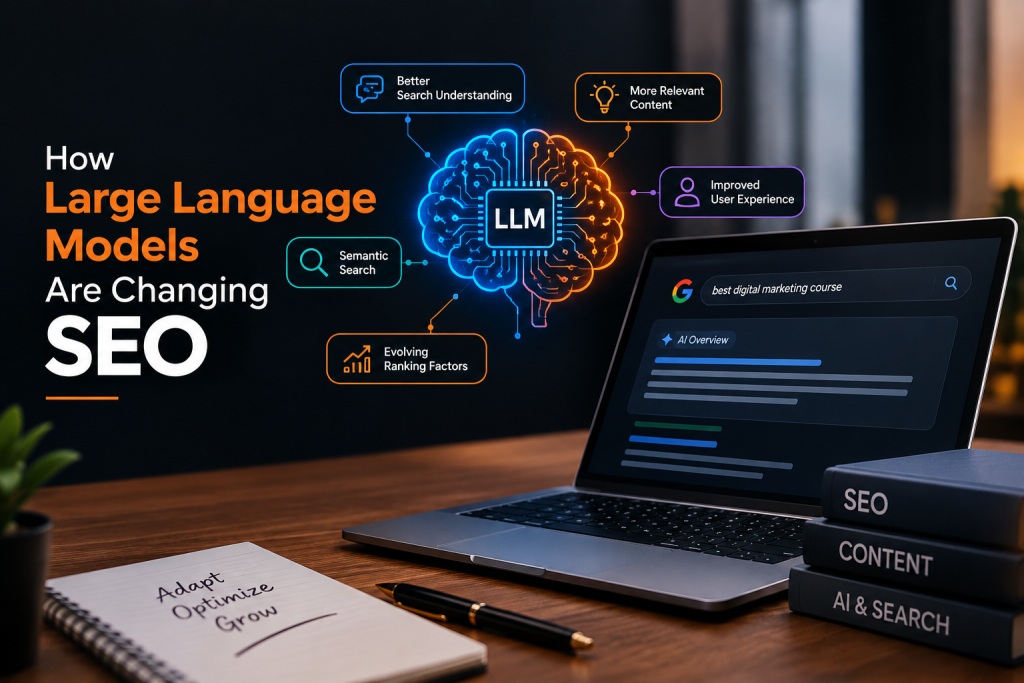
How Large Language Models Are Changing SEO
Search is changing faster than ever, and Large Language Models in SEO are becoming an important part of that transformation. Earlier, SEO mainly focused on keywords, backlinks, technical optimization, and ranking pages in traditional search results. Today, search engines and AI-powered platforms can understand context, user intent, conversational queries, and the relationships between different topics. As a result, SEO professionals need to think beyond individual keywords and focus more on useful, trustworthy, and well-structured content.
Large Language Models (LLMs) such as GPT-based models and other advanced AI systems can understand human language and generate meaningful responses. Their influence is now visible across content creation, keyword research, search behavior, content optimization, and the way users discover information online.
For businesses and marketers, this shift creates both opportunities and challenges. Understanding how LLMs work and how they influence search can help websites remain visible as search continues to evolve.
What Are Large Language Models?
Large Language Models are artificial intelligence systems trained on large amounts of text and other data. They are designed to understand and generate human-like language.
Instead of simply matching a search query with exact words on a webpage, modern language models can interpret the meaning, context, and intent behind a query.
For example, consider someone searching:
“Best digital marketing course for beginners after B.Com.”
A traditional keyword-focused approach might concentrate on phrases such as:
- Digital marketing course
- Digital marketing course for B.Com
- Best digital marketing course
- Digital marketing training
However, an LLM can understand that the user may be looking for:
- A beginner-friendly course
- Career opportunities after B.Com
- Practical training
- Course duration
- Skills covered
- Placement or internship opportunities
This deeper understanding is changing how search engines and AI platforms process information.
Why Does This Matter for SEO?
SEO is no longer only about getting a webpage to match a keyword.
Instead, the goal is to create content that clearly answers the user’s underlying question.
Therefore, marketers need to understand search intent, topical relevance, context, content quality, and user experience along with traditional SEO fundamentals.
How Large Language Models Are Changing Search
One of the biggest changes caused by LLMs is the movement from simple keyword-based search toward conversational and intent-based search.
Users can now ask longer and more specific questions instead of typing short keywords.
For example:
Traditional search:
“Google Ads course”
Conversational search:
“Which Google Ads skills should a beginner learn to get an entry-level PPC job?”
The second query contains more context. An AI-powered system can understand the relationship between the user’s experience, career goal, skill requirement, and the requested information.
As a result, websites that provide comprehensive and genuinely useful answers can become more valuable in modern search environments.
Search Intent Is Becoming More Important
Search intent has always been important in SEO. However, Large Language Models are making the understanding of intent even more sophisticated.
Search intent refers to the reason behind a user’s query.
Common types include:
- Informational intent: The user wants information.
- Navigational intent: The user wants to find a particular website or brand.
- Commercial intent: The user is researching products or services.
- Transactional intent: The user is ready to take an action or make a purchase.
For example, someone searching for:
“How does Google Ads work?”
probably wants educational information.
On the other hand:
“Google Ads agency in Hisar”
shows a stronger commercial intent.
Therefore, creating one generic page for both queries may not provide the best experience.
Instead, SEO professionals should create content according to the specific needs behind each search.
Semantic SEO Is Becoming More Important
Another major impact of LLMs is the growing importance of semantic relationships between words and topics.
Semantic SEO focuses on the meaning and context surrounding a topic rather than repeating one keyword throughout an article.
Suppose you are writing about Google Ads.
A useful article may naturally discuss:
- Search campaigns
- Keywords
- Ad groups
- Quality Score
- Landing pages
- Conversion tracking
- Cost per click
- Ad relevance
- Campaign optimization
These terms help establish the broader context of the topic.
Therefore, instead of writing an article that repeatedly uses the phrase “Google Ads,” create content that covers the subject comprehensively.
This approach can help search systems understand what your page is actually about.
Content Quality Matters More Than Keyword Density
For many years, some SEO strategies focused heavily on keyword density. However, modern search increasingly rewards content that provides genuine value.
Large Language Models can understand variations of language and related concepts. Consequently, repeating the same keyword excessively is neither necessary nor natural.
For example, instead of writing:
“Our digital marketing course is the best digital marketing course for students looking for a digital marketing course.”
A better sentence would be:
“The course helps beginners develop practical skills in SEO, Google Ads, social media marketing, analytics, and AI-powered marketing.”
The second example communicates more useful information without unnecessary repetition.
Practical SEO Insight
Use your focus keyphrase naturally in:
- The title
- Introduction
- Relevant H2/H3 headings
- Body content
- Meta title and description where appropriate
- Image alt text when genuinely relevant
However, avoid forcing the phrase into every paragraph.
AI-Generated Content and the Future of SEO
The availability of generative AI has made content creation faster. Marketers can now use AI to research topics, create outlines, generate ideas, summarize information, and improve drafts.
However, simply publishing AI-generated content does not automatically create a successful SEO strategy.
The biggest challenge is original value.
For example, imagine ten websites publish articles about “SEO trends” using similar AI-generated information. If all ten pages repeat the same general points, they offer little differentiation.
A stronger article could include:
- Original examples
- First-hand observations
- Expert insights
- Data or research
- Practical recommendations
- Industry-specific examples
- Unique case studies
Therefore, AI should support the content process rather than replace strategic thinking.
Topic Clusters and Topical Authority
LLMs are capable of understanding relationships between different concepts. Because of this, creating content around a complete topic can be more useful than publishing isolated articles.
This is where topic clusters become valuable.
For example, a website targeting the topic “Digital Marketing” could create a main pillar page supported by related articles such as:
- What Is Digital Marketing?
- SEO vs PPC
- How Google Ads Works
- Social Media Marketing Strategy
- Email Marketing Basics
- Digital Marketing Analytics
- AI in Digital Marketing
These pages can be internally linked.
As a result, users can explore related information easily, while search engines can better understand the site’s topical coverage.
How LLMs Are Changing Keyword Research
Keyword research is also becoming more contextual.
Earlier, marketers often selected keywords based on:
- Search volume
- Competition
- Cost per click
- Keyword difficulty
These metrics remain useful. However, they should not be the only considerations.
Modern keyword research should also examine:
- Search intent
- Related questions
- Conversational queries
- Long-tail searches
- User problems
- Topic relationships
- Content gaps
For example, instead of targeting only:
“SEO course”
you could research questions such as:
“How long does it take to learn SEO?”
“What skills are required for an SEO job?”
“Can a B.Com graduate start a career in SEO?”
These queries reveal the questions and concerns of the target audience.
Conversational Search Is Creating New SEO Opportunities
Voice assistants, AI search interfaces, and conversational platforms have encouraged users to search in a more natural way.
People may now ask complete questions rather than short keyword phrases.
For example:
“What should I learn first if I want to start a career in digital marketing?”
This creates opportunities for websites that publish clear, structured, question-based content.
Therefore, consider including relevant questions and direct answers within your content.
However, the goal should not be to create content only for AI systems. The content should first be useful to the human reader.
Featured Snippets and AI Search Experiences
Search engines increasingly provide direct answers within search results.
A user may not always need to click several websites to find basic information.
This means SEO professionals need to think about visibility beyond the traditional blue links.
Well-structured content can help search systems identify useful information.
For example, use:
- Clear headings
- Short explanatory paragraphs
- Lists where appropriate
- Tables for comparisons
- Step-by-step explanations
- Direct answers to specific questions
At the same time, businesses should focus on topics where users need deeper information, expertise, products, or services.
How Businesses Can Adapt to LLM-Driven SEO
Businesses do not need to completely change their existing SEO strategy because of Large Language Models. Instead, they should gradually adapt their approach as search becomes more focused on context, relevance, user intent, and helpful information.
Traditional SEO practices such as keyword research, technical optimization, internal linking, backlinks, and website performance still matter. However, businesses should combine these practices with a stronger focus on content quality and the questions their target audience is actually asking.
Here are some practical ways businesses can adapt.
1. Focus on People First
The first step is to create content for people rather than writing only to satisfy search engines.
Before creating a page or blog post, think about what the target audience actually wants to know. What problem are they trying to solve? What information do they need before making a decision? What questions might they have after reading the page?
For example, a digital marketing agency should not simply create a page targeting the keyword “digital marketing services.” Instead, the page should explain what services are offered, who they are suitable for, how the services work, what results businesses can realistically expect, and how customers can get started.
This approach makes the content more useful and easier to understand. Moreover, when content directly addresses user needs, it becomes more relevant to different variations of search queries.
2. Build Topic Depth
Businesses should avoid creating content around random keywords without considering how those topics are connected.
Instead, develop a group of useful pages around the main subjects related to your business. This helps create stronger topical coverage.
For example, a company offering SEO services could publish content about:
- What Is SEO?
- How Keyword Research Works
- Technical SEO Basics
- On-Page SEO
- Local SEO
- Google Business Profile Optimization
- Link Building
- SEO Analytics
- Common SEO Mistakes
These topics can then be connected through internal links.
As a result, visitors can move from one relevant topic to another, while search engines can better understand the relationship between the pages.
3. Strengthen Internal Linking
Internal linking is another important part of an LLM-friendly content strategy.
When related pages are connected naturally, both users and search systems can understand how different pieces of information relate to each other.
For example, a blog explaining Google Ads Quality Score could link to another page explaining Google Ads campaign optimization. Similarly, an article about keyword research could link to a detailed guide on search intent.
However, links should be added because they are genuinely useful to the reader. Avoid adding internal links simply to increase the number of links on a page.
A logical internal linking structure can also make it easier for visitors to discover deeper information and spend more time exploring the website.
4. Add Original Insights
As AI makes content creation easier, original information can become even more valuable.
Many businesses can now create a basic article using AI within minutes. However, generic information is unlikely to make a brand stand out on its own.
Therefore, businesses should add information that comes from their actual experience.
For example, an SEO agency could include:
- Real campaign observations
- Industry-specific examples
- Original research
- Customer questions
- Performance insights
- Practical case studies
- Expert recommendations
Suppose an agency writes about Google Ads. Instead of only explaining what Google Ads is, it could explain common campaign mistakes it has observed, how landing pages affect conversions, or what businesses should check before increasing their advertising budget.
Such information adds depth and gives the content a more authentic and useful perspective.
5. Improve Website Experience
High-quality content is important, but the overall website experience also matters.
A visitor may leave a website if the page takes too long to load, is difficult to navigate, or is not comfortable to use on a mobile device.
Therefore, businesses should maintain a website that is fast, accessible, and easy to understand.
Important areas include:
- Fast loading times: Pages should load quickly so visitors do not have to wait unnecessarily.
- Mobile-friendly design: The website should work properly across smartphones, tablets, and desktops.
- Easy navigation: Visitors should be able to find important pages without confusion.
- Clear calls to action: Users should understand what to do next, such as contacting the business, requesting a quote, or booking a consultation.
- Readable content: Use appropriate headings, spacing, font sizes, and short paragraphs.
- Secure browsing: HTTPS and proper website security should be maintained to provide a safer experience.
For example, a business may have an excellent service page, but if the contact button is difficult to find, potential customers may leave without taking action.
Therefore, SEO should not be treated separately from the overall user experience.
6. Use AI Responsibly
AI can become a useful part of an SEO workflow when it is used as an assistant rather than a complete replacement for human judgment.
Businesses can use AI to brainstorm content ideas, identify related questions, organize research, create initial outlines, summarize large amounts of information, and improve the readability of existing content.
However, every important piece of content should be reviewed before publication.
The writer or SEO professional should check facts, remove unnecessary information, add original insights, and make sure the content genuinely answers the user’s question.
For example, AI may generate a general explanation of Local SEO, but a local business can make the article more valuable by adding real examples, location-specific considerations, customer FAQs, and practical recommendations based on its experience.
In this way, AI can make the content creation process more efficient while human expertise remains responsible for accuracy, relevance, and originality.
7. Monitor Search Performance Regularly
Adapting to AI-driven search is not a one-time task. Businesses should regularly monitor how their content performs and identify areas that need improvement.
Track important signals such as:
- Organic traffic
- Search queries
- Click-through rate
- Engagement
- Conversions
- Top-performing pages
- Pages losing visibility
If a page receives traffic but generates very few enquiries, the problem may not be the ranking alone. The content, offer, page structure, or call to action may also need improvement.
Therefore, SEO data should be used to understand what users are doing and where the website can provide a better experience.
8. Keep Content Updated
Search behavior, technology, products, and industry information can change over time. Consequently, old content may become inaccurate or less useful.
Businesses should periodically review important pages and update outdated information, statistics, examples, screenshots, links, and recommendations.
For example, an article explaining digital marketing tools may become outdated as new AI platforms and features are introduced.
Regular updates help businesses maintain useful and relevant resources instead of continuously publishing new content while ignoring their existing pages.
Common SEO Mistakes to Avoid in the Age of LLMs
As AI continues to change the way people search for information, businesses need to rethink some common SEO practices. Strategies that focus only on keywords or producing large amounts of content may not be enough to build long-term search visibility.
The goal should not be to create content simply because it can rank. Instead, businesses should focus on creating useful resources that satisfy search intent, provide original value, and offer a good experience to readers.
Here are some common SEO mistakes businesses should avoid in the age of Large Language Models.
1. Overusing Keywords
Keyword optimization is still a part of SEO, but using the same keyword repeatedly can make content difficult to read.
For example, a business selling digital marketing services might repeatedly use a phrase such as “digital marketing services” in almost every sentence. Although the business may believe this will improve rankings, the content can quickly start sounding unnatural.
Instead, use the main keyword where it makes sense and explain the topic naturally using related terms and concepts.
For example, an article about digital marketing services can naturally discuss SEO, Google Ads, social media marketing, lead generation, campaign optimization, and analytics.
This creates a better reading experience while also giving search systems more context about the subject.
2. Publishing Generic AI Content
AI tools can help businesses create content much faster. However, generating an article and publishing it without proper review can result in content that feels generic or repetitive.
For example, hundreds of websites may publish articles explaining the same basic definition of SEO, followed by similar advantages, strategies, and tips.
Such content may provide basic information, but it does not necessarily give readers a reason to choose one website over another.
Businesses should therefore use AI as a supporting tool rather than relying on it to produce the complete final article.
Add original examples, industry knowledge, customer questions, research, case studies, expert insights, and practical experiences wherever possible.
The objective is to make the content genuinely useful rather than simply increasing the number of pages on a website.
3. Ignoring Search Intent
A common SEO mistake is choosing a keyword based only on its search volume.
A keyword may have thousands of searches, but that does not mean every page targeting it will satisfy the people searching for it.
Consider the difference between:
“What is Google Ads?”
and
“Google Ads agency near me”
The first query has an informational purpose. The user is looking for an explanation.
The second query has a stronger commercial purpose. The user may be looking for a service provider.
If a business creates a long educational article when the user is actually looking for a service page, the content may not match the search intent.
Therefore, always understand what users expect to find before creating or optimizing a page.
4. Creating Thin Content
Thin content refers to pages that provide little useful information or fail to address the topic properly.
For example, a business might create ten separate pages targeting slightly different keyword variations, but each page contains almost the same two or three paragraphs.
Instead of creating multiple low-value pages, businesses should focus on building useful and comprehensive resources.
This does not mean every article needs to be extremely long. A short page can also perform well when it answers a specific question clearly and completely.
The important factor is whether the content provides enough value for the purpose of the page.
For example, a page answering a simple definition may only need a few hundred words, while a detailed guide to Google Ads campaign optimization may require significantly more explanation.
5. Forgetting Human Readers
One of the biggest mistakes businesses can make is focusing so heavily on SEO that the content becomes difficult for people to read.
Search engines are important, but visitors are the ones who ultimately read the content, contact the business, purchase products, or submit enquiries.
Therefore, content should have a natural flow and a clear purpose.
Avoid filling paragraphs with keywords, unnecessary technical terms, or repetitive information simply to make the page appear more optimized.
Instead, use clear headings, short and readable paragraphs, relevant examples, helpful visuals, and direct explanations.
For example, if a service page is designed to generate leads, the visitor should quickly understand what the business offers, who the service is for, why it may be useful, and what action they can take next.
6. Ignoring Content Accuracy
AI can generate information quickly, but generated information should still be reviewed carefully.
An incorrect statistic, outdated recommendation, broken link, or inaccurate technical explanation can reduce the usefulness of a page.
This becomes particularly important for content related to rapidly changing areas such as AI, Google Ads, SEO updates, technology, and digital marketing.
Before publishing, verify important facts and update information that may have changed.
A strong SEO strategy should focus not only on visibility but also on maintaining accurate and trustworthy information.
7. Publishing Content Without a Clear Purpose
Another common mistake is creating content simply because competitors are writing about the same topic.
Before publishing an article, ask:
- Who is this content for?
- What question does it answer?
- What problem does it solve?
- What makes it different from existing content?
- What should the reader do after reading it?
For example, a digital marketing agency could publish a detailed guide explaining how local businesses can generate leads through Google Ads. The article can then naturally connect readers to the agency’s relevant services.
This gives the content both informational and business value without making it overly promotional.
8. Ignoring Existing Content
Businesses often focus heavily on publishing new articles while forgetting their older pages.
However, existing content may already have traffic, backlinks, rankings, or useful information.
Instead of constantly producing new pages, review important existing content regularly. Update outdated information, improve weak sections, add relevant internal links, replace old examples, and improve the overall user experience.
This can help maintain the usefulness of content as search behavior and industry trends change.
What SEO Professionals Should Learn Next
As Large Language Models continue influencing search, SEO professionals should expand their skill sets.
Traditional SEO knowledge remains important, but professionals should also understand:
- Search intent
- Semantic SEO
- Topic clusters
- Content strategy
- AI-assisted research
- Structured content
- User experience
- Analytics
- Conversion optimization
- AI search visibility
Most importantly, SEO professionals should learn why users search, not just what they search.
That shift can make SEO strategies more adaptable as search technology continues to develop.
The Future of Large Language Models in SEO
The relationship between AI and search is still developing. Search platforms are becoming better at understanding natural language, context, and complex questions.
As a result, SEO may continue moving from a keyword-centered discipline toward a broader approach based on meaning, relevance, authority, experience, and usefulness.
This does not mean keywords, backlinks, technical SEO, or website performance will become irrelevant. Instead, these elements will increasingly work together.
Businesses that consistently create useful content, maintain a strong website experience, demonstrate expertise, and understand their audience can be better prepared for changes in search.
Conclusion
Large Language Models in SEO are changing how search engines interpret queries, how users discover information, and how marketers create content. The shift is moving SEO beyond exact keyword matching toward search intent, semantic relevance, topical depth, and genuinely useful information.
For SEO professionals, the answer is not to abandon traditional SEO. Instead, the strategy should evolve. Continue working on technical SEO, keywords, backlinks, and performance while also developing stronger content strategies and understanding conversational search.
AI can make SEO workflows faster, but human experience, originality, and strategic thinking remain valuable.
If you want to build practical skills in SEO, Google Ads, Meta Ads, social media marketing, website development, and AI-powered digital marketing, explore an AI-integrated Digital Marketing Course at HIDM and develop skills through practical learning and live projects.
Start learning today and prepare your digital marketing skills for the next generation of search with HiDM (Hisar Institute of Digital Marketing)