Google Certifications vs Practical Skills: What Matters More for a Digital Marketing Career?
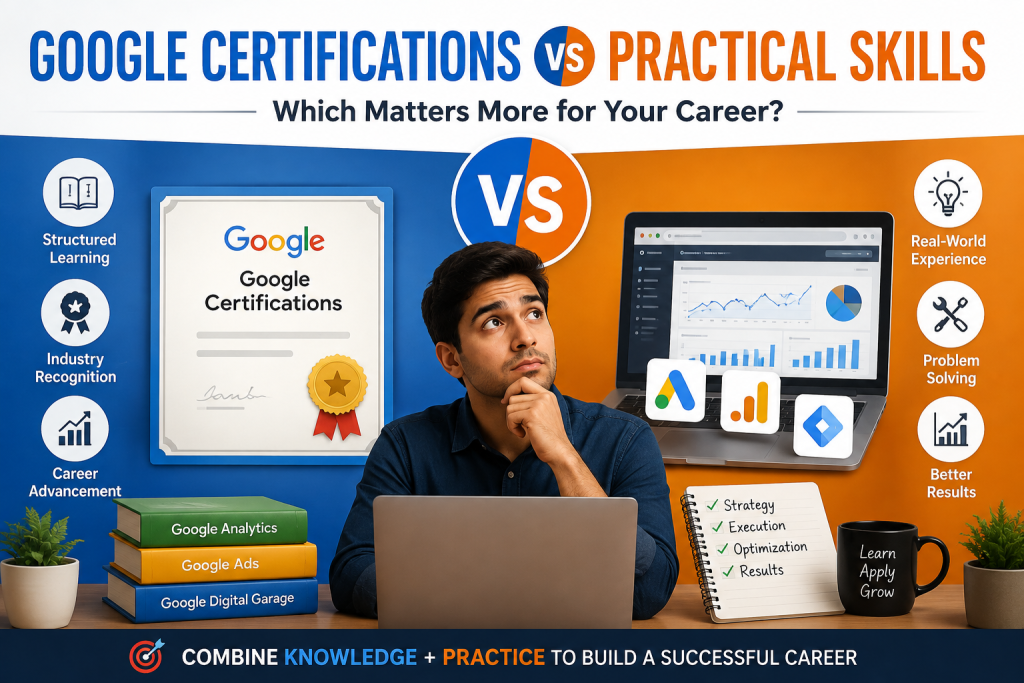
In today’s competitive digital marketing industry, learners often face one important question: Google Certifications vs Practical Skills — which one matters more for building a successful career? Google certifications can demonstrate that you understand specific digital marketing tools and concepts. However, practical skills help you apply that knowledge to real business problems, campaigns, websites, audiences, and customers.
Therefore, choosing between certifications and practical experience is not always the right approach. Instead, digital marketing professionals should understand how both can work together. A certification can strengthen your knowledge and credibility, while practical experience can help you prove that you can actually use that knowledge.
For students, freshers, business owners, and aspiring digital marketers, this difference is especially important. Employers generally want people who can contribute to real projects, understand marketing objectives, analyze performance, and improve results.
So, let’s understand Google Certifications vs Practical Skills in detail and discover what can help you build a stronger digital marketing career.
What Are Google Certifications?
Google certifications are professional credentials or certificates designed to demonstrate knowledge of particular Google tools, platforms, or digital marketing concepts.
For example, learners can explore certifications and learning programs related to areas such as:
- Google Ads
- Google Analytics
- Digital marketing and e-commerce
- Data and measurement
- Google Cloud
- Other Google technology and advertising platforms
These certifications can be useful because they provide structured learning. Moreover, they can help beginners understand important concepts without randomly studying different topics.
A certification can also add credibility to your resume or professional profile. When an employer sees relevant certifications, it can indicate that you have invested time in learning a particular subject.
However, certification alone does not automatically mean that someone can manage a successful marketing campaign.
What Are Practical Digital Marketing Skills?
Practical skills are the abilities you develop by actually working with digital marketing tools, platforms, websites, campaigns, content, and data.
For instance, a person may understand how Google Ads works after completing a certification. However, managing a real campaign requires additional skills.
You may need to:
- Conduct keyword research
- Create and organize campaigns
- Write effective ad copy
- Select appropriate audiences
- Manage budgets
- Analyze campaign performance
- Identify underperforming keywords
- Optimize landing pages
- Track conversions
- Prepare performance reports
- Make data-driven decisions
Similarly, SEO knowledge becomes more valuable when you can perform an actual website audit, identify technical issues, optimize content, build a keyword strategy, and monitor organic performance.
Therefore, practical experience transforms theoretical knowledge into usable professional skills.
Google Certifications vs Practical Skills: The Major Difference
When comparing Google Certifications vs Practical Skills, the main difference comes down to knowledge and application. A Google certification can show that you have studied a particular subject, understood important concepts, and completed a structured learning program or assessment. However, practical skills demonstrate your ability to apply that knowledge when working on real-world digital marketing tasks.
In simple terms, a certification can show that you have learned the skill, while practical experience proves that you know how to use it. Both are valuable, but they serve different purposes in a digital marketing career.
For example, consider two candidates applying for the same digital marketing position. Candidate A has several Google certifications but has never worked on an actual marketing campaign. Candidate B, on the other hand, has fewer certifications but has worked on practice campaigns, performed keyword research, optimized websites, created SEO strategies, analyzed campaign data, and prepared performance reports.
In this situation, Candidate B may have a stronger practical advantage because they can demonstrate how they apply their knowledge to real marketing situations. An employer can better understand their problem-solving ability, decision-making process, and familiarity with digital marketing tools.
Therefore, certifications should not be viewed as a replacement for practical experience. Instead, they should work together. Certifications can build your knowledge and credibility, while practical skills can help you demonstrate what you can actually achieve with that knowledge.
For aspiring digital marketers, the ideal approach is to learn, get certified where relevant, practice those skills, work on real or realistic projects, and build a portfolio. This combination can create a much stronger professional profile than relying on certifications or theory alone.
Why Google Certifications Are Still Valuable
Although practical experience plays a major role in digital marketing, Google certifications still have significant value, especially for beginners and professionals who want to strengthen their knowledge. A certification does not guarantee that someone is an expert, but it can provide a structured way to learn important concepts and understand how digital marketing platforms work.
Moreover, certifications can complement practical experience. When you combine a recognized certification with hands-on projects, you can demonstrate both what you know and how you apply it.
1. Certifications Provide Structured Learning
One of the biggest advantages of certifications is that they provide a clear and structured learning path. Beginners often find digital marketing confusing because there are hundreds of videos, blogs, tutorials, and courses available online.
Instead of jumping from one topic to another, a structured certification program can help learners understand concepts in a logical sequence. For example, a beginner can gradually learn about advertising fundamentals, campaign planning, targeting, measurement, and optimization.
As a result, learners can develop a stronger foundation before moving on to advanced practical work.
2. They Strengthen Your Resume
Relevant Google certifications can also make your resume more informative, particularly when you are applying for an entry-level digital marketing position. They show potential employers that you have invested time in learning a specific area and have completed a formal learning or assessment process.
For example, if you are applying for a role related to paid advertising, a relevant Google Ads certification can support your profile by demonstrating your familiarity with the platform and its concepts.
However, certification should be treated as supporting evidence, not as the entire resume. Employers may still want to know whether you can create campaigns, analyze performance, solve problems, and work with real marketing objectives.
3. They Help Beginners Build Confidence
Starting a career in digital marketing can feel overwhelming. There are many tools, technical terms, platforms, and strategies to understand. Certifications can give beginners a sense of direction and help them measure their progress.
After completing a structured learning program and assessments, learners often feel more confident discussing concepts during interviews or while working on their own projects.
However, confidence becomes much stronger when certification is followed by practice. Therefore, after completing a certification, beginners should immediately try to apply what they have learned through practical assignments, personal projects, or supervised training.
4. They Support Professional Credibility
Certifications can also contribute to your professional credibility. When you are building a career, freelance profile, LinkedIn presence, or digital marketing portfolio, relevant certifications can show that you have actively developed your knowledge.
For freelancers and beginners, this can be particularly useful because they may not have years of professional experience to showcase. A relevant certification can provide an additional indication of their learning efforts.
Nevertheless, credibility becomes stronger when you can combine certifications with practical projects, a portfolio, client work, case studies, or measurable results. In other words, a certificate can help start the conversation, but your actual skills and work can help build long-term trust.
5. Certifications Help You Understand Industry Tools
Another advantage is that certifications can introduce learners to the terminology, features, and basic functionality of widely used digital marketing platforms.
For instance, someone learning about Google Ads may become familiar with concepts such as campaign objectives, keywords, bidding, ad formats, conversions, and performance measurement.
This knowledge can make it easier to understand professional discussions and follow industry trends. However, learners should remember that platforms continuously evolve. Therefore, staying updated and regularly practicing the tools is just as important as earning the certification.
6. They Can Give You a Stronger Starting Point for Practical Learning
Finally, certifications can act as a starting point for hands-on learning. Once you understand the fundamentals, you can move beyond theory and start applying those concepts to realistic marketing situations.
For example, after learning the fundamentals of Google Ads, you can create a sample campaign structure, research keywords, write advertisements, plan a budget, and analyze potential performance. Similarly, after learning analytics concepts, you can practice interpreting traffic and conversion data.
This creates a more effective learning cycle:
Learn → Get Certified → Practice → Analyze → Improve → Build a Portfolio
Therefore, the real value of a Google certification is not simply the certificate itself. Its value increases when you use the knowledge gained from the certification to develop practical skills and real-world problem-solving abilities.
Why Practical Skills Matter More in Real-World Digital Marketing
Digital marketing is constantly changing. Platforms introduce new features, consumer behavior changes, competition increases, and businesses expect measurable results.
Because of this, marketers need more than theoretical knowledge.
1. Practical Skills Help You Solve Problems
Real marketing rarely follows a perfect textbook example.
A campaign may have a high cost per click. An SEO page may receive impressions but few clicks. A landing page may receive traffic but generate very few leads.
In these situations, a marketer needs to investigate the problem and find a solution.
That requires practical thinking.
2. Practical Experience Improves Decision-Making
Furthermore, practical experience teaches you how to make decisions.
For example, you may know the definition of CTR, CPC, conversion rate, bounce rate, or ROAS. However, understanding what those numbers mean for a real campaign requires experience.
You need to ask:
- Why did performance change?
- Which audience is performing better?
- Which keywords are generating valuable traffic?
- Where are users dropping off?
- Should the budget be increased or reduced?
- Which landing page needs improvement?
These decisions cannot always be learned simply by memorizing definitions.
What Employers Look for in Digital Marketing Candidates
When companies hire digital marketers, they generally want people who can contribute to business objectives.
Therefore, employers may look for skills such as:
- SEO
- Google Ads
- Meta Ads
- Social media marketing
- Content marketing
- Keyword research
- Google Analytics
- Conversion tracking
- Website optimization
- Data analysis
- Copywriting
- Reporting
- Communication
- Problem-solving
Certifications can support these skills. However, practical projects can provide stronger evidence that you know how to use them.
For this reason, candidates should build a portfolio alongside their certifications.
Certifications + Practical Skills: The Best Combination
When discussing Google Certifications vs Practical Skills, it is easy to think that you have to choose one over the other. However, the strongest approach for a digital marketing career is to combine both. Certifications can help you build a strong theoretical foundation, while practical skills allow you to apply that knowledge to real-world marketing situations.
In simple terms, certifications can tell employers what you have learned, while practical projects can demonstrate what you can actually do. When these two elements come together, they can create a much stronger and more credible digital marketing profile.
1. Start With the Fundamentals
The first step is to build a clear understanding of digital marketing fundamentals. Certifications can help you learn important concepts in a structured manner and become familiar with the tools and terminology used in the industry.
For example, if you are interested in paid advertising, you can learn about Google Ads, keywords, bidding, targeting, campaign objectives, conversions, and performance measurement.
However, learning the concepts should only be the beginning.
2. Turn Knowledge Into Practical Experience
Once you understand the fundamentals, the next step is to apply that knowledge through practical projects. This is where theoretical learning starts becoming a professional skill.
For example, after completing a Google Ads certification, you could create a sample campaign structure for a fictional business. You can conduct keyword research, organize ad groups, write different ad variations, plan a budget, select appropriate targeting options, and determine which performance metrics should be monitored.
This type of exercise helps you understand how different elements of a campaign work together instead of simply memorizing definitions.
3. Practice, Analyze, and Improve
Practical learning becomes even more valuable when you analyze your work. Instead of simply completing a project, ask yourself what could be improved and why.
For instance, you can compare different ad copies, evaluate keyword relevance, review potential customer intent, or analyze hypothetical campaign performance. This process develops your problem-solving and decision-making skills, which are essential for a digital marketer.
Similarly, while learning SEO, you can perform a website audit, identify technical issues, conduct keyword research, evaluate competitors, optimize sample content, and develop an internal linking or content strategy.
The goal is not simply to complete a task. The goal is to understand why you are doing it and what impact it can have on a business.
4. Build a Portfolio to Showcase Your Skills
Finally, document your best projects and create a professional portfolio. A portfolio gives you an opportunity to demonstrate your learning instead of simply mentioning it on your resume.
You can include your SEO audits, keyword research, content strategies, sample Google Ads campaigns, social media plans, analytics reports, or other relevant projects. Where appropriate, explain the objective, strategy, actions taken, and expected or actual outcome.
This gives potential employers or clients a clearer picture of your capabilities.
5. The Ideal Learning Cycle
A successful digital marketing learning journey can therefore follow a simple process:
Learn → Get Certified → Practice → Analyze → Improve → Build a Portfolio
This approach combines theoretical knowledge with practical application. Consequently, you are not just collecting certificates; you are continuously developing skills that can be used in real marketing situations.
Ultimately, the goal should not be to have the maximum number of certifications. Instead, focus on becoming a professional who can understand digital marketing concepts, use the right tools, solve marketing problems, analyze data, and contribute to business growth.
That combination of knowledge, certification, and practical experience can make your digital marketing profile significantly stronger.
How HIDM Helps Students Build Practical Digital Marketing Skills
For students who want to build a career in digital marketing, choosing the right learning environment can make a significant difference.
HIDM, or Hisar Institute of Digital Marketing, focuses on digital marketing education with an emphasis on practical learning and industry-oriented skills.
Instead of treating digital marketing as only a theoretical subject, a practical training approach can help students understand how different marketing activities work in real-world situations.
Students can learn areas such as:
- Search Engine Optimization (SEO)
- Search Engine Marketing (SEM)
- Google Ads
- Meta Ads
- Social Media Marketing (SMM)
- Content marketing
- Website-related marketing activities
- Analytics and performance measurement
- AI-supported digital marketing practices
The important advantage of practical training is that students can understand not only what a tool does, but also how and when to use it.
For someone starting from zero, this can make the learning journey more organized.
Moreover, working on practical assignments and projects can help learners develop confidence before entering the professional environment.
If you are considering digital marketing as a career, a course should therefore be evaluated not only by its certificate but also by the amount of practical exposure, mentor guidance, project work, and industry relevance it provides.
How to Build a Portfolio Without Years of Experience
One common problem among beginners is:
“I don’t have experience, so how can I show practical skills?”
The answer is to start creating projects.
You do not always need years of employment experience to build a portfolio.
You can create:
SEO Projects
Choose a website or practice project and conduct:
- Keyword research
- On-page SEO
- Technical SEO checks
- Content optimization
- Internal linking
- Competitor analysis
Then document your process and observations.
Google Ads Projects
Create a sample campaign strategy that includes:
- Campaign objective
- Target audience
- Keyword research
- Ad copy
- Budget allocation
- Landing page recommendations
- Conversion tracking plan
Social Media Projects
Create a complete content strategy for a hypothetical business.
Include:
- Content pillars
- Posting calendar
- Creative concepts
- Captions
- Hashtags
- Audience targeting
- Performance metrics
These projects can demonstrate your ability to think like a marketer.
Common Mistake: Collecting Certifications Without Practicing
One of the most common mistakes beginners make in digital marketing is collecting certification after certification without actually applying what they have learned. While having multiple certificates may look impressive on a resume, certifications alone cannot demonstrate how effectively you can use your knowledge in a real marketing environment.
Imagine an interviewer asking you a simple question:
“What have you actually done with the knowledge you gained from these certifications?”
At that point, simply listing certificates may not be enough. An employer may want to know whether you have created campaigns, performed keyword research, analyzed data, optimized content, solved marketing problems, or worked on practical projects.
For example, if you have completed a Google Ads certification, you should be able to explain how you would structure a campaign, select relevant keywords, write effective ad copy, manage a budget, and evaluate campaign performance. Similarly, if you have learned SEO, you should be able to demonstrate your understanding through website audits, keyword research, content optimization, technical SEO, or other practical work.
Therefore, instead of focusing only on how many certifications you can collect, focus on how effectively you can apply the knowledge behind those certifications.
Turn Every Certification Into a Practical Project
A simple way to avoid this mistake is to follow every major certification with a practical project. Once you finish learning a topic, immediately try to use that knowledge in a realistic situation.
For instance, after learning Google Ads, create a sample campaign for a business. After learning SEO, conduct an audit of a website and develop a keyword and content strategy. After learning social media marketing, create a complete content plan for a brand.
This approach helps you understand the subject more deeply and also gives you something valuable to showcase during interviews or client discussions.
Follow a Continuous Learning Cycle
The most effective approach is to treat learning as an ongoing process rather than a one-time activity:
Learn → Practice → Analyze → Improve → Document
First, learn the concept and understand how it works. Then, practice it through a project. After that, analyze your work to identify what can be improved. Make the necessary changes and finally document the project in your portfolio.
Over time, this process can help you build a stronger professional profile because you are developing knowledge, practical skills, problem-solving ability, and a portfolio at the same time.
Ultimately, a certification should be viewed as a starting point for practical learning, not the final destination. The real value comes when you can take what you have learned and use it to solve real digital marketing challenges.
How to Become Job-Ready in Digital Marketing
If your goal is to build a successful career and become job-ready in digital marketing, you need more than theoretical knowledge or a collection of certifications. A balanced learning approach can help you develop the technical knowledge, practical experience, analytical thinking, and communication skills that employers value.
Step 1: Build a Strong Foundation
Start by understanding the fundamentals of digital marketing. Focus on important areas such as Search Engine Optimization (SEO), paid advertising, social media marketing, content marketing, analytics, and basic website concepts.
Rather than trying to master everything at once, learn each area step by step. A strong foundation will make it easier to understand advanced strategies and work with different digital marketing platforms later.
Step 2: Earn Relevant Certifications
Once you understand the fundamentals, consider earning relevant certifications from trusted platforms. Certifications can help validate your theoretical knowledge and provide a structured learning path.
However, avoid making certifications your only goal. Instead, use them as a way to strengthen your understanding and prepare yourself for practical application.
Step 3: Apply Your Knowledge Through Practical Projects
The next and most important step is to put your knowledge into practice. Work on websites, SEO audits, sample advertising campaigns, content strategies, social media plans, or other realistic digital marketing projects.
Practical projects help you understand how marketing concepts work outside a textbook. Moreover, they give you real examples that you can discuss during interviews or with potential clients.
Step 4: Analyze and Improve Your Work
Completing a project is not the end of the learning process. You should also analyze your work and understand what worked, what did not work, and what could be improved.
For example, you can review keyword selection, ad performance, content engagement, website traffic, conversion data, or other relevant metrics. This habit can gradually improve your analytical and problem-solving skills, which are essential in digital marketing.
Step 5: Build a Professional Portfolio
As you complete projects, document your best work and create a professional portfolio. Instead of simply mentioning that you know SEO or Google Ads, show how you have applied those skills.
Your portfolio can include website audits, keyword research, campaign structures, content strategies, analytics reports, screenshots, project objectives, strategies, and measurable results wherever available.
A well-organized portfolio can make it easier for employers and clients to understand your capabilities.
Step 6: Develop Strong Communication Skills
Technical knowledge is important, but digital marketers also need to communicate their ideas effectively. You may need to explain a marketing strategy to a client, present campaign results to a manager, or discuss performance with a team.
Therefore, work on your written and verbal communication skills alongside your technical abilities. Learn how to explain complex marketing concepts in simple language and support your recommendations with data.
Build Skills, Not Just Certificates
Becoming job-ready is a gradual process. Instead of focusing only on completing courses or collecting certificates, focus on developing skills that you can confidently demonstrate.
A practical career-building approach can be summarized as:
Learn → Get Certified → Practice → Analyze → Improve → Build a Portfolio → Communicate
By following this process consistently, you can develop a more complete professional profile and become better prepared for real-world digital marketing opportunities.
Google Certifications vs Practical Skills: Which One Should You Choose?
So, Google Certifications vs Practical Skills — which one is better for a digital marketing career? The answer depends largely on your current level of knowledge, career goals, and professional experience.
If you are a complete beginner, certifications can provide a structured foundation and help you understand important digital marketing concepts. They can give you the direction you need to start learning the right topics and become familiar with industry tools.
However, once you have developed a basic understanding, practical experience should become a major priority. Working on real or realistic projects allows you to apply your knowledge, solve problems, analyze performance, and understand how digital marketing works in actual business situations.
For job seekers, the most effective approach is to combine relevant certifications with a strong portfolio. Your certifications can demonstrate what you have learned, while your projects can provide evidence of how you apply those skills.
Similarly, freelancers need to focus heavily on practical expertise, communication, client requirements, strategy development, and measurable outcomes. Clients are generally more interested in what you can achieve for their business than in the number of certificates you have collected.
Therefore, there is no need to choose certifications over practical skills or practical skills over certifications. The stronger approach is to use both strategically.
Certifications can build your knowledge and credibility, while practical skills can turn that knowledge into real professional value. When you combine the two with a strong portfolio and continuous learning, you can build a more competitive and job-ready digital marketing profile.
Final Verdict: Skills Matter, But Certifications Can Support Them
The discussion around Google Certifications vs Practical Skills should not be about choosing one and completely ignoring the other. Both play an important role in building a strong digital marketing career, but they serve different purposes.
Certifications can help you develop structured knowledge, understand industry concepts, and strengthen your professional profile. However, practical skills allow you to take that knowledge beyond theory and apply it to real marketing challenges, business objectives, campaigns, websites, and customer needs.
Therefore, the most effective approach is to combine both. Learn the fundamentals, earn relevant certifications, practice your skills, work on meaningful projects, analyze your performance, and build a professional portfolio. This continuous process can help you develop not only knowledge but also the confidence and problem-solving ability required in a professional environment.
Over time, this approach can help you move from simply learning digital marketing to actually becoming capable of working in digital marketing. Your ability to understand a problem, develop a strategy, use the right tools, analyze data, and improve results is what ultimately adds professional value.
For beginners looking for structured learning along with practical exposure, HIDM (Hisar Institute of Digital Marketing) is one option to consider when exploring digital marketing training. A practical, industry-oriented learning environment can help students understand how concepts and tools are applied beyond the classroom.
Ultimately, a certification can demonstrate that you have invested time in learning a particular subject. Your practical work, however, demonstrates how effectively you can apply that knowledge.
In a competitive digital marketing industry, having both recognized learning and demonstrable practical skills can give you a stronger foundation for building your career, preparing for job opportunities, and taking on real-world marketing responsibilities.