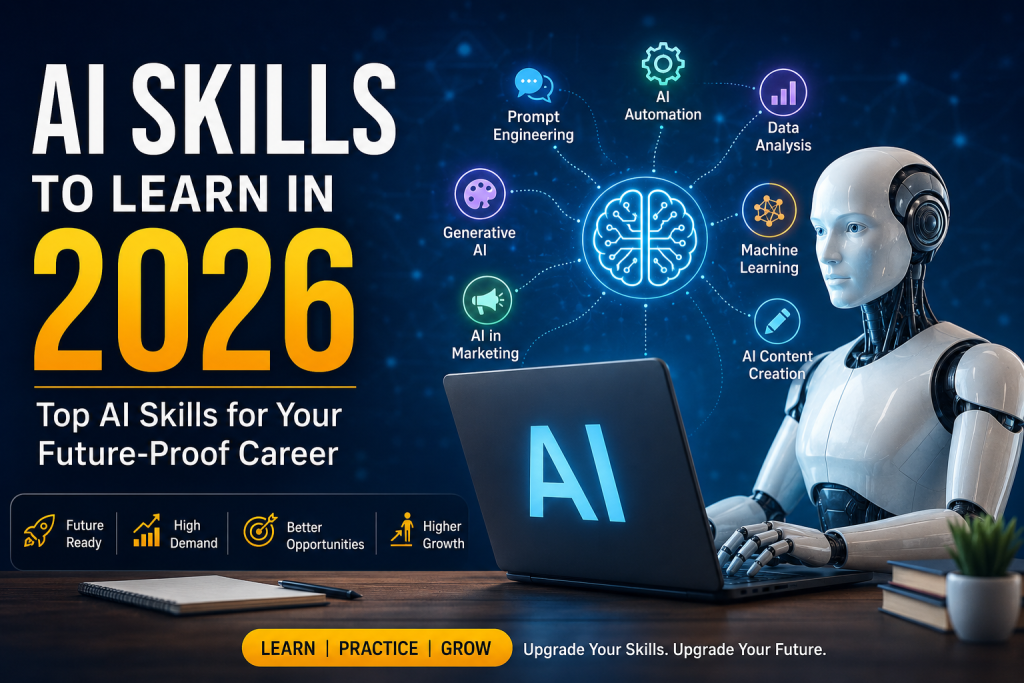
AI Skills to Learn in 2026: Top Skills for Your Career
AI Skills to Learn in 2026 are becoming increasingly important for students, professionals, freelancers, entrepreneurs, and business owners. Artificial intelligence is no longer limited to technology companies. Instead, AI is now being used in marketing, finance, education, healthcare, design, customer service, content creation, and almost every other industry. Therefore, learning the right AI skills can help you improve your productivity, build better career opportunities, and stay competitive in the changing job market.
Moreover, you do not necessarily need to become a programmer to build a successful career with AI. Many valuable AI skills can be learned by people from non-technical backgrounds as well. So, whether you are a beginner or already working professionally, understanding the AI Skills to Learn in 2026 can help you prepare for the future.
Why Should You Learn AI Skills in 2026?
AI is changing the way people work. Companies are increasingly using AI tools to automate repetitive tasks, analyze information, create content, understand customers, and improve business decisions. As a result, employees who know how to use AI effectively can become more productive.
Furthermore, AI is not simply replacing traditional skills. Instead, it is creating demand for people who can combine industry knowledge with AI capabilities. For example, a digital marketer who understands AI can create campaigns, analyze customer data, generate content, and automate repetitive marketing tasks more efficiently.
Therefore, learning AI in 2026 can provide several benefits:
- Better productivity and efficiency
- More career opportunities
- Higher-value professional skills
- Better freelance opportunities
- Improved business decision-making
- Ability to work with modern AI tools
- Stronger competitiveness in the job market
Top AI Skills to Learn in 2026
There are several AI-related skills that can help you build a future-ready career. However, you should focus on skills that have practical applications rather than simply learning AI terminology.
Here are some of the most useful AI Skills to Learn in 2026.
1. Prompt Engineering
Prompt engineering is one of the most useful AI Skills to Learn in 2026. It involves creating clear and effective instructions for AI systems so that they can produce better and more relevant results.
For example, instead of asking an AI tool to “write a blog,” you can provide information about the target audience, tone, structure, keywords, word count, and purpose. Consequently, the AI can generate a more useful response.
Prompt engineering can be useful for:
- Content creation
- Marketing
- Research
- Data analysis
- Customer support
- Business planning
- Image and video generation
Moreover, prompt engineering does not require advanced programming knowledge. Therefore, it can be a good starting point for beginners who want to learn AI.
2. AI Automation
AI automation is another important skill to add to your list of AI Skills to Learn in 2026. Businesses are constantly looking for ways to reduce repetitive work. AI automation allows companies to connect different tools and automate routine processes.
For example, an automated workflow can collect a lead from a website, organize the information, send a notification to the sales team, and trigger a follow-up message.
You can explore tools and platforms such as:
- Zapier
- Make
- ChatGPT
- AI agents
- CRM automation platforms
- Workflow automation tools
As a result, professionals who understand AI automation can help businesses save both time and resources.
3. AI-Powered Data Analysis
Data has become one of the most valuable resources for modern businesses. However, large amounts of data can be difficult to understand manually. Therefore, AI-powered data analysis is becoming increasingly valuable.
With AI tools, professionals can identify patterns, summarize information, generate reports, and find useful insights more quickly.
For example, a marketing professional can use AI to analyze campaign performance and identify which audience, advertisement, or keyword is generating better results.
Additionally, learning basic skills in Excel, Google Sheets, SQL, data visualization, and AI-assisted analytics can make you more effective in this area.
4. Machine Learning
Machine learning is one of the more technical AI Skills to Learn in 2026. It focuses on developing systems that can learn patterns from data and make predictions or decisions.
Machine learning is widely used in:
- Recommendation systems
- Fraud detection
- Search engines
- Predictive analytics
- Customer segmentation
- Image recognition
- Natural language processing
If you have a technical background, machine learning can be an excellent skill to develop. However, beginners should first understand basic statistics, Python, data structures, and fundamental machine learning concepts.
5. Generative AI
Generative AI has become a major part of the modern digital ecosystem. Therefore, understanding how generative AI works and how to use it effectively is one of the essential AI Skills to Learn in 2026.
Generative AI can create different types of content, including:
- Text
- Images
- Videos
- Presentations
- Audio
- Marketing materials
- Computer code
Professionals can use these capabilities to speed up creative and business workflows. However, human creativity and judgment are still important. Therefore, you should learn how to combine AI-generated outputs with your own expertise.
6. AI for Digital Marketing
Digital marketing is another field where AI is creating significant opportunities. Therefore, AI for digital marketing should be included in your list of AI Skills to Learn in 2026.
AI can help marketers with keyword research, content planning, audience analysis, ad copy, campaign optimization, customer segmentation, and personalization.
For example, marketers can use AI to analyze advertising data and identify patterns in customer behavior. Similarly, AI can help create multiple versions of ad copy for testing.
However, marketers should not depend completely on AI. Instead, they should understand SEO, Google Ads, Meta Ads, content marketing, analytics, and consumer psychology while using AI to improve their workflow.
7. AI Content Creation
Content creation is changing rapidly because of AI. Therefore, learning AI-assisted content creation can be highly valuable for writers, marketers, social media managers, and creators.
AI tools can help generate:
- Blog ideas
- Social media captions
- Video scripts
- Email drafts
- Product descriptions
- Content outlines
- Creative concepts
Nevertheless, simply generating content with AI is not enough. Quality, originality, accuracy, and audience understanding still matter. Therefore, you should learn how to edit, fact-check, personalize, and improve AI-generated content.
8. AI Image and Video Generation
Visual content has become extremely important for businesses and creators. At the same time, AI image and video generation tools are making visual production faster.
Consequently, learning AI-powered creative tools is another practical skill to consider.
Professionals can use AI for:
- Social media creatives
- Advertising visuals
- Product concepts
- Video backgrounds
- Storyboards
- Presentations
- Promotional videos
Furthermore, people who understand design principles, storytelling, composition, branding, and AI prompting can create stronger results than people who only know how to generate images.
9. AI Agents and Intelligent Systems
AI agents are becoming an important area of AI development. Unlike basic AI chatbots, AI agents can perform multiple steps to complete a particular task.
For example, an AI agent could research information, organize the findings, create a report, and perform another action based on predefined instructions.
As AI systems become more capable, businesses may use agents for customer service, research, sales support, operations, and internal workflows.
Therefore, understanding AI agents, workflows, tool usage, and automation can become a valuable skill in 2026 and beyond.
10. AI Ethics and Responsible AI
Technical skills are important. However, responsible AI usage is equally important. Therefore, AI ethics should also be considered among the AI Skills to Learn in 2026.
AI systems can create inaccurate information, biased results, privacy concerns, and security risks. Consequently, professionals need to understand how AI should be used responsibly.
Important areas include:
- Data privacy
- AI bias
- Copyright
- Security
- Transparency
- Human oversight
- Responsible AI usage
Businesses need professionals who can use AI while also understanding its limitations and risks.
How to Choose the Right AI Skill
You do not need to learn every AI skill at once. Instead, choose a skill based on your career, industry, and professional goals. This approach makes learning easier and helps you apply AI more effectively in real-world situations.
1. If You Are a Student
Students can start with generative AI, prompt engineering, AI productivity tools, and basic data analysis. These skills can help with research, presentations, content creation, and everyday tasks. Moreover, practicing AI through small projects can help students build a strong portfolio for future job opportunities.
2. If You Are a Digital Marketer
Digital marketers should focus on AI-powered SEO, content creation, campaign analysis, automation, and customer insights. AI can help with keyword research, content ideas, ad copy, audience analysis, and campaign optimization. Therefore, combining AI with traditional digital marketing skills can make marketers more productive and competitive.
3. If You Are a Business Owner
Business owners should focus on AI skills that can save time and improve business operations. AI automation, customer support, AI marketing, data analysis, and productivity tools are good areas to explore. As a result, repetitive tasks can be reduced while customer experience and business efficiency can be improved.
4. If You Are a Developer
Developers can explore more technical AI skills such as machine learning, Python, generative AI, APIs, AI agents, and model integration. These skills can help developers build AI-powered applications, automation systems, chatbots, and intelligent software solutions.
5. Choose Based on Your Goal
Ultimately, the right AI skill depends on your career path. Students can begin with AI productivity and generative AI, marketers can focus on AI-powered marketing, business owners can prioritize automation, and developers can explore technical AI development.
Therefore, start with one relevant skill, practice it through real projects, and gradually expand your AI knowledge as your experience grows.
How to Start Learning AI Skills in 2026
Starting with AI can feel overwhelming because new tools and technologies are introduced regularly. However, you can make the learning process easier by following a structured approach and getting practical training.
Step 1: Choose One Skill
First, choose an AI skill according to your career goals and interests. For example, digital marketers can start with AI-powered marketing, while developers can explore machine learning. Focusing on one skill initially makes learning easier and more effective.
Step 2: Learn the Fundamentals
Next, understand the basic concepts behind your chosen skill. Learn how the tools work and where they can be applied. As a result, you can use AI more confidently and effectively.
Step 3: Get Practical Training
After learning the basics, practical training can help you understand how AI skills are used in real-world situations. Hisar Institute of Digital Marketing (HIDM) provides digital marketing training that can help learners develop practical knowledge of areas such as SEO, SEM, Google Ads, Meta Ads, social media marketing, content creation, and AI tools.
Therefore, learners who want to build a career in digital marketing can combine their marketing knowledge with AI skills and learn how to apply modern AI tools to real marketing tasks.
Step 4: Practice With Real Projects
Once you understand the fundamentals, start working on practical projects. For example, you can create an AI-powered content plan, analyze campaign data, develop marketing creatives, or automate repetitive tasks. This hands-on practice can help you build confidence and improve your problem-solving skills.
Step 5: Build a Portfolio
Document your best projects and add them to a professional portfolio. Clearly mention what you created, which tools you used, and what you learned. Consequently, your portfolio can demonstrate your practical skills to potential employers and clients.
Step 6: Keep Learning
Finally, continue updating your AI knowledge. Since AI is developing rapidly, new tools and techniques are introduced regularly. Therefore, continuous learning and experimentation can help you stay relevant and competitive in 2026 and beyond.
AI Skills to Learn in 2026 for Better Career Opportunities
The future job market will increasingly reward people who can work effectively with AI. However, AI skills should not be viewed separately from traditional professional skills.
Instead, the strongest combination is AI + domain expertise + communication + creativity + problem-solving.
For example, an AI-skilled marketer can be more valuable when they also understand SEO and customer behavior. Similarly, an AI-skilled designer can create better work when they understand branding and visual communication.
Therefore, do not focus only on learning AI tools. Focus on learning how to solve real problems with AI.
Final Thoughts
The demand for AI-related knowledge is growing across industries. Therefore, learning the right AI Skills to Learn in 2026 can help students, professionals, freelancers, and business owners prepare for a changing career landscape.
Prompt engineering, AI automation, data analysis, machine learning, generative AI, AI marketing, content creation, AI agents, and responsible AI are some of the most valuable areas to explore.
However, you do not need to master everything overnight. Start with one skill, practice it through real projects, build a portfolio, and gradually expand your knowledge. Most importantly, learn how to use AI to solve real-world problems.
As a result, you will not simply be someone who knows about AI. Instead, you can become a professional who knows how to work effectively with AI.