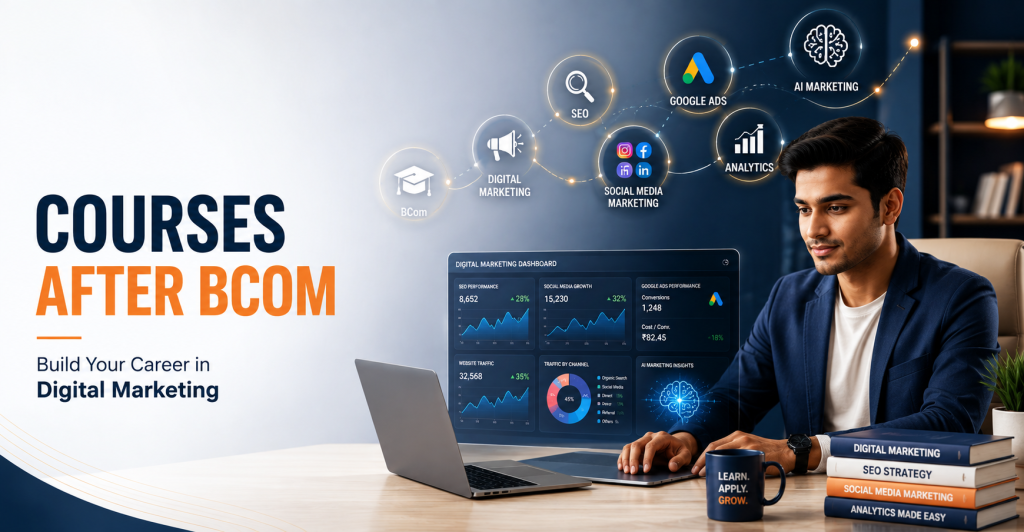
Courses After BCom: Why Digital Marketing Is a Smart Career Choice
Courses After B.com can open the door to many exciting career opportunities. After completing a Bachelor of Commerce, students often look for a course that can provide practical skills, career growth, and better job opportunities. Traditionally, B.com graduates have explored careers in accounting, banking, finance, taxation, and business management. However, the digital economy has created many new career paths. One of the most promising options is Digital Marketing After B.com
Today, almost every business needs an online presence. Therefore, companies are looking for professionals who understand search engines, social media, online advertising, content, websites, and customer behaviour. Because of this growing demand, digital marketing has become one of the practical Courses After B.com for students who want to build a modern and skill-based career.
In this blog, we will explore different career options after B.com, understand why digital marketing is suitable for commerce graduates, learn the skills required, and see how an AI-integrated digital marketing course can help you prepare for the industry.
What Are the Best Courses After B.com?
After B.com, students have several options depending on their interests, career goals, and strengths. For example, students interested in finance can explore accounting and financial management courses. Similarly, students interested in management can choose MBA-related programs.
Some popular Courses After B.com include:
- MBA or postgraduate management programs
- Chartered Accountancy (CA)
- Company Secretary (CS)
- Cost and Management Accounting
- Banking and financial services courses
- Business analytics
- Data analytics
- Taxation and accounting courses
- Digital marketing
- E-commerce and online business
- Financial technology-related courses
However, choosing a course should not depend only on popularity. Instead, students should consider whether the course provides practical skills and whether those skills are relevant to current industry requirements.
That is where digital marketing becomes an interesting option for BCom graduates.
Why Choose Digital Marketing After BCom?
Digital Marketing After BCom is a practical career combination because commerce graduates already understand several business concepts.
For example, BCom students learn about business, economics, accounting, management, customers, and financial concepts. Digital marketing adds another important skill set: understanding how businesses attract customers through digital platforms.
Moreover, digital marketing connects business knowledge with technology and creativity.
A digital marketer may work on:
Lorem ipsum dolor sit amet, consectetur adipiscing elit. Ut elit tellus, luctus nec ullamcorper mattis, pulvinar dapibus leo.
- Search Engine Optimization (SEO)
- Social Media Marketing (SMM)
- Google Ads
- Content Marketing
- Email Marketing
- Website Marketing
- Analytics
- Lead Generation
- E-commerce Marketing
- Online Branding
Therefore, a BCom graduate can use existing business knowledge while developing practical digital skills.
How Does Digital Marketing Connect With BCom?
At first, digital marketing and commerce may appear to be different fields. However, they have several common areas. B.com teaches students how businesses work. On the other hand, digital marketing teaches students how businesses can reach customers online.
For instance, understanding profit and loss can help you understand marketing budgets. Similarly, knowledge of business and customers can help you create better marketing campaigns.
Furthermore, digital marketing involves measuring results. Marketers regularly analyse clicks, leads, conversions, costs, revenue, and return on investment. Because commerce students already work with numbers and business concepts, they can develop these analytical skills effectively.
As a result, Digital Marketing After BCom can become a strong career combination for students who want to move beyond traditional commerce roles.
Digital Marketing Is One of the Practical Courses After BCom
Many academic programs focus heavily on theoretical knowledge. However, digital marketing requires practical implementation. For example, simply knowing what SEO means is not enough. You should understand how keyword research works, how to optimise a website, how to analyse competitors, and how to measure organic traffic.
Similarly, knowing about social media is different from managing a business account. A professional needs to understand content planning, audience targeting, engagement, analytics, and paid advertising.
Therefore, while comparing Courses After B.com, students should look for programs that provide practical exposure rather than only theoretical lessons.
What Skills Can You Learn in a Digital Marketing Course?
If you are exploring Courses After BCom, digital marketing can be a practical option because it combines business knowledge with modern marketing skills. A good digital marketing course can help you understand how businesses attract customers, generate leads, increase sales, and build their online presence.
Here are some of the most important skills you can learn:
1. Search Engine Optimization (SEO)
Search Engine Optimization, or SEO, helps websites improve their visibility on search engines such as Google. It is one of the most important skills in digital marketing because businesses need organic traffic to reach potential customers.
In an SEO module, you can learn keyword research, on-page SEO, technical SEO basics, content optimization, link building, local SEO, and SEO analytics. You can also understand how search engines evaluate websites and why some pages rank higher than others.
As a result, SEO knowledge can help you explore career roles such as SEO Executive, SEO Analyst, SEO Specialist, or SEO Content Strategist.
2. Social Media Marketing
Social media has become an essential part of modern business marketing. Therefore, learning how to use platforms such as Instagram, Facebook, LinkedIn, and YouTube can be valuable for students looking for Courses After BCom.
Social media marketing involves much more than simply posting content. You can learn how to create content calendars, understand your target audience, develop social media strategies, improve engagement, and analyse page performance.
Furthermore, you can learn how brands use social media to build awareness, communicate with customers, generate leads, and promote their products or services.
3. Google Ads and Paid Advertising
While SEO focuses on organic visibility, paid advertising helps businesses reach their target audience more quickly. Google Ads is one of the major platforms used by businesses to generate traffic, leads, sales, and brand awareness.
A digital marketing course can introduce you to search ads, campaign structure, keyword targeting, audience targeting, ad copy, bidding strategies, conversion tracking, and performance analysis.
Consequently, students can explore career opportunities such as PPC Executive, Google Ads Specialist, Paid Media Executive, or Performance Marketing Specialist.
4. Content Marketing
Content is at the heart of digital marketing. Blogs, videos, social media posts, landing pages, emails, and other forms of content help businesses communicate with their target audience.
Therefore, content marketing teaches you how to create useful and relevant content for different stages of the customer journey. You can learn how to identify audience needs, generate content ideas, write SEO-friendly blogs, create engaging social media content, and use content to support business goals.
Moreover, strong content can attract potential customers, build trust, improve search visibility, and eventually encourage people to take action.
5. Analytics and Performance Tracking
Digital marketing is not only about creating content or running advertisements. Measuring results is equally important. Marketers need to understand whether their campaigns are actually delivering the expected results.
Through analytics and performance tracking, you can learn how to analyse website traffic, user behaviour, campaign performance, conversions, engagement, and other important marketing metrics.
For example, analytics can help you identify which marketing channel is bringing the most visitors or leads. Based on these insights, businesses can improve their strategies and use their marketing budgets more effectively.
As a result, analytical skills can make you a more effective and valuable digital marketing professional.
6. AI Tools for Digital Marketing
Artificial Intelligence is rapidly changing the digital marketing industry. Today, AI tools can assist marketers with content ideas, research, copywriting, data analysis, campaign planning, customer insights, and marketing automation.
However, AI should not be viewed as a complete replacement for marketing knowledge. Instead, marketers who understand both marketing fundamentals and AI tools can use technology more effectively.
For example, AI can help generate content ideas or analyse large amounts of data. However, a marketer still needs to understand the target audience, business objectives, brand voice, and overall strategy.
Therefore, learning AI along with digital marketing can give BCom graduates an additional advantage and help them prepare for the changing requirements of the modern workplace.
Career Options After BCom in Digital Marketing
One major reason students explore Courses After BCom is career flexibility. Digital marketing provides several possible career paths.
After developing the right skills, you can explore roles such as:
- Digital Marketing Executive
- SEO Executive
- SEO Analyst
- Social Media Executive
- Social Media Manager
- Google Ads/PPC Executive
- Content Marketing Executive
- Email Marketing Executive
- Digital Marketing Analyst
- Performance Marketing Executive
- E-commerce Marketing Executive
Furthermore, digital marketing can offer opportunities in agencies, startups, e-commerce companies, educational institutions, real estate businesses, hospitality companies, and many other industries.
You can also work as a freelancer or eventually build your own digital marketing agency.
Can a B.com Fresher Start a Digital Marketing Career?
Yes. A B.com graduate does not necessarily need years of marketing experience to start learning digital marketing.
However, having a certificate alone is not enough. Employers usually value practical knowledge, problem-solving ability, communication skills, and the ability to demonstrate your work.
Therefore, freshers should focus on building a portfolio.
For example, you can create a sample website, perform keyword research, write SEO blogs, prepare a social media content calendar, create a Google Ads campaign structure, or analyse a business’s online presence.
These projects can demonstrate your skills during interviews.
Why Practical Training Matters in Courses After B.com
When choosing Courses After BCom, students should carefully check what the course actually provides.
A good program should ideally include:
- Practical assignments
- Live projects
- Industry-relevant tools
- SEO training
- Social media marketing
- Paid advertising
- Content marketing
- Analytics
- AI tools
- Portfolio development
- Interview preparation
Most importantly, students should get opportunities to apply what they learn.
For example, instead of only learning the definition of SEO, students should perform keyword research and optimise actual content. Similarly, instead of only learning about social media marketing, they should create and evaluate social media campaigns.
This practical approach can make learning more useful and career-focused.
Learn Digital Marketing at HiDM – Hisar Institute of Digital Marketing
f you are searching for Courses After BCom and want to develop practical digital skills, HiDM (Hisar Institute of Digital Marketing) can be an option to explore.
HiDM offers an AI Integrated Digital Marketing Course designed around modern digital marketing skills. The course covers important areas such as SEO, SEM, social media marketing, Google Ads, content marketing, graphic designing, AI tools, and practical projects.
For BCom graduates, this type of learning can be useful because it combines business understanding with digital marketing skills.
Moreover, learning through practical projects can help students understand how digital marketing works in real business situations.
Instead of limiting your learning to definitions, you can focus on how different marketing channels work together to achieve business goals.
What Can You Expect From an AI Integrated Digital Marketing Course?
An AI-integrated approach can help students understand how artificial intelligence is becoming part of everyday marketing.
For example, AI can help marketers with:
- Content ideas
- Keyword research assistance
- Audience research
- Content planning
- Marketing copy
- Data analysis
- Campaign ideas
- Productivity and automation
However, AI should be treated as a supporting technology rather than a replacement for marketing strategy.
Therefore, students should first understand marketing fundamentals and then learn how AI tools can improve their workflow.
This combination of digital marketing + AI + practical projects can help students prepare for changing industry requirements.
How to Choose the Right Course After BCom?
Choosing the right option from the many Courses After BCom can have a significant impact on your career. Therefore, instead of selecting a course simply because it is popular, you should consider your interests, career goals, skills, and future opportunities.
1. Identify Your Career Interests
First, understand what type of work you enjoy. If you are interested in accounting, finance, taxation, or numbers, courses related to accounting and financial management may be a suitable choice.
On the other hand, if you enjoy business, creativity, communication, technology, social media, and online platforms, digital marketing can be an interesting career option. It allows you to combine your commerce background with practical digital skills.
2. Check the Course Curriculum
Next, carefully review the course curriculum before enrolling. A good course should cover the important concepts required for your chosen career rather than focusing only on theoretical knowledge.
For example, a digital marketing course should ideally include areas such as SEO, social media marketing, Google Ads, content marketing, analytics, email marketing, and AI tools.
3. Look for Practical Learning
Practical experience is another important factor to consider. Therefore, check whether the institute provides live projects, assignments, case studies, practical campaigns, and hands-on experience with industry tools.
This type of learning can help you understand how the concepts work in real business situations. Moreover, practical experience can make it easier to demonstrate your skills when applying for internships or jobs.
4. Evaluate the Institute and Trainers
Before choosing a course, research the institute carefully. Check the experience of trainers, student reviews, course structure, learning support, and career assistance.
Additionally, find out whether the trainers have practical industry experience. Learning from professionals who understand current market trends can provide valuable insights beyond textbooks.
5. Consider Future-Ready Skills
The digital industry continues to evolve. Therefore, your course should also focus on modern technologies and skills.
For instance, learning AI tools, marketing analytics, automation, data interpretation, and performance marketing can help you stay prepared for changing industry requirements.
6. Focus on Skills, Not Just the Institute Name
Finally, remember that the best option among Courses After BCom is not necessarily the course with the biggest brand name or the highest fee.
Instead, choose a course that matches your career goals, provides practical experience, teaches relevant skills, and prepares you for real-world opportunities.
In short, take time to compare your options before making a decision. The right course can help you turn your BCom qualification into a stronger foundation for a successful career.
Digital Marketing After BCom: Is It Worth It?
For students who want a skill-based career, Digital Marketing After BCom can be a valuable option.
The field offers multiple career paths, and digital skills are useful across different industries. Furthermore, digital marketing allows professionals to work with businesses of different sizes and sectors.
However, success does not happen simply because you complete a course. You need continuous learning, practical experience, creativity, analytical thinking, and adaptability.
The digital industry changes quickly. Therefore, professionals need to keep learning new tools, platforms, algorithms, advertising features, and AI technologies.
If you enjoy learning and experimenting, digital marketing can offer an exciting career journey.
Final Thoughts on Courses After BCom
Choosing among different Courses After BCom is an important career decision. BCom provides a strong foundation in business and commerce. However, adding a modern skill such as digital marketing can help you explore new career opportunities.
Digital Marketing After BCom is especially useful for students who are interested in business, technology, social media, content, advertising, and analytics.
Moreover, learning digital marketing with AI can help students understand the changing requirements of the modern marketing industry.
If you are a BCom graduate or are about to complete your BCom degree, start by identifying your strengths and career goals. Then, compare different courses based on curriculum, practical training, projects, tools, and career support.
If digital marketing matches your interests, you can explore the AI Integrated Digital Marketing Course at HiDM (Hisar Institute of Digital Marketing) and take the next step toward building practical digital marketing skills.
Your BCom degree can be the foundation. The right digital skill can become the next step in your career.