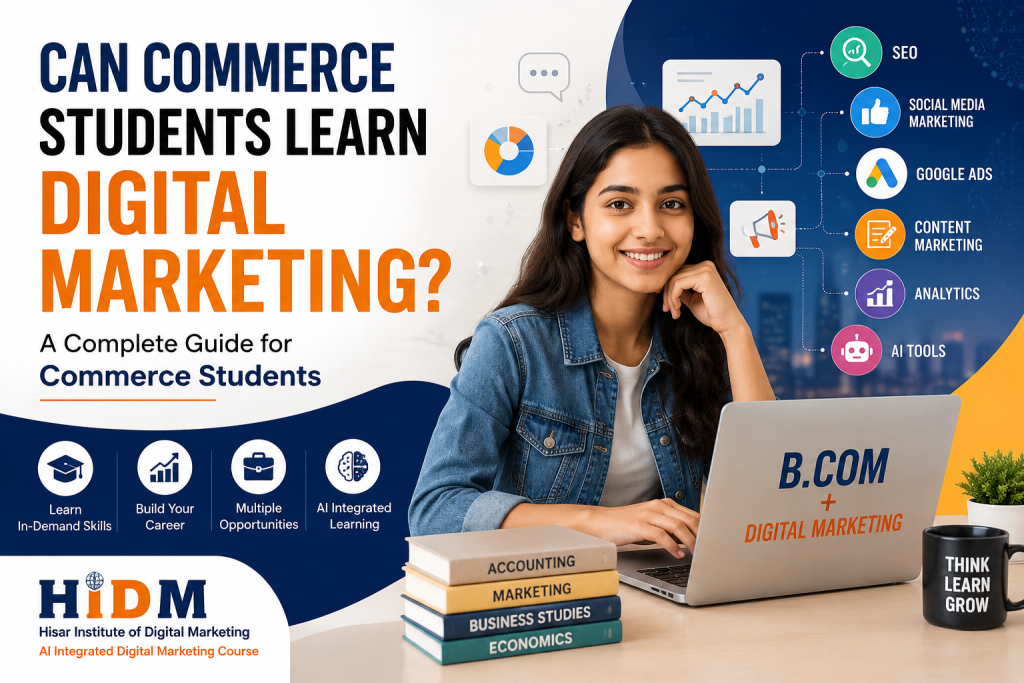
Can Commerce Students Learn Digital Marketing? A Complete Guide for Commerce Students
In today’s competitive job market, students are looking for skills that can help them build better career opportunities. Digital Marketing for Commerce Students has become an increasingly valuable career option because commerce students already understand important business concepts such as accounting, finance, marketing, economics, and business management. However, many students still ask, “Can commerce students learn digital marketing?” The answer is yes.
In fact, commerce students can build a strong foundation in digital marketing because their academic background is closely connected with business and marketing. Moreover, digital marketing combines creativity, analytics, communication, technology, and business strategy. Therefore, students with a B.Com or other commerce background can learn digital marketing and use it to explore jobs, internships, freelancing, and business opportunities.
With the growing importance of online businesses, brands need professionals who understand how to attract customers through search engines, social media, websites, advertisements, and content. As a result, Digital Marketing for Commerce Students can become a practical career path after graduation.
Why Is Digital Marketing a Good Option for Commerce Students?
Commerce education helps students understand how businesses work. They learn about customers, markets, business operations, financial management, and marketing principles. These concepts can be useful when learning digital marketing.
For example, a commerce student may already understand the basics of market segmentation, consumer behaviour, business communication, and marketing. Consequently, learning digital marketing becomes easier because many concepts can be connected with what the student has already studied.
Furthermore, digital marketing does not require students to have a computer science or technical degree. Most digital marketing skills can be developed through structured learning and regular practical practice.
Therefore, if you are a B.Com student or commerce graduate, you do not need to change your academic background to enter digital marketing. Instead, you can combine your commerce knowledge with modern digital skills.
What Is Digital Marketing?
Digital marketing refers to promoting products, services, brands, or businesses through digital channels. These channels can include search engines, social media platforms, websites, email, online advertising, and content platforms.
Some of the major areas of digital marketing include:
- Search Engine Optimization (SEO)
- Search Engine Marketing (SEM)
- Google Ads
- Social Media Marketing (SMM)
- Content Marketing
- Email Marketing
- Website Marketing
- Analytics and Reporting
- Influencer Marketing
- AI-powered marketing
Because businesses are increasingly moving online, these skills are becoming important for companies of different sizes.
For commerce students, this creates an opportunity to combine their understanding of business with practical digital marketing skills.
Which Digital Marketing Skills Can Commerce Students Learn?
One of the biggest advantages of digital marketing is that it includes multiple specializations. Therefore, students can explore different areas before choosing the field they enjoy most.
1. Search Engine Optimization
SEO helps websites appear higher in search engine results. Students learn how keywords, content, technical optimization, backlinks, and website structure affect search visibility.
Commerce students can use their understanding of customers and markets to identify what people are searching for. Moreover, SEO requires both analytical thinking and content understanding.
2. Social Media Marketing
Social media platforms have become important channels for businesses. Social media marketing involves creating content, managing pages, understanding audiences, running campaigns, and analyzing performance.
Commerce students can use their communication and marketing knowledge to understand customers and create better social media strategies.
3. Google Ads and Paid Advertising
Google Ads allows businesses to advertise their products and services to people who are actively searching for relevant solutions.
This area can be especially interesting for commerce students because paid advertising involves budgets, performance measurement, conversion tracking, and return on investment.
As a result, students who enjoy numbers and business analysis can develop strong skills in performance marketing.
4. Content Marketing
Content marketing focuses on creating useful content that attracts and engages an audience. It can include blogs, social media posts, videos, website content, and other formats.
Commerce students can use their knowledge of business and consumers to create content that addresses real customer problems.
5. Analytics and Reporting
Digital marketing is not only about creating advertisements or social media posts. Marketers also need to understand data.
Analytics helps marketers identify website traffic, leads, conversions, engagement, campaign performance, and other important metrics.
Because commerce students are often comfortable working with numbers and business data, analytics can become a useful area for them.
6. AI in Digital Marketing
Artificial intelligence is changing the way marketers work. Today, AI can assist with content ideas, research, audience analysis, campaign planning, data interpretation, and creative development.
Therefore, learning AI along with digital marketing can give students an additional advantage.
Students who learn how to use AI responsibly can save time, improve productivity, and support better marketing decisions. However, AI should be treated as a supporting tool rather than a complete replacement for human creativity and strategic thinking.
Is Digital Marketing Difficult for Commerce Students?
Many commerce students worry that digital marketing might be difficult because it involves technology. However, digital marketing is generally skill-based rather than degree-based.
You do not need advanced programming knowledge to begin learning SEO, social media marketing, Google Ads, content marketing, or analytics.
Initially, some concepts may seem new. However, with structured learning and regular practice, students can gradually understand them.
For example, a student can begin with basic concepts such as:
Marketing → Digital Channels → SEO → Social Media → Google Ads → Analytics → AI Tools
After learning the fundamentals, students can move toward practical projects. Consequently, they can understand how different digital marketing activities work together.
Can B.Com Students Learn Digital Marketing After Graduation?
Yes. B.Com graduates can learn digital marketing after graduation and develop it as a professional skill.
A B.Com degree provides an understanding of business and commerce. Digital marketing can then add practical online marketing skills to that foundation.
This combination can be useful because companies need professionals who understand both business objectives and digital marketing strategies.
For instance, a B.Com graduate who understands profit, cost, customers, and business growth can also learn how to generate leads through Google Ads, improve website visibility through SEO, and build brand awareness through social media.
Therefore, Digital Marketing for Commerce Students is not only possible but can be a practical combination of academic knowledge and modern professional skills.
What Career Options Are Available After Learning Digital Marketing?
Digital Marketing Executive
A Digital Marketing Executive manages different online marketing activities for a business or brand. Their work can include SEO, social media marketing, content marketing, email marketing, Google Ads, and website promotion. They also monitor campaign performance and prepare reports to understand what is working. For commerce students, this role can be a good starting point because it combines business knowledge with practical digital marketing skills.
SEO Executive
An SEO Executive helps a website improve its visibility on search engines such as Google. Their responsibilities can include keyword research, on-page SEO, technical SEO, content optimization, and link-building activities. They also monitor search rankings and website performance. Since SEO requires research, analysis, and understanding of customer search behaviour, commerce students can use their analytical skills effectively in this role.
Social Media Executive
A Social Media Executive manages a brand’s presence on platforms such as Instagram, Facebook, LinkedIn, and other social networks. They create and schedule posts, write captions, monitor engagement, and help plan social media campaigns. Moreover, they analyze metrics such as reach, impressions, engagement, and followers. Commerce students who are interested in communication, creativity, and marketing can explore this career option.
Google Ads Specialist
A Google Ads Specialist manages paid advertising campaigns on Google. Their work includes keyword research, campaign creation, audience targeting, budget management, conversion tracking, and performance optimization. They regularly analyze metrics such as clicks, conversions, cost per conversion, and return on advertising spend. Therefore, this role can be particularly suitable for commerce students who enjoy numbers, data, and business performance.
Content Marketing Executive
A Content Marketing Executive creates and manages valuable content that helps a business attract and engage its target audience. Their work can include blog writing, website content, social media content, email content, and other marketing materials. They also research topics and understand what information customers are looking for. Commerce students can use their understanding of business and consumer behaviour to create content that supports marketing goals.
Performance Marketing Specialist
A Performance Marketing Specialist focuses on measurable marketing results such as leads, sales, conversions, and revenue. They may manage advertising campaigns across platforms such as Google Ads and social media advertising platforms. Furthermore, they analyze campaign data and continuously optimize budgets, audiences, creatives, and strategies. Because performance marketing is strongly connected with numbers, budgets, and ROI, it can be an attractive career option for commerce students.
Digital Marketing Freelancer
Commerce students can also choose freelancing after learning digital marketing. A freelancer works independently and provides digital marketing services to different clients. These services can include SEO, social media management, Google Ads, content marketing, website optimization, and lead generation. Initially, students can start with small projects and gradually build their portfolio, experience, and client base. As their skills improve, they can take on larger projects and work with businesses from different industries.
Digital Marketing Entrepreneur
Commerce students who want to start their own business can also use digital marketing to promote their products or services. They can create a website, build social media profiles, run online advertisements, generate leads, and communicate directly with customers. Moreover, digital marketing can help entrepreneurs reach a wider audience without depending only on traditional marketing methods. Therefore, learning digital marketing can be useful not only for getting a job but also for building and growing a business.
What Should Commerce Students Learn in a Digital Marketing Course?
A good digital marketing course should provide more than theoretical knowledge. Students should look for a course that covers multiple digital marketing areas and provides opportunities for practical learning.
A comprehensive learning path can include:
- SEO
- Search Engine Marketing
- Google Ads
- Social Media Marketing
- Content Marketing
- Website Marketing
- Analytics
- Lead Generation
- Email Marketing
- Graphic Designing
- AI tools for marketing
- Practical projects
- Campaign analysis
- Industry-oriented training
Moreover, students should practice these skills through real or simulated projects. This helps them understand how marketing strategies work in practical situations.
Why Choose HIDM for Digital Marketing Learning?
For students who want to build digital marketing skills, HIDM (Hisar Institute of Digital Marketing) offers an AI Integrated Digital Marketing Course designed to provide comprehensive digital marketing learning.
The key advantage of an integrated approach is that students can learn multiple areas of digital marketing instead of focusing on only one skill.
At HIDM, students can learn areas such as SEO, SEM, social media marketing, Google Ads, content marketing, graphic designing, and AI-integrated digital marketing.
Furthermore, practical learning can help students understand how these skills are used in real marketing situations.
For a commerce student, this combination can be particularly useful. Their existing knowledge of business and commerce can be combined with practical digital marketing skills.
AI-Integrated Learning at HIDM
AI has become an important part of modern digital marketing. Therefore, learning how AI tools can support marketing activities can help students become more productive and future-ready.
An AI-integrated approach can help students understand how AI can support:
- Content creation
- Marketing ideas
- SEO research
- Campaign planning
- Audience research
- Data analysis
- Creative development
- Marketing productivity
However, students should also learn how to review and improve AI-generated outputs. Human creativity, strategy, accuracy, and decision-making remain important.
How Can Commerce Students Start Their Digital Marketing Journey?
Starting does not have to be complicated. Students can follow a simple step-by-step approach.
Step 1: Understand Marketing Fundamentals
First, commerce students should understand the basic concepts of marketing. Learn how businesses identify their target customers, promote products, build brands, and achieve their business goals. Concepts such as customer behaviour, market segmentation, branding, and the marketing mix can provide a strong foundation. Moreover, your commerce background can make these concepts easier to understand because you may already have studied some of them.
Step 2: Learn Digital Marketing Fundamentals
Once you understand traditional marketing concepts, move toward digital marketing. Learn how businesses use websites, search engines, social media, online advertisements, email, and content to reach customers. At this stage, focus on understanding how different digital channels work together. Consequently, you will have a clearer idea of how a complete digital marketing strategy is created.
Step 3: Learn Core Digital Marketing Skills
Next, start developing practical skills in important areas of digital marketing. These can include SEO, Social Media Marketing, Google Ads, Content Marketing, Email Marketing, Website Marketing, and Analytics. You do not have to master everything immediately. Instead, learn the fundamentals of each area and gradually develop deeper knowledge through practice. This approach can help you understand which digital marketing specialization interests you the most.
Step 4: Learn AI Tools for Digital Marketing
After learning the basic digital marketing concepts, start exploring AI tools. AI can help marketers with content ideas, keyword research, audience research, campaign planning, data analysis, and creative development. However, students should not depend completely on AI. Instead, learn how to use AI as a supporting tool while applying your own creativity, strategy, and judgement. This combination can help you work more efficiently and prepare for the changing digital marketing industry.
Step 5: Work on Practical Projects
Practical experience is one of the most important parts of learning digital marketing. Therefore, students should work on real or practice-based projects. You can create a sample website, manage a social media page, perform keyword research, write SEO content, create a Google Ads campaign, or analyze marketing data. Furthermore, practical projects help you understand how the concepts you learn are actually used in business situations.
Step 6: Build a Strong Portfolio
Once you have completed some projects, create a professional digital marketing portfolio. Include your SEO projects, social media campaigns, content samples, advertising campaigns, analytics reports, or other work you have completed. Also, explain your role and the results of each project wherever possible. A good portfolio can demonstrate your practical skills to recruiters and clients. As a result, it can be especially helpful when you are a fresher with limited professional experience.
Step 7: Apply for Internships, Jobs, or Freelance Projects
Finally, start looking for opportunities where you can use your digital marketing skills. Commerce students can apply for digital marketing internships, SEO internships, social media roles, Google Ads positions, content marketing jobs, and entry-level digital marketing positions. Additionally, you can explore freelancing and work on small projects for businesses. Initially, focus on gaining experience and improving your skills. Gradually, as your knowledge and portfolio grow, you can target better career opportunities and larger projects.
Digital Marketing vs Traditional Commerce Career
Commerce students traditionally explore careers in accounting, finance, banking, taxation, business management, and related areas. These are still valuable career options.
However, digital marketing offers another path.
The benefit of digital marketing is that it connects business knowledge with modern technology. Moreover, students can explore both employment and independent work.
For example, a commerce graduate can work for a company as a digital marketing executive while also developing freelance skills. Similarly, an entrepreneur can use digital marketing knowledge to promote their own business.
Therefore, digital marketing can complement a commerce degree rather than replace it.
Important Skills Commerce Students Should Develop
Although technical knowledge is important, successful digital marketers also need soft skills.
Students should develop:
- Communication skills
- Creativity
- Analytical thinking
- Problem-solving
- Time management
- Research skills
- Adaptability
- Basic design understanding
- Data interpretation
- Strategic thinking
Additionally, students should keep learning because digital platforms and marketing trends change frequently.
Final Thoughts
So, can commerce students learn digital marketing? Absolutely.
In fact, commerce students can have a useful starting point because they already understand many business-related concepts. By adding digital marketing skills, they can create a stronger combination of business knowledge, marketing strategy, technology, analytics, and AI.
Digital Marketing for Commerce Students can open opportunities in SEO, social media marketing, Google Ads, content marketing, analytics, performance marketing, freelancing, and entrepreneurship.
However, learning digital marketing should not stop at theory. Practical projects, continuous learning, portfolio building, and industry-oriented training are equally important.
For students looking for a comprehensive learning path, HIDM’s AI Integrated Digital Marketing Course can be a useful option to explore. With an integrated approach covering digital marketing skills and AI-powered marketing practices, students can work toward building the practical skills needed in today’s digital business environment.
If you are a commerce student or B.Com graduate and are interested in digital marketing, now can be a good time to start learning, practicing, and building your digital career.