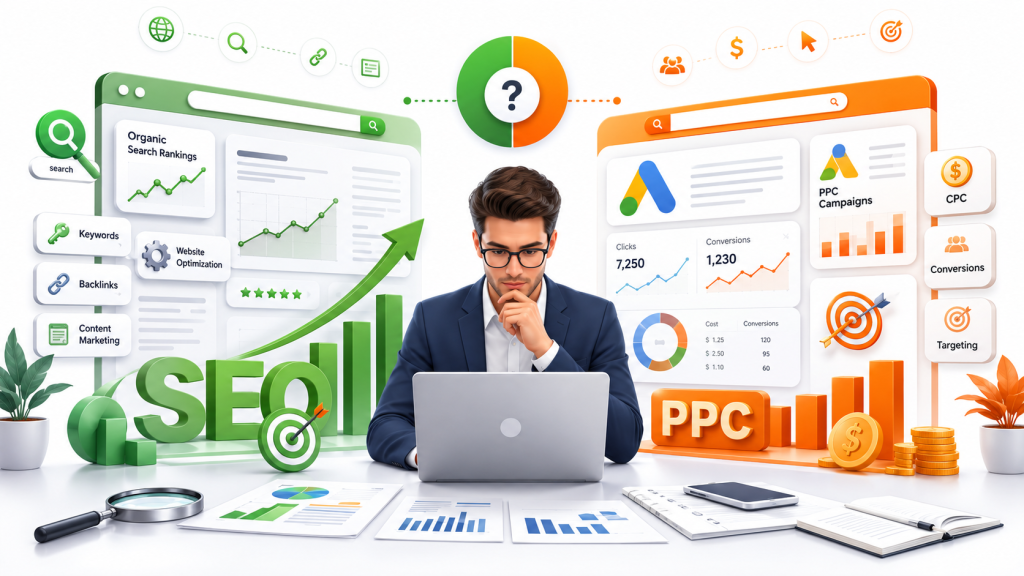
SEO vs Google Ads is one of the most common questions business owners ask when they want to grow online. Every business wants more website visitors, quality leads, and increased sales. However, choosing the right digital marketing strategy can be confusing, especially when both Search Engine Optimization (SEO) and Google Ads offer unique advantages.
If you’re wondering whether SEO vs Google Ads is the right choice for your business, you’re not alone. Many startups, local businesses, eCommerce brands, and service providers face the same challenge. While SEO helps your website rank organically on search engines, Google Ads allows you to appear instantly at the top of Google search results through paid advertising.
The right strategy depends on your business goals, budget, competition, and timeline. Some businesses need immediate leads, while others focus on long-term brand growth. Understanding the strengths and limitations of both methods can help you make an informed decision.
In this detailed guide, we’ll compare SEO vs Google Ads, explain their differences, advantages, disadvantages, costs, ROI, and help you decide which option delivers the best results for your business.
What is SEO?
Search Engine Optimization (SEO) is the process of improving your website so it ranks higher in Google search results without paying for every click.
SEO focuses on increasing organic traffic by optimizing website content, improving technical performance, building authority, and providing a better user experience.
A successful SEO strategy includes:
- Keyword Research
- On-Page SEO
- Technical SEO
- Off-Page SEO
- Local SEO
- Content Marketing
- Website Speed Optimization
- Mobile Optimization
- Link Building
- User Experience Improvements
Unlike paid advertising, SEO takes time. However, once your website ranks well, it can generate consistent traffic and leads without paying for each visitor.
Benefits of SEO
1. Long-Term Organic Traffic
SEO continues bringing visitors even after your content is published. Unlike paid ads, traffic doesn’t stop immediately when you stop investing.
2. Higher Trust and Credibility
People often trust organic search results more than advertisements because they believe Google recommends high-quality websites.
3. Better Return on Investment
Although SEO requires patience, it often provides excellent ROI over time because organic clicks are free.
4. Brand Authority
Ranking on Google’s first page builds trust and establishes your business as an industry leader.
5. Better User Experience
SEO improves website speed, navigation, mobile responsiveness, and overall usability.
What is Google Ads?
Google Ads is Google’s online advertising platform that allows businesses to display paid advertisements on search results, YouTube, Gmail, Google Maps, and millions of partner websites.
Instead of waiting months like SEO, Google Ads can start generating visitors immediately after your campaign goes live.Businesses bid on keywords, and whenever someone searches those keywords, Google may display their advertisement.
A Google Ads campaign can instantly place your business at the top of search results.
Types of Google Ads
Google Ads offers a variety of campaign types, each designed to help businesses achieve different marketing goals. Whether you want to increase website traffic, generate leads, boost online sales, or improve brand awareness, choosing the right campaign type can significantly impact your results. Below are the main types of Google Ads campaigns and how they work.
1. Search Ads
Search Ads are text-based advertisements that appear at the top or bottom of Google Search results when users search for specific keywords. These ads are ideal for businesses looking to reach people who are actively searching for their products or services.
For example, if someone searches for “best digital marketing course”, a Search Ad can display your business above the organic search results. Since these users already have purchase intent, Search Ads are highly effective for generating quality leads and conversions.
2. Display Ads
Display Ads are visual banner advertisements that appear on millions of websites, mobile apps, and blogs within the Google Display Network (GDN). These ads use attractive images, graphics, and branding elements to capture users’ attention, even when they are not actively searching for your business.
Display Ads are commonly used to increase brand awareness, promote special offers, and retarget visitors who have previously visited your website.
3. Shopping Ads
Shopping Ads are specially designed for eCommerce businesses. These ads display product images, prices, store names, customer ratings, and other important details directly in Google Search results.
Unlike regular text ads, Shopping Ads provide users with visual information before they click, making them highly effective for driving product sales and improving conversion rates.
4. Video Ads
Video Ads are advertisements that appear before, during, or after videos on YouTube and across Google’s video partner network. They allow businesses to engage audiences through compelling visual storytelling, product demonstrations, tutorials, and promotional videos.
Video Ads are highly effective for building brand awareness, increasing customer engagement, and reaching a large audience.
5. Performance Max Campaigns
Performance Max is an AI-powered campaign type that automatically displays your ads across all Google platforms, including Google Search, YouTube, Display Network, Gmail, Discover, and Google Maps.
Using Google’s machine learning technology, Performance Max optimizes bidding, targeting, placements, and creatives in real time to maximize conversions and improve campaign performance with minimal manual effort.
6. Local Ads (Local Campaigns)
Local Ads are designed to help businesses attract customers in specific geographic areas. These ads appear on Google Search, Google Maps, YouTube, and the Google Display Network, making it easier for nearby customers to discover your business.
Businesses such as restaurants, coaching institutes, gyms, clinics, salons, and retail stores commonly use Local Ads to increase foot traffic, phone calls, and store visits.
Benefits of Google Ads
Instant Results
Unlike SEO, Google Ads starts generating traffic immediately.
Highly Targeted Audience
Businesses can target users based on:
- Location
- Age
- Gender
- Interests
- Device
- Time
- Keywords
- Audience Behavior
Detailed Analytics
Businesses can measure:
- Clicks
- Conversions
- Cost per Click
- Return on Ad Spend
- Cost per Lead
SEO vs Google Ads: Which Delivers Better ROI?
One of the biggest questions businesses ask is whether SEO vs Google Ads offers a better return on investment.
The answer depends on your objectives.
If your business needs leads within a few days, Google Ads is usually the better choice because it can start driving targeted visitors almost immediately. This makes it ideal for new product launches, limited-time offers, seasonal campaigns, and businesses that need quick results.
On the other hand, if your goal is to build a strong online presence that continues generating traffic month after month, SEO often delivers better long-term ROI. Once your website ranks for valuable keywords, you can receive consistent organic traffic without paying for every click.
Businesses that invest in SEO also benefit from increased trust, stronger brand authority, and a steady flow of qualified visitors over time.
Which Businesses Should Choose SEO?
SEO is an excellent choice for:
- Local businesses
- Educational institutes
- Healthcare providers
- Real estate agencies
- Bloggers
- Service-based businesses
- SaaS companies
- Startups planning long-term growth
- Personal brands
Because SEO builds lasting visibility, it’s especially valuable for businesses that want sustainable lead generation and long-term digital growth.
SEO vs Google Ads for Small Businesses
When comparing SEO vs Google Ads, small business owners often have limited marketing budgets. Therefore, selecting the right strategy becomes even more important. If your business has recently launched and needs inquiries immediately, Google Ads is an excellent starting point. It allows you to appear in front of potential customers as soon as your campaign goes live. However, depending only on paid advertising is not a sustainable long-term strategy. Once your advertising budget runs out, your visibility on Google also disappears.
On the other hand, SEO requires patience but offers lasting benefits. A well-optimized website can continue attracting visitors, generating leads, and building trust without paying for every click. For small businesses, the ideal approach is often to use Google Ads for immediate traffic while simultaneously investing in SEO for long-term organic growth.
SEO vs Google Ads: Cost Comparison
Understanding the costs involved is essential when deciding between SEO vs Google Ads.
SEO Costs
SEO is not entirely free. It involves investments in:
- Website optimization
- High-quality content creation
- Keyword research
- Technical improvements
- Link building
- SEO tools
- Professional SEO services
Although these activities require time and resources, they continue delivering value long after the initial work is completed.
Google Ads Costs
Google Ads works on a Pay-Per-Click (PPC) model, meaning you pay whenever someone clicks your advertisement.
Your advertising costs depend on factors such as:
- Industry competition
- Keyword difficulty
- Target location
- Quality Score
- Bidding strategy
- Campaign optimization
Highly competitive industries like insurance, legal services, finance, healthcare, and education often have higher cost-per-click rates.
SEO vs Google Ads: Which Generates Better Leads?
Lead quality is another important factor when comparing SEO vs Google Ads.
SEO Leads
Visitors coming from organic search usually trust the website because they found it naturally through Google. They often spend more time exploring the website, reading blog posts, and comparing services before making a purchase decision. As a result, SEO generally generates highly qualified leads over the long term.
Google Ads Leads
Google Ads can also generate excellent leads, especially when campaigns are properly optimized.
Businesses can target people based on:
- Search intent
- Geographic location
- Device
- Age
- Interests
- Previous interactions
This allows businesses to attract highly relevant customers who are ready to take action.
When Should You Choose SEO?
SEO is the right option if your business wants:
- Long-term growth
- Sustainable website traffic
- Better Google rankings
- Strong online authority
- Higher customer trust
- Consistent lead generation
- Better ROI over time
- Increased brand visibility
SEO is particularly effective for businesses that publish valuable content regularly and want to establish themselves as industry leaders.
When Should You Choose Google Ads?
Google Ads is ideal when you need:
- Immediate website traffic
- Quick lead generation
- Fast sales
- Product launches
- Event promotions
- Seasonal campaigns
- Local advertising
- Time-sensitive offers
Businesses that need instant visibility often achieve excellent results through well-managed Google Ads campaigns.
Common Mistakes Businesses Make
Many businesses fail to achieve success because they make avoidable mistakes.
Some common mistakes include:
- Expecting SEO results within a few weeks
- Running Google Ads without conversion tracking
- Ignoring keyword research
- Creating low-quality content
- Not optimizing landing pages
- Forgetting mobile optimization
- Ignoring website speed
- Not measuring ROI
- Targeting irrelevant keywords
- Focusing only on traffic instead of conversions
Avoiding these mistakes can significantly improve your digital marketing performance.
Final Thoughts on SEO vs Google Ads
When comparing SEO vs Google Ads, there is no one-size-fits-all answer. The best choice depends on your business goals, budget, competition, and marketing timeline.
If your priority is generating quick leads and instant visibility, Google Ads is an excellent option. However, if you want sustainable traffic, stronger online authority, and long-term business growth, SEO is the smarter investment.
For most businesses, the most successful approach is not choosing one over the other but combining both strategies. Google Ads can drive immediate traffic while SEO builds a lasting online presence that continues delivering results for years.
Ultimately, understanding SEO vs Google Ads allows you to create a balanced digital marketing strategy that maximizes visibility, improves lead generation, and increases return on investment.